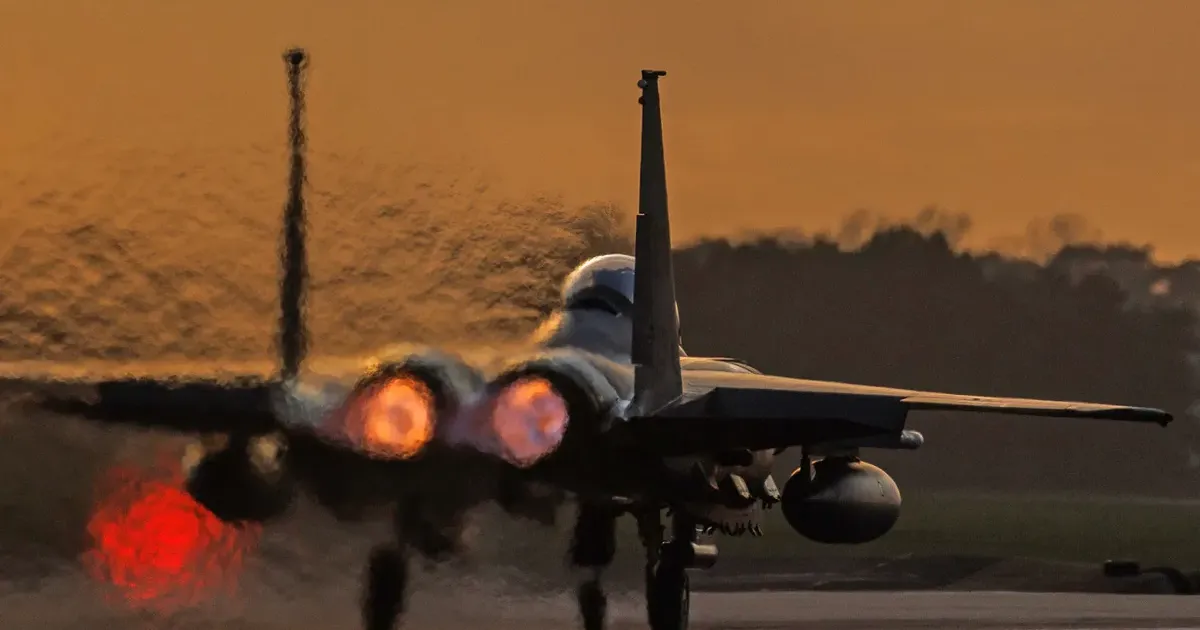
President Donald Trump faced a collapsing military narrative on April 4, 2026, when Iranian forces destroyed an F-15E Strike Eagle over hostile territory. This strike occurred less than 48 hours after the administration asserted that Tehran's military capabilities were nonexistent. One crew member was successfully recovered by American rescue teams, while a second airman remains missing deep within Iranian borders. Pentagon officials have launched an expansive search operation to locate the missing service member before local ground forces can intervene.
Donald Trump told the American public only two days ago that the military had beaten and completely decimated Iran. He specifically noted that Tehran possessed no air defenses capable of threatening modern American aviation during a televised victory rally. Secretary of Defense Pete Hegseth echoed these claims in subsequent briefings, suggesting that the path for American air operations was entirely clear. These assessments now clash with the reality of a burning multi-role fighter in the Iranian desert.
Rescue teams launched a high-risk scramble to locate the two service members immediately after the aircraft vanished from radar. Search operations are currently a race against time as Iranian ground units converge on the crash site. National security contributor Sam Vinograd noted that the missing airman is an enormous political and military liability for the White House. U.S. Central Command has diverted multiple assets to provide overhead surveillance for the recovery effort.
F-15E Strike Eagle Recovery Efforts Continue
Military personnel pulled one airman from the region and transported the individual out of the country for emergency medical treatment. NBC News reporter Courtney Kube confirmed that this survivor is currently stable but under heavy security at a regional base. Commanders have not released the identity of either crew member to protect the integrity of the ongoing search operation. Air Force units are maintaining a constant presence over the suspected location of the second airman.
Tactical logs confirm the F-15E Strike Eagle was operating in a sector previously cleared of threats by American intelligence. Sudden deployment of functional surface-to-air missiles contradicts the White House assessment of Iranian ruin. Military analysts are now investigating whether Tehran hid mobile defense units in hardened underground facilities to evade earlier bombing runs. This possibility suggests that the previous suppression of enemy air defenses was incomplete despite official declarations.
Pete Hegseth previously touted the dominance of American air power, insisting that Iranian skies were open for unrestricted U.S. operations. His statements were intended to reassure a nervous public that the conflict had reached a swift and safe conclusion. Debris from the downed fighter jet is a physical rebuttal to that optimism. Command centers are now re-evaluating flight corridors for all active assets in the Persian Gulf theater.
Secretary Pete Hegseth Defends Pre-Strike Assessments
Defense officials are currently reviewing the intelligence failures that led to the claim of Iranian decimation. Pete Hegseth faced intense questioning during a closed-session briefing regarding the resilience of Tehran's anti-aircraft networks. Some sources within the Pentagon suggest the administration prioritized political optics over tactical reality during the recent briefings. The discrepancy between the rhetoric and the kinetic environment has created friction between civilian leadership and uniformed officers.
The fate of the entire regional strategy now depends on the success of the rescue mission.
Donald Trump has not yet addressed the downed jet in a formal press conference since the news broke. He instead focused on previous successes during a brief social media post on Saturday morning without mentioning the missing airman. Silence from the Oval Office has frustrated families of the flight crew who are seeking clarity on the status of the search. White House aides spent the morning drafting a response that balances the previous victory claims with the current crisis.
Iranian state media claimed the strike was a victory for their domestic defense industry, though they offered no immediate evidence of the specific weapon used. U.S. officials believe a sophisticated, perhaps foreign-made, radar system guided the missile that struck the aircraft. Tehran has historically exaggerated its technological prowess, but the loss of a $100 million aircraft confirms a baseline level of operational capability. The missile battery likely used passive tracking to avoid detection until the final seconds before impact.
Technical Analysis of Iranian Missile Capabilities
Military planners typically rely on satellite imagery and signals intelligence to map out enemy batteries before ordering flight missions. Failure to identify this specific threat suggests a meaningful blind spot in American surveillance over the Iranian interior. Donald Trump had relied on these same intelligence reports when he made his victory speech to the nation. Analysts are checking for similarities between this strike and previous engagements involving advanced mobile defense systems.
A U.S. official familiar with the search operation provided a brief statement on the current conditions in the field.
"The search is an exhaustive race against time to rescue our missing airman before hostile forces can use the individual for propaganda purposes," the official said.
Iranian ground troops are reportedly using thermal imaging to scan the rugged terrain for the American survivor. Tehran's Revolutionary Guard units have established a perimeter around the crash site to block U.S. special operations forces from reaching the wreckage. These local forces hope to recover sensitive avionics from the F-15E Strike Eagle for reverse engineering. Satellite feeds show several convoys moving toward the site from neighboring military districts.
Sam Vinograd emphasized that the capture of a U.S. service member would provide Tehran with serious leverage in any future negotiations. Operations involve multiple special forces units and extensive aerial cover to prevent an escalation into a wider ground engagement. These teams are operating under the constant threat of further anti-aircraft fire from hidden batteries. High-altitude drones are loitering over the area to coordinate the various rescue elements.
History shows that declaring victory before a conflict is fully resolved often leads to these exact types of tactical reversals. While some Pentagon officials wanted to delay the announcement of total air superiority, the political pressure for a definitive win was overwhelming. Records show that similar intelligence gaps existed during earlier phases of the campaign. The missing airman is currently the highest priority for every American asset in the region.
Downed Jet Undercuts Victory Claims
Questions about the source of the Iranian missiles are irrelevant compared to the systemic deception occurring at the highest levels of the Pentagon. If the Secretary of Defense truly believed the skies were clear, he is incompetent. If he knew the risks and sent those airmen anyway to maintain the illusion of victory, he is negligent. The rescue of one airman provides momentary relief, but the missing service member is now a pawn in a game that the administration claimed was over. Tehran did not need to win the war to win this exchange. They only needed to prove that the American president was lying about the state of their defenses.