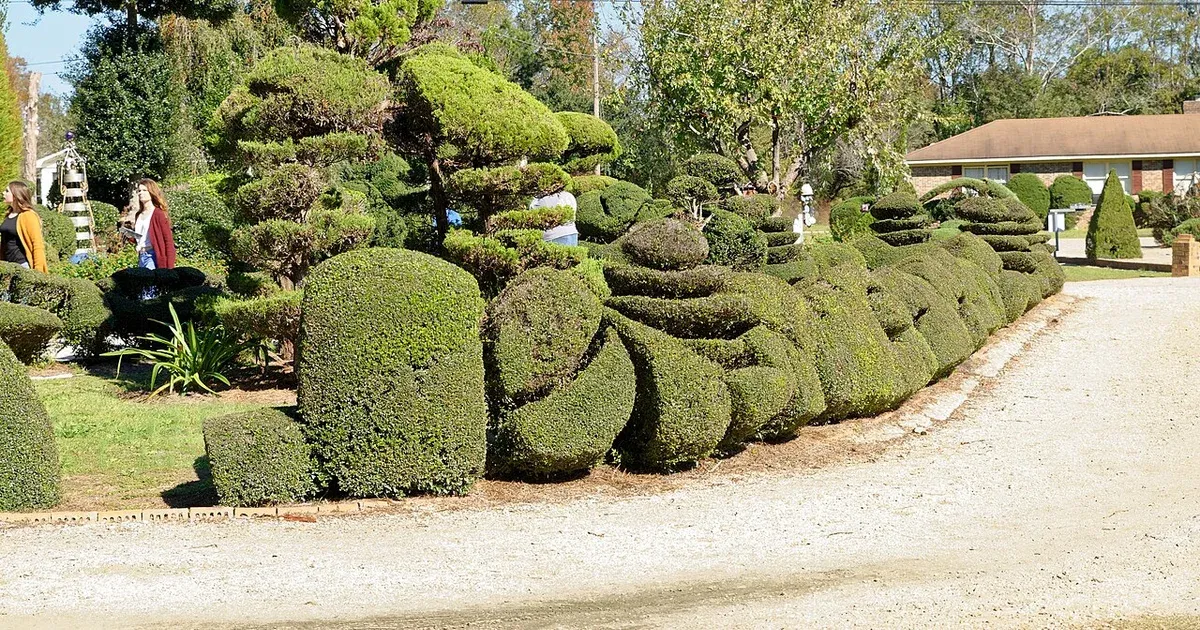
Pearl Fryar, the self-taught topiary artist who turned a South Carolina yard into an international landmark, has died at 86. His garden in Bishopville became a living artwork built from rescued plants, patience and a message of love, peace and goodwill. The site grew into one of South Carolina's most distinctive outsider-art landmarks. Family and friends confirmed his death on April 11, 2026, after a period of declining health. Preservation groups now face the delicate work of keeping that living landmark recognizable without the hand that shaped it.
Initial motivations for the garden were rooted in local social dynamics. Fryar purchased his home in the late 1970s and sought to win the Yard of the Month award from the local garden club. Local residents at the time suggested that a Black man could not maintain a garden to such a standard. Rejecting this premise, he began sculpting evergreen trees and shrubs into complex geometric and abstract forms. He achieved the award shortly after. Fryar moved to Bishopville in 1976.
Hedge trimmers and chainsaws became the primary tools for his artistic expression. He worked without sketches or formal training, often laboring late into the night under floodlights. His method relied on intuition and a deep understanding of plant growth patterns. He refused to buy premium nursery stock, preferring to rescue plants from the clearance bins of local hardware stores. Fryar frequently cited his ability to see beauty in what others discarded as a core component of his philosophy. Records indicate he saved hundreds of juniper and Fraser fir trees from the compost heap.
Bishopville Garden Records Four Decades of Work
Bishopville witnessed the slow transformation of a standard residential lawn into a dense thicket of spiral, pom-pom, and tiered topiaries. Some structures reached over twenty feet in height, requiring Fryar to work from tall ladders well into his seventies. Maintaining the precision of these shapes required constant vigilance against the fast-growing South Carolina climate. Rain and heat accelerated the growth of the local Leyland cypress and boxwood. The garden covers more than 300 individual topiaries across a residential plot that became a pilgrimage stop.
Success brought recognition far beyond local accolades. By the 1990s, the garden had become a fixture in travel guides and art history circles. Scholars of vernacular art began traveling to Bishopville to study his techniques. Unlike traditional European topiary, which often focuses on representational shapes like birds or animals, his work leaned toward the abstract. Curves and sharp angles merged in ways that defied traditional horticultural logic. He never used wires or frames to guide the branches.
“I am a man who wanted to show that you can take nothing and make something out of it. If you have a dream and you are willing to work for it, you can achieve it regardless of your background,” Fryar said.
Public interest peaked with the release of the 2006 documentary titled A Man Named Pearl. Filmmakers captured the daily rhythms of his life, from the early morning pruning sessions to the steady stream of visitors seeking advice. He greeted almost every guest personally, often pausing his work to share stories about specific plants. The film distributed his message of perseverance to a global audience. Ticket sales for the documentary surpassed expectations in independent theaters.
Horticultural Innovation and Discarded Plants
Innovation characterized every corner of the property. Fryar developed a unique fertilization and watering schedule that allowed supposedly dying plants to thrive in the sandy soil of Lee County. He experimented with various species, proving that plants typically considered unsuitable for topiary could be molded with enough patience. His garden became a living laboratory for the Garden Conservancy, an organization dedicated to preserving exceptional American gardens. He used a mixture of commercial fertilizer and composted pine needles.
Racial and economic barriers were central themes in the discussions surrounding his work. As a son of sharecroppers, Fryar lacked access to formal art education or the financial resources typical of high-end landscape design. His success challenged the exclusivity of the gardening world. Academic researchers from Clemson University and other institutions visited the site to document his impact on rural tourism. He often spoke to student groups about the intersection of labor and creativity. The property remains a key site for regional cultural studies.
Love, Peace, and Goodwill was the message he chose to carve into the very ground of his garden. He used large letters cut from the turf to greet visitors. This slogan reflected his desire to foster community in a region historically divided by racial tension. He believed that beauty could serve as a neutral ground for dialogue. Politicians and activists alike visited the site, often remarking on the tranquility of the environment. Letters in the grass required weekly edging.
Preservation became a primary concern as Fryar aged. The physical labor required to maintain the three-acre site was immense. A nonprofit organization, the Pearl Fryar Topiary Garden Inc., was established to manage the property and secure its future. This group worked closely with the Garden Conservancy to develop a long-term maintenance plan. Volunteers and paid staff began learning his specific pruning techniques. The goal was to ensure the garden did not revert to a wild state after his death. Financial stability for the garden relied on a mix of donations, grants, and limited admission fees. Fundraisers held in Columbia and Charleston raised hundreds of thousands of dollars for an endowment. These funds are designated for the ongoing care of the plants and the maintenance of the visitor center. Engineers assessed the property to improve accessibility for disabled visitors. They installed paved walkways through portions of the site. Maintenance costs for the garden continue to rise each year. Future plans for the site include an educational center dedicated to self-taught artists. The board of directors intends to host workshops that teach the basics of topiary and organic gardening. They hope to inspire a new generation of creators to find beauty in their own backyards. Fryar often stated that his greatest achievement was not the plants themselves, but the people he encouraged. He viewed the garden as a tool for social empowerment. The site will reopen to the public after a brief period of mourning. Legacy is a complicated concept for an artist whose medium is constantly growing and changing. Unlike a painting or a sculpture, a garden requires daily intervention to exist in its intended form. Without Fryar's specific touch, the topiaries will inevitably evolve. The staff now faces the challenge of honoring his original vision while allowing the plants to mature. Every hedge trimmer in the shed has been cataloged for historical purposes. Pearl Fryar died with his boots near the door.
Keeping the Garden Alive
Pearl Fryar’s passing raises questions about the future of the grassroots American visionary. It comes at a time of hyper-curated, algorithmically driven aesthetics where the raw, sweat-equity grit of a self-taught laborer is becoming a relic. Fryar did not have a social media strategy or a brand consultant. He had a chainsaw and a conviction that his dignity was non-negotiable. His garden was not just a collection of plants; it was a physical manifestation of defiance against the low expectations a segregated society once held for him. The preservation of such sites remains a tense enterprise. While the Garden Conservancy and local boards scramble to maintain the topiaries, they face the impossible task of institutionalizing a spark that was purely individual. A technician can learn how to trim a hedge but cannot be taught the intuition of a man who worked by floodlight to prove his neighbors wrong. There is a high risk that the Bishopville site becomes a static museum, losing the vibrant, living energy that defined Fryar's tenure. If the community fails to foster new, unpolished talent, the garden will survive as a monument but perish as an inspiration. True art is often born from the friction of necessity and neglect. Fryar built an empire from the clearance rack of a big-box store. His death leaves a void in the American cultural landscape that cannot be filled by government-funded grants or corporate-sponsored public art projects. American culture is losing the masters of the discarded. Without the individual obsession of the amateur, public spaces will grow dim.