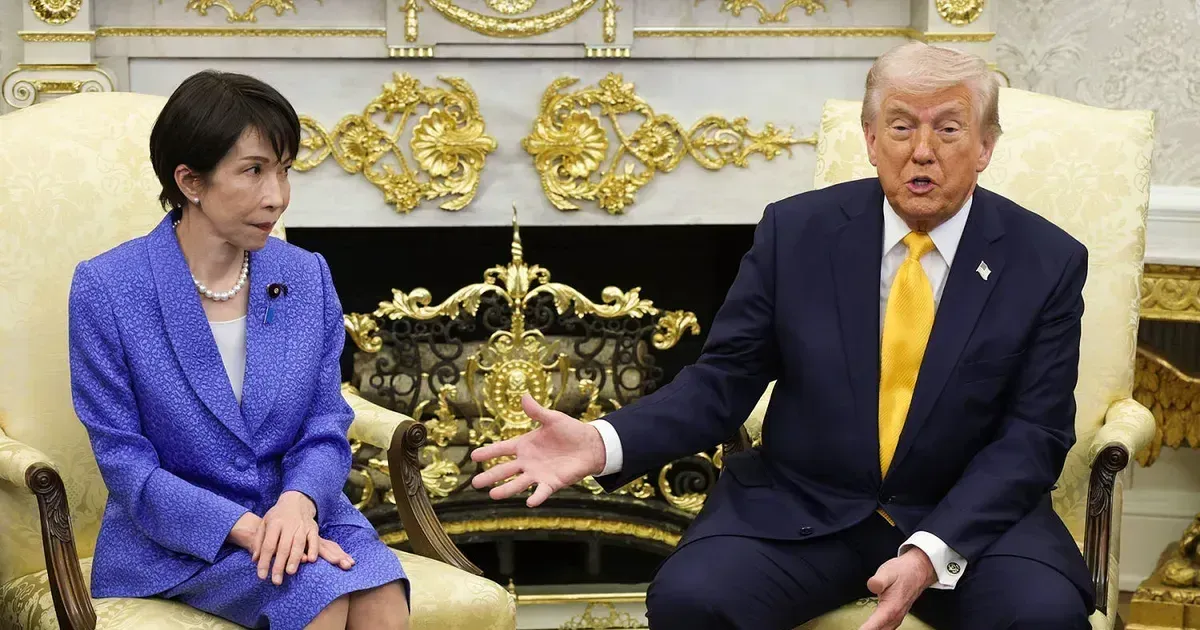
President Donald Trump questioned Japan’s Prime Minister Sanae Takaichi about the December 1941 attack on Pearl Harbor during a tense meeting in the Oval Office on Thursday. Reporters present for the bilateral session asked why the White House failed to inform Pacific allies about recent joint military operations with Israel against Iran. Trump leaned forward in his chair and insisted that the element of surprise was the most critical component of his current foreign policy. Takaichi sat stiffly as the American president turned his focus toward the historical conflict between their two nations to justify his administration's secrecy. Trump grinned at the press corps before delivering a remark that visibly unsettled his guest.
The exchange became a diplomatic problem because it touched wartime memory and alliance protocol at once. Who knows better about surprise than Japan? Ok, why didn’t you tell me about Pearl Harbor? Prime Minister Sanae Takaichi widened her eyes and took a deep breath as the room fell silent. She did not provide an immediate verbal response to the quip, which broke decades of diplomatic protocol regarding the sensitive history of the Second World War. Aides in the room later described the atmosphere as exceptionally strained. The meeting continued for another forty minutes behind closed doors. White House staffers later characterized the comment as a lighthearted attempt to illustrate a strategic point about military intelligence. Japanese officials did not share that interpretation in their subsequent briefings.
Diplomatic Friction Over Surprise Strikes in Iran
Tensions between Washington and Tokyo have mounted since the Pentagon launched a series of kinetic strikes against Iranian nuclear facilities and command centers last week. Japanese leadership expressed frustration that they were kept in the dark despite the presence of Japanese commercial shipping in the Strait of Hormuz. Donald Trump has consistently maintained that sharing operational details with any foreign capital increases the risk of intelligence leaks. He argued that even the closest partners cannot always be trusted with the timing of a preemptive strike. This stance complicates the traditional structure of the U.S.-Japan Security Treaty.
Tokyo contributes billions of dollars annually to host American forces on its soil. Takaichi arrived in Washington seeking clarity on whether Japan is still a primary partner or a secondary observer in Middle Eastern affairs.
But the president’s choice of metaphor shifted the focus from modern energy security to the scars of 1941. Analysts at the Stimson Center noted that invoking Pearl Harbor in a formal diplomatic setting is virtually unheard of for a sitting commander-in-chief. Most presidents treat the site as a place of solemn remembrance rather than a punchline for policy debates. Trump appeared unbothered by the gravity of the reference. He suggested that Japan’s own history proves that unannounced attacks are the most effective way to achieve military objectives. The comparison implies that the United States is now adopting the very tactics it once condemned.
Historical Tensions and the Pearl Harbor Comparison
Yet the historical context of the 1941 attack is still a deeply painful subject for both nations. Over 2,400 Americans died during the surprise raid on the Hawaiian naval base. For Japan, the event is inextricably linked to the eventual nuclear bombings of Hiroshima and Nagasaki. Takaichi belongs to a conservative faction of the Liberal Democratic Party that has sought to move Japan toward a stronger military posture. She has often visited the Yasukuni Shrine, a move that draws criticism from neighbors in Asia. Forcing her to defend or acknowledge the 1941 attack in the Oval Office creates a difficult political vacuum for her back in Tokyo. Her opponents will likely use the exchange to argue that her rapport with the American president is one-sided.
The Pearl Harbor reference comes at a time when Japan is debating constitutional reforms to its pacifist Article 9. If the United States can no longer be relied upon to share intelligence, some Japanese lawmakers argue that Japan must develop its own independent strike capabilities. This would represent the most significant change in Japanese defense policy since 1945. Trump’s comments might inadvertently accelerate this move toward Japanese rearmament. White House Press Secretary Karoline Leavitt told reporters that the president respects the alliance but will not apologize for focusing on American security. She insisted the joke was about military strategy, not a criticism of the modern Japanese state. Tokyo has yet to issue a formal protest through the Ministry of Foreign Affairs.
Japanese Prime Minister Reacts to Oval Office Commentary
Meanwhile, the Japanese press corps has reacted with a mixture of confusion and indignation. NHK and the Asahi Shimbun ran lead stories highlighting the discrepancy between Trump’s rhetoric and the supposed ironclad nature of the alliance. Takaichi is the first female Prime Minister of Japan and has faced intense scrutiny regarding her ability to manage the relationship with a volatile American administration. Her silence in the Oval Office was seen by some as a calculated display of stoicism. Others viewed it as a sign of the widening gap between the two leaders’ worldviews. The $11 billion in annual support Japan provides for U.S. bases is now a frequent topic of discussion in the Diet.
And the timing of the remark could not be worse for regional stability. China and South Korea are watching the exchange closely to see if the U.S.-Japan rift deepens. If the White House continues to treat its Pacific allies with such casual disregard, those allies may look to diversify their security partnerships. Australia and India have already expressed private concerns about the lack of communication regarding the Iran strikes. The suddenness of the air campaign caught the entire global community off guard. Trump views this as a victory for American power. His allies view it as a failure of American leadership.
Security Alliance Stability and Intelligence Sharing Protocol
Still, the logistical reality of the alliance remains unchanged for now. Thousands of American sailors and airmen are stationed at Yokosuka and Kadena. These bases are essential for any potential conflict in the South China Sea or the Taiwan Strait. If Trump continues to withhold intelligence, the risk of friendly fire or conflicting maneuvers increases sharply. Prime Minister Sanae Takaichi left the meeting without the assurances she sought. Her delegation spent the evening in meetings at the State Department trying to smooth over the ripples caused by the president’s joke. Diplomatic cables from the Japanese embassy suggest a deep sense of betrayal among the senior staff. They believe that 1941 should not be used as a rhetorical weapon in 2026.
According to NBC News, several Republican senators expressed private concern that the president is alienating the only reliable partner the U.S. has in East Asia. They fear that a joke about Pearl Harbor could do more damage than a trade war. The Japanese public is notoriously sensitive to how their history is portrayed by Western leaders. A single offhand comment can trigger massive protests in the streets of Tokyo. To that end, the administration may need to engage in significant damage control in the coming weeks. The White House has indicated it has no plans for a follow-up statement. Donald Trump believes his point about surprise was made effectively. He has moved on to planning the next phase of the campaign in the Middle East.
The Diplomatic Cost of Improvised History
Should anyone really be surprised that a man who views the world as a series of zero-sum transactions would weaponize the ghost of 1941 to silence an ally? The incident in the Oval Office is not a simple gaffe but a calculated dismantling of the post-war consensus that has kept the Pacific stable for eight decades. By invoking the surprise attack on Pearl Harbor to justify his own lack of transparency regarding Iran, Trump has signaled that the era of the reliable alliance is over. He is effectively telling Tokyo that the U.S. now operates on the same principle of predatory unpredictability that once led to global catastrophe. This is a dangerous game of historical revisionism that ignores the blood-bought lessons of the 20th century. While his supporters may cheer the unfiltered nature of his rhetoric, the cold reality is that he is burning the very bridges that allow America to project power across the globe. Japan is not a vassal state to be bullied into submission with schoolyard taunts about the Second World War. If the American president continues to treat the most sensitive historical trauma of his allies as a debate tool, he should not be shocked when those allies decide that the price of American protection has finally become too high.