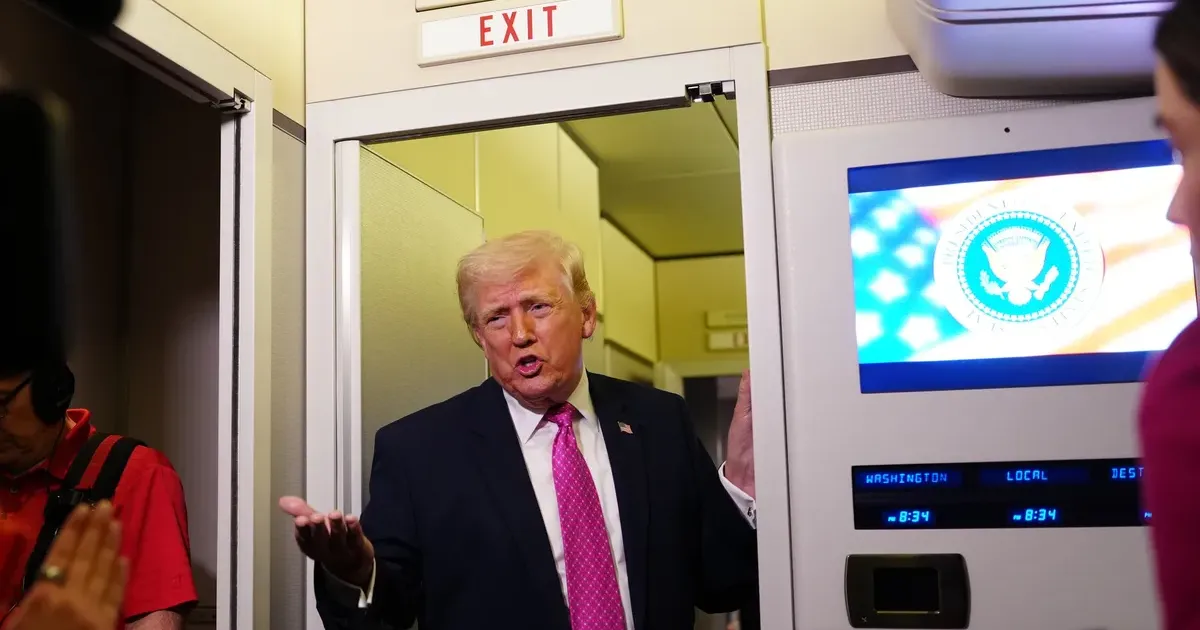
Trump's Iran victory claim landed against a market still pricing in war. The contrast between politics and oil screens was immediate. President Donald Trump announced on March 30, 2026, that the United States had forced major concessions from Tehran through sustained economic and military pressure. Speaking to reporters aboard Air Force One during a flight from West Palm Beach to Washington, the commander-in-chief characterized a new agreement to allow 20 tankers through the Strait of Hormuz as a gesture of submission. He cast the moment as a political victory, despite the persistence of the clerical establishment and ongoing kinetic exchanges in the Persian Gulf. Crude oil prices surged to $116 a barrel during the morning trading session as the world faces a generational energy crisis. This pricing pressure intensified after reports surfaced of a lethal Iranian raid on a critical power facility in Kuwait. While the White House projects a narrative of total victory, the global energy market remains skeptical of long-term stability in the world's most essential maritime chokepoint. Kuwait Power Infrastructure Sustains Direct Hits Kuwaiti officials confirmed that an Iranian strike targeted a major power site, resulting in the death of an Indian laborer. The Indian Ministry of External Affairs is currently coordinating with authorities in Kuwait City to repatriate the remains of the deceased worker. Iranian forces launched the raid as part of a broader retaliatory campaign against regional neighbors perceived as US allies. Emergency crews continue to battle fires at the site to prevent a total collapse of the local electrical grid. Military activity across the Gulf region has reached levels not seen in decades. Tehran maintains that these strikes are a necessary response to what it describes as an imminent American invasion force gathering in the Arabian Sea. Pentagon officials have not commented on specific troop movements but have reiterated their commitment to maintaining freedom of navigation.
The president, speaking to reporters on Air Force One, cast the permission as a sign of respect. He also asserted that the United States had forced Tehran into major concessions.
Intelligence reports from the region indicate that the strikes on Kuwaiti infrastructure were precision-guided. Witnesses near the power station described multiple explosions that lit up the night sky before the facility went dark. Kuwaiti defense systems engaged several incoming projectiles, yet at least two missiles successfully bypassed the perimeter.
Global Energy Markets React to Hormuz Bottleneck
Traders in London and New York reacted with volatility to the news of the 20 tankers being granted passage. This influx of supply is a minor fraction of the global demands currently blocked by the Iranian blockade. Energy analysts argue that the permission granted for these specific vessels is a tactical maneuver by Tehran to ease immediate international pressure without fully reopening the strait.
Major economies are currently depleting their strategic petroleum reserves at an unsustainable pace. If prices stay above the $110 threshold for the remainder of the quarter, several European nations face the prospect of mandatory energy rationing. Shipping insurance premiums for vessels entering the Persian Gulf have tripled in the last forty-eight hours alone. The ongoing instability has disrupted the global energy market, causing jet fuel costs to double alongside record crude prices.
Supply-chain disruptions are rippling through the manufacturing sector in East Asia. Refineries in India and South Korea, which rely heavily on heavy sour crude from the region, have already begun scaling back production. These facilities require a consistent flow of tankers that far exceeds the small batch authorized by the Iranian government on March 30, 2026.
Washington Declares Iran Pressure Campaign a Success
Trump told reporters that his primary objective in the region involves securing petroleum assets for American interests. He stated a desire to take the oil directly to ensure global price stability and to repay the costs of military operations. These comments have sparked intense debate among international legal scholars regarding the sovereignty of Iranian natural resources.
Tehran, however, views the rhetoric from the White House as a declaration of war. Iranian state media continues to broadcast images of military drills and missile batteries positioned along the coastline. The government in Iran denies that any meaningful change in leadership has occurred and insists its command structure is fully intact.
Diplomatic channels between Washington and Tehran remain closed. European mediators have attempted to broker a more thorough ceasefire, but the aggressive stance of both administrations has stalled progress. TASS reported that Russian officials are monitoring the movement of the 20 tankers as they navigate the narrow waters under Iranian escort.
Military Mobilization Triggers Invasion Accusations
Iranian leaders accused the United States of preparing a full-scale ground invasion under the guise of protecting oil interests. They pointed to the increased presence of carrier strike groups and amphibious assault ships in the region as evidence of offensive intent. Washington denies these claims, asserting that the naval presence is purely defensive.
Ground forces in neighboring Iraq and Saudi Arabia have been placed on high alert. The potential for a localized skirmish to expand into a broader regional conflict is a primary concern for the United Nations Security Council. Despite the release of the 20 tankers, the military buildup on both sides of the water continues to accelerate.
Logistical preparations for a possible maritime operation are evident across the theater. Defense contractors have surged personnel to regional hubs to maintain the readiness of advanced aircraft and missile systems. Satellite imagery shows Iran has moved mobile anti-ship batteries into the mountains overlooking the Strait of Hormuz.
Victory Claim Risk
Declaring the end of a regime while its missiles are still striking neighboring power grids demands a specific type of geopolitical myopia. The White House is currently attempting to market a tactical pause in a maritime blockade as a total strategic surrender by Tehran. This narrative serves domestic political needs but ignores the reality that $116 oil is a functional victory for the Iranian treasury, regardless of how many tankers are allowed to pass.
By describing the moment as regime-level success, the administration is effectively boxing itself into a corner. If the clerical establishment continues to issue orders and launch raids like the one in Kuwait, the American public will eventually notice the discrepancy between the president's rhetoric and the reality of the conflict. The ambition to simply take the oil is equally problematic. It replaces the traditional goal of regional stability with a colonial-era resource grab that will alienate every one of Washington's remaining allies in the Middle East.
Security in the Gulf cannot be bought with a few dozen tankers or won through unilateral declarations of victory on an airplane. The current trajectory points toward a prolonged war of attrition that the global economy is ill-equipped to survive. It is not leadership. It is a gamble on a house that is already on fire. Verdict: Strategic failure.