Pakistan's offer to host U.S.-Iran talks on March 29, 2026, was not a ceremonial gesture dropped into a distant war. It came from a state with a long Iranian border, deep exposure to Gulf energy flows and little room for another regional fire to move closer to its own politics. Islamabad was trying to turn geography into a diplomatic asset before geography turned into a security liability.
The timing was important. The war had already pulled in Israel, U.S. forces, Iran, Hezbollah pressure in Lebanon and Houthi missile activity from Yemen. Oil, gas, fertilizer, air travel and shipping were all part of the same stress field. That made Pakistan's offer less like neutral pageantry and more like an attempt to stop a military chain reaction before it reached the point where no mediator could slow it down.
Pakistan will be honored to host and facilitate meaningful talks between the two sides in the coming days.
Islamabad Was Buying Time
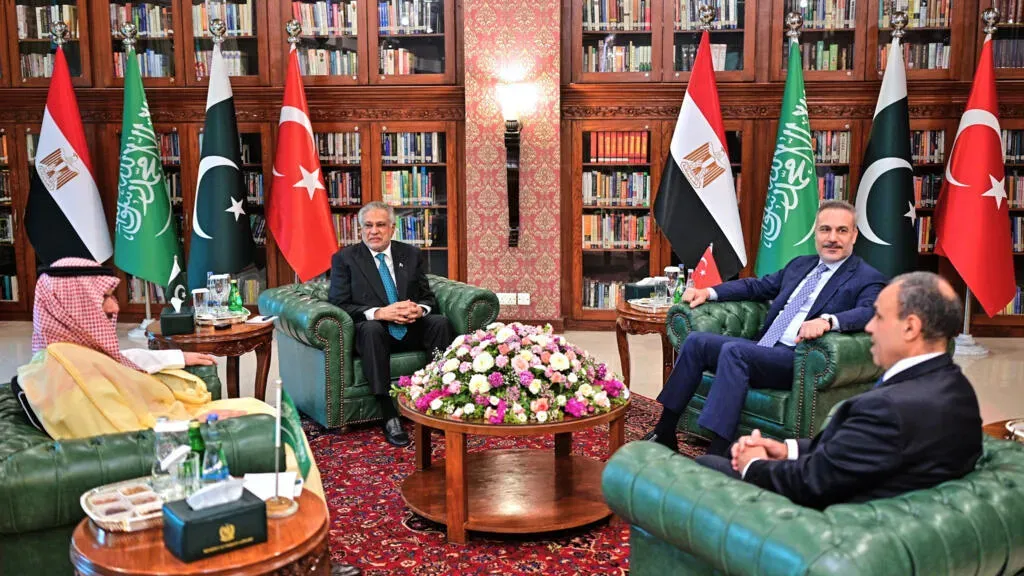
Foreign Minister Ishaq Dar's line came after senior diplomats from Turkey, Egypt and Saudi Arabia met in Islamabad. The mix of countries around the table was important. None could end the war alone, but each had a reason to fear a long U.S.-Iran fight that hardened positions around the Strait of Hormuz, widened the conflict in Lebanon or gave the Houthis more room to disrupt Red Sea traffic.
Pakistan also had a specific advantage: it could speak to Tehran without being treated as a Western extension, while still maintaining channels with Washington and Gulf capitals. That does not make it a miracle broker. It does give Pakistan a practical role in a conflict where direct trust was scarce and where both sides needed someone else to carry messages that would be politically costly to deliver in public.
The offer also gave Washington and Tehran a way to test intentions without announcing a retreat. The United States had been pushing a 15-point ceasefire framework through intermediaries. Iran rejected U.S. pressure and floated demands around guarantees, reparations and its position over maritime issues. Pakistan's role was to create a room where those incompatible public claims could be measured against private room for movement.
The Ground-War Warning Was The Point
Mohammad Bagher Ghalibaf's warning about American ground troops was the article's clearest signal. Iran's parliament speaker dismissed the Pakistan track as possible cover after U.S. Marines trained in amphibious landings arrived in the region. His language about setting U.S. troops on fire was brutal, but the message beneath it was political as much as military: Tehran wanted to raise the cost of any land option before Washington could normalize it as one choice among many.
That line needs careful handling. The warning was not proof that a U.S. ground invasion had been ordered. Public reporting at the time showed force movement, option-building and regional preparation, not a confirmed land-war decision. Treating Iranian rhetoric as confirmed U.S. intent would be sloppy. Ignoring the rhetoric would also be a mistake, because threat perception in wartime can shape mobilization, deterrence and miscalculation.
A ground war in Iran would have changed the category of the conflict. Airstrikes can hit facilities and command nodes; a land operation raises questions about terrain, occupation, border spillover, U.S. casualties, Iranian proxy retaliation and the legal mandate behind the campaign. For Pakistan, that was not an abstract Pentagon debate. It was a scenario that could strain its border, fuel markets and domestic sectarian politics at once.
Regional States Saw The Same Trap
Egypt's emphasis on direct dialogue pointed to the central problem: the war had started while indirect diplomacy was already fragile, and now both sides were trying to negotiate under fire. That is the worst environment for clean concessions. Each proposal can be read as a trap. Each pause can be read as weakness. Each military movement can poison the next diplomatic message before it is even delivered.
Turkey, Egypt, Saudi Arabia and Pakistan were not acting from the same interests, but they were responding to the same danger. A longer war could push energy prices higher, keep air corridors unstable, pull Lebanon deeper into open conflict and make the Red Sea-Hormuz connection a permanent risk premium for global trade. Regional diplomacy was therefore not an alternative to security policy. It was security policy by other means.
The later April talks and ceasefire efforts gave the March offer more weight in hindsight. Pakistan did become one of the few venues where the two sides could test whether a pause was possible. The process did not remove the structural conflict, and later violence showed how thin the diplomatic floor remained. Still, March 29 stands out because Islamabad was already trying to create an off-ramp while the war's military logic was still accelerating.
A Mediator Cannot Hide The Cost
Pakistan was not offering peace because peace was easy. It was offering mediation because the alternative was moving toward a war that could punish nearby states even if they never fired a shot. A larger U.S.-Iran conflict would not stay neatly inside Iran. It would run through fuel bills, shipping schedules, refugee routes, border policing, Gulf security calculations and domestic politics across the region.
Washington had reason to test the channel for the same reason Tehran had reason to use it: military pressure does not automatically produce a political end state. Strikes can degrade assets. They cannot tell a government how to stop fighting without humiliation, nor can they guarantee that proxies, markets and allied publics will accept the tempo chosen in Washington.
Pakistan's mediation offer carried weight because it recognized an uncomfortable fact earlier than many distant observers did. Once a ground-war threat becomes plausible, diplomacy is no longer a soft add-on to the conflict. It is the mechanism that keeps worst-case planning from becoming routine. Islamabad was not solving the war on March 29. It was trying to keep the door from being nailed shut.