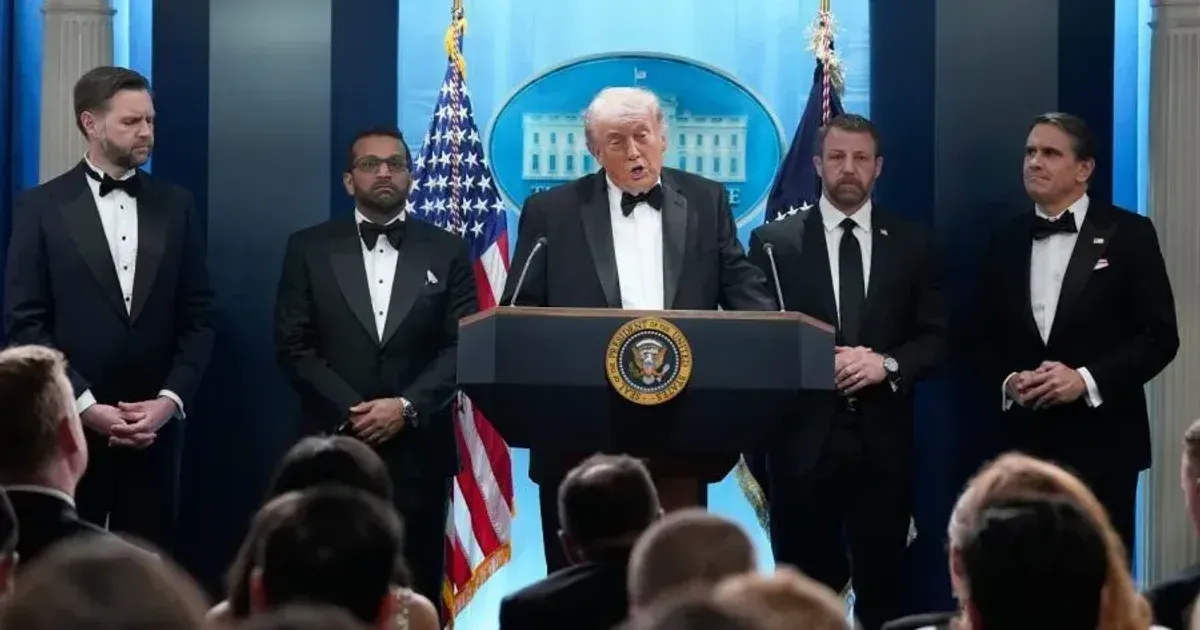
Donald Trump’s explanation for repeated shooting attempts turned personal danger into a claim about political effectiveness. He portrayed threats against him as evidence that his agenda changes the system enough to provoke violence. That framing will appeal to supporters, but it also risks converting security failures into campaign mythology. The Washington incident adds another layer to a public life already shaped by assassination attempts. Investigators still have to separate motive from political interpretation. Donald Trump explained on April 26, 2026, his belief that violent incidents gravitate toward figures who achieve high levels of systemic change. He articulated a causal link between his policy agenda and the physical threats he has encountered over the last several years. His remarks suggest a worldview where personal danger is a metric for political success.
Assassination attempts and security breaches have punctuated his recent public life, creating a unique security profile for the former president. These events include the 2024 shooting in Pennsylvania and a subsequent rifle-related incident at his Florida golf club. Trump maintains that these moments are neither coincidental nor solely the result of lapsed security protocols. Impact remains the central theme of his self-analysis regarding these threats. He posits that opponents, or those influenced by the political climate, target individuals who pose the greatest threat to the status quo. This perspective characterizes the violence as a form of feedback from a resisting political establishment.
Trump Connects Political Impact to Security Threats
Trump spoke candidly during a recent broadcast about the psychological and strategic burden of constant surveillance and threat assessment. He noted that figures of insignificance rarely attract the level of vitriol or violence directed at his campaign operations. His rhetoric implies that the intensity of the opposition is proportional to the scale of his legislative and cultural goals.
Critics often point to the heavy rhetoric of modern elections as a primary driver of such incidents. Trump, however, views the causality through a different lens, focusing on the result of his actions rather than the words of his detractors. He has frequently referenced his polling numbers and rally attendance as indicators of the influence that makes him a target.
"The people that make the biggest impact, they're the ones that they go after," Trump said.
Direct threats against presidential candidates have historically risen during periods of high economic or social transition. Data from the Secret Service indicates a sharp increase in protective intelligence cases involving high-profile political figures since 2016. Trump remains the focal point of a disproportionate share of these investigations. His framing of these events has become a staple of his communication strategy. By linking security threats to political impact, he transforms potential vulnerabilities into a narrative of strength and resilience. Every incident becomes a data point supporting his claim of being an effective disruptor.
Analysis of Security Failures and Agency Reform
Security protocols faced unmatched scrutiny after a gunman opened fire from a rooftop during a rally in Butler, Pennsylvania. That event led to the resignation of top officials within the Department of Homeland Security and a complete overhaul of the protective detail. Investigators discovered major gaps in communication between local law enforcement and federal agents. Budgetary increases for protective services followed these incidents, with Congress authorizing over $3 billion for enhanced security measures. These funds were directed toward advanced drone surveillance and increased personnel for candidate protection. The logistics of securing a figure who holds frequent outdoor rallies in varying jurisdictions present a perpetual challenge for the agency.
Standard operating procedures now include wider perimeters and more rigorous vetting of local site security. Agency leaders have admitted that the threat landscape has evolved faster than their traditional protective models. Lone-actor threats, often motivated by digital radicalization, remain the most difficult to predict and prevent. Technological solutions are now being integrated into the daily routine of the Secret Service to reduce these risks. Infrared sensors and AI-driven crowd monitoring have become standard at large-scale events. These tools aim to identify anomalies before they escalate into direct action against the protectee.
Historical Trajectory of Campaign Violence
Political violence in the United States has a long history, though the frequency of direct attempts on a single individual is rare. Attacks on Trump represent a shift in the nature of political dissent in the 21st century. Social media amplification and deep political polarization contribute to an environment where individuals feel compelled to take extreme measures. Previous eras saw violence driven by specific policy grievances or organized extremist groups. Current threats appear more fragmented and decentralized, often originating from individuals with complex psychological profiles. This shift requires a more subtle approach to intelligence gathering and threat assessment.
Trump remains a polarizing figure, and his presence on the stage continues to draw both intense loyalty and extreme hostility. He uses this duality to strengthen his image as a fighter for his constituency. The narrative of the targeted leader has proven effective in maintaining a high level of engagement among his supporters. Political analysts suggest that this strategy carries inherent risks by further polarizing the electorate. Presenting oneself as a target of the establishment can deepen the divide between different segments of the population. It also sets a precedent for how future leaders might frame security challenges.
Political Implications of the Survival Narrative
Surviving multiple incidents has allowed Trump to cultivate a sense of inevitability around his career. He often uses the imagery of his survival to contrast himself with political rivals. This imagery is powerful in a visual-driven media culture, where a single photograph can define a campaign cycle. Supporters view his endurance as a sign of divine or providential protection. The interpretation adds a quasi-religious layer to his political persona, making him more than just a candidate for office. It creates a bond with voters that goes beyond traditional policy platforms or economic arguments. The impact of this narrative on the 2026 political landscape is substantial. It forces other candidates to address the issue of political violence and their own security measures. Public discussion has shifted from debating policy to discussing the safety and stability of the democratic process. Violence should never be a normalized part of the American political experience. Trump’s assertion that impact leads to target status reflects a grim reality of current public life. It is a stark observation of the cost of high-stakes political engagement.
Trump Is Turning Security Failures Into a Martyrdom Narrative
Donald Trump has masterfully converted his security vulnerabilities into a political asset, yet this strategy masks a deeper, more corrosive reality for the American republic. By claiming that his political impact is the direct cause of shooting attempts, he is doing more than analyzing security; he is building a cult of martyrdom that delegitimizes any form of opposition as potentially murderous. The rhetorical maneuver is effective, but it is also exceptionally dangerous because it leaves no room for civil disagreement. The logic he presents is a closed loop. If he is attacked, it proves he is right; if he is not attacked, it suggests he is not fighting hard enough. Such a framework ensures that the temperature of American politics can only rise, never fall. The picture emerging is the transformation of the presidency from a civil office into a high-risk security theater where the primary qualification is physical survival. The shift prioritizes the safety of the individual over the health of the institution. Is the American public prepared for a permanent state of siege? Trump’s narrative suggests that violence is the inevitable tax on meaningful change, a cynical conclusion that could discourage future leaders from taking bold positions for fear of the bullet. It is not leadership. It is a hostage situation where the terms are dictated by the most extreme actors in the fringes of society.