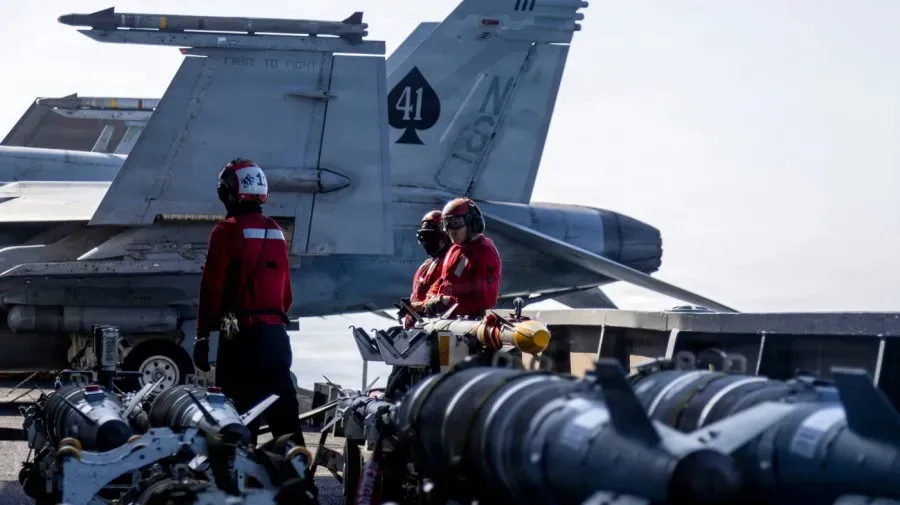
The arrival of USS Tripoli in the U.S. Central Command region gives the Trump administration another military option at a dangerous moment in the Gulf. On March 28, 2026, the amphibious ready group brought sailors, Marines and aviation assets closer to Iran as Washington tried to signal deterrence without openly committing to a wider conflict. The move matters because it adds flexible strike, evacuation and crisis-response capacity in a theater where a single misread signal can change the political calculation overnight.
Roughly 3,500 sailors and Marines are attached to the deployment, including the 31st Marine Expeditionary Unit. Central Command described the arrival as an increase in regional readiness, while defense analysts treated it as part of a broader buildup around Iranian pressure points. The administration has not publicly defined a final mission, and that ambiguity is part of the message. Tehran sees more American steel in the area; U.S. allies see a president trying to keep options open. The Tripoli is not a symbolic vessel. It is an aviation-heavy amphibious assault ship able to support F-35B operations, helicopters and command functions across a maritime crisis. That makes it useful for raids, defensive air coverage, embassy evacuation planning and show-of-force missions. It also gives the White House a visible tool that falls short of deploying another full carrier strike group.
The timing also gives the deployment a domestic political edge. Trump can present the movement as strength without yet explaining whether the intended outcome is deterrence, coercive diplomacy or preparation for strikes. That ambiguity may be useful in the short term, but it creates a burden for every later statement from the Pentagon and the White House. It also makes congressional oversight more difficult, because lawmakers cannot judge proportionality without knowing the administration’s intended threshold for action. That matters in an Iran crisis because a narrow maritime incident can quickly become a vote-defining foreign policy confrontation.
USS Tripoli Adds Flexible Pressure in the Gulf
The military value of the deployment lies in its range of uses. Amphibious ready groups can move Marines without relying on vulnerable land bases, and they can shift quickly between humanitarian, evacuation and combat tasks. In the Strait of Hormuz environment, that flexibility has political weight. Iran can threaten shipping, proxies can target regional bases, and the United States can answer without immediately moving into a ground-war posture.
Yet flexibility also creates temptation. A force designed for rapid response can make limited action look deceptively manageable. The United States has repeatedly entered Middle East crises believing that a contained operation would remain contained. The presence of Marines and F-35B aircraft therefore strengthens deterrence but also raises the cost of a local accident, militia attack or political demand for retaliation.
The deployment connects directly to internal debate over Iran. One camp argues that Tehran only respects pressure and that a larger U.S. footprint reduces the chance of miscalculation. Another warns that highly visible deployments can create the very escalation they are meant to prevent. The unanswered question is whether the White House has a clear end state or is collecting military tools faster than it is defining policy.
Megyn Kelly Turns Scrutiny Toward Trump Allies
Megyn Kelly sharpened that question by criticizing allies who, in her view, are pushing President Trump toward a confrontation with Iran. Her complaint was not simply anti-war rhetoric. It was a demand for accountability before the United States becomes locked into a decision that advisers can later disown. In a political ecosystem built around loyalty to Trump, public pressure from a conservative media figure carries unusual force. Kelly’s warning also exposes a familiar problem in presidential war rooms: advice can sound resolute when the costs are still theoretical. Commentators and political allies can urge strength without owning the intelligence assumptions, casualty estimates or exit strategy. The president then inherits both the decision and the consequences. That is why the advisory chain matters as much as the movement of ships.
The White House has not presented the Tripoli deployment as the start of a campaign. Still, military posture and domestic messaging are now moving together. The administration wants Iran to read resolve, supporters to see toughness and critics to believe that options remain controlled. Those objectives can coexist only if the president receives advice that distinguishes deterrence from momentum.
Marine Expeditionary Unit Raises the Stakes
The 31st Marine Expeditionary Unit brings capabilities that are practical in a Gulf crisis. Marines can conduct visit, board, search and seizure missions, secure evacuation corridors, reinforce embassies and support limited raids. Their aircraft can move people and equipment rapidly across a region where land access is politically complicated. That is precisely why the unit is useful and why its presence will be watched closely.
The link to shipping security is especially important. Any confrontation around the Strait of Hormuz would hit energy markets, insurance rates and regional partners before it became a conventional battlefield. The Tripoli group gives Washington a platform near those chokepoints, complementing other forces already tied to Iran contingency planning and earlier debates over pressure on Kharg Island and Hormuz.
For Tehran, the deployment will be read through the memory of past American buildups. For Gulf allies, it may be reassuring, but reassurance can fade if the White House seems to be improvising. A military signal is strongest when the political message behind it is disciplined. Without that discipline, every ship becomes a headline and every headline becomes a pressure point.
Strategic Risk Behind the Deployment
The essential issue is not whether the Tripoli can perform. It can. The issue is whether the administration can use a tool like this without letting the tool define the strategy. Marines at sea are a serious deterrent, but they are not a substitute for a negotiated objective, a congressional argument or a public explanation of what success would look like.
Kelly’s demand for transparency lands because American voters have seen this pattern before. A deployment begins as precaution, then becomes leverage, then becomes proof that backing down would look weak. If the president is moving forces to prevent war, the administration should be able to say what would make those forces come home. If the deployment is preparation for strikes, the public deserves more than atmospherics.
The Tripoli’s arrival therefore marks a military development and a political test. It gives Trump more room to maneuver, but it also narrows the margin for careless rhetoric. In the Gulf, hardware can deter enemies. It cannot repair confused decision-making. The next phase will show whether this is controlled pressure or the visible beginning of a policy that still lacks its final sentence.