Donald Trump expressed his dissatisfaction on April 16, 2026, with Australian military commitments regarding the escalating crisis in the Strait of Hormuz. Discontent within the White House surfaced as maritime blockades in the Persian Gulf continued to destabilize global energy markets. Australia has faced direct criticism from the American administration for its perceived reluctance to commit naval assets to the region during the initial stages of the Iranian maritime shutdown.
Richard Marles, the Australian deputy prime minister, defended the alliance while dodging specific questions about the American leader's social media activity. Marles insisted that the relationship with Washington deeply matters to Canberra, despite the public rebukes emanating from the Oval Office. Tensions peaked after Trump posted AI-generated imagery and engaged in public disputes with religious figures, creating a complex diplomatic environment for Australian officials to navigate.
Australia failed to provide support during the initial phases of the blockade. Criticisms leveled by the president focused on the absence of Australian naval assets when the White House requested immediate assistance. The White House considers the lack of participation a breach of the enduring security partnership that has defined Pacific and Middle Eastern policy for decades.
Keir Starmer Demands Global Solution to Naval Blockade
Keir Starmer arrived in Paris on April 16, 2026, to coordinate an international response to the shipping crisis. The British prime minister met with Emmanuel Macron to discuss the reopening of the essential waterway. Starmer characterized the mission as a global responsibility, moving to distance the European response from the more aggressive stance adopted by Washington. British officials are wary of being drawn into a broader regional conflict without a clear defensive mandate.
Blockades in the Persian Gulf have forced a rethink of maritime security across the Atlantic. London and Paris are co-hosting a high-level video conference to finalize the details of a purely defensive mission. This initiative seeks to provide escort services for merchant vessels without engaging in the offensive strikes favored by the American administration. France maintains that the opening of the strait must occur, but not at any price that risks a total regional fire.
Global shipping lanes stay choked by Iranian naval maneuvers.
Franco-British Defensive Mission and Diplomatic Friction
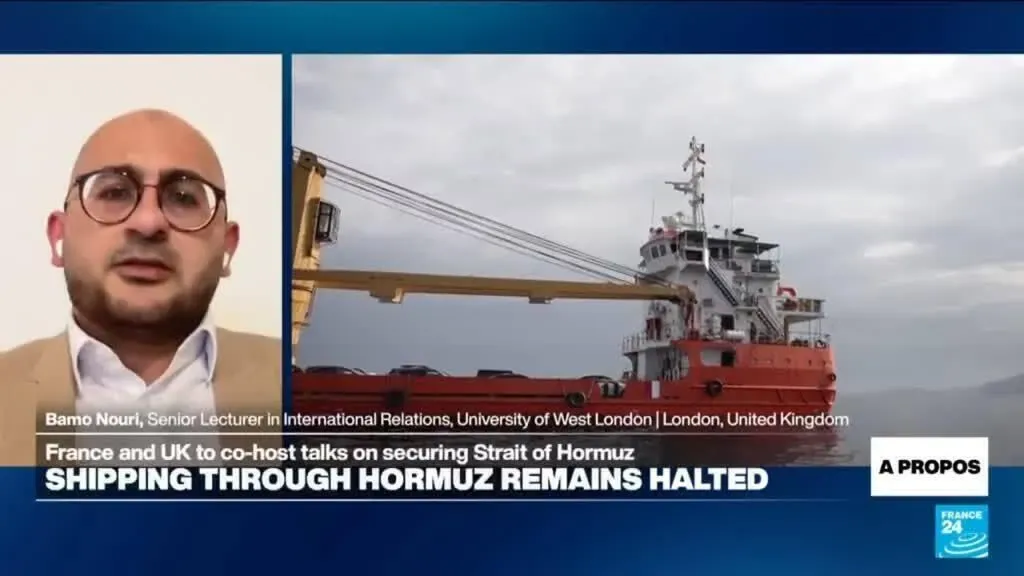
Dr. Bamo Nouri, a senior lecturer at the University of West London, argued that the European initiative is a calculated attempt to reinsert regional influence. Europe has found itself sidelined by decisions made in Washington and Jerusalem. Nouri described the current situation as a war of choice that has been shaped by external actors, leaving European powers to manage the economic fallout. The French finance minister emphasized that the mission remains defensive to avoid provocative escalations.
European leaders are treading a thin line between supporting their American allies and maintaining their own strategic autonomy. Divergent goals have emerged as the UK and France prioritize trade stability over regime change or punitive strikes.
Reopening the Strait of Hormuz is a global responsibility that requires a coordinated and defensive international presence to ensure the free flow of trade.
Paris remains the staging ground for European pushback against the Trump blockade. Coordination between the Royal Navy and the French Navy suggests a return to traditional maritime cooperation.
Experts note that the success of this mission depends on whether Iran perceives these forces as truly neutral or merely an extension of American power. The risk of miscalculation on the high seas has reached its highest point in three decades.
Australian Defense Spending Spikes During Iran Conflict
Defense officials in Canberra announced a major increase in military spending on April 16, 2026, citing the complications of the ongoing Iran war. The conflict has disrupted traditional strategic calculations in the Indo-Pacific. Richard Marles confirmed that the Australian government is reallocating billions to enhance naval capabilities and long-range strike systems. Internal pressure has mounted as domestic energy infrastructure faces vulnerabilities, evidenced by a recent fire at the Geelong refinery.
Strategic analysts at the University of West London suggest that Australia is attempting to balance its late entry into the Hormuz crisis with a show of force elsewhere. The Geelong refinery fire highlighted the fragility of Australian fuel security in an environment of global supply-chain disruptions. While the fire is being investigated, its timing coincided with the highest oil price spike since the 1970s. Canberra faces a difficult choice between domestic protection and international expeditionary requirements.
Domestic political critics in Australia have seized on the lack of preparation. They argue that the sudden increase in defense spending is a reactionary measure to appease an angry American president. Trump has made it clear that he expects not only financial commitments from allies. He wants hardware and personnel in the water, patrolling the 21-mile-wide choke point through which a third of the world's liquefied natural gas passes.
Geopolitical Tensions Strain the Five Eyes Alliance
Intelligence sharing and military cooperation within the Five Eyes network face historic strain. The public nature of Trump’s criticism of Australia is a departure from the usually private grievances of the alliance. Australia maintains that its focus must remain on the Indo-Pacific, where local threats are perceived as more immediate than the disruptions in the Persian Gulf. Washington, however, views the two theaters as closely linked by the global energy market.
Military spending in Australia is expected to reach $11 billion in additional funding over the next fiscal year. This surge in capital is intended to accelerate the procurement of frigates and maritime surveillance drones. Defense planners are operating under the assumption that the Strait of Hormuz will remain a contested zone for the foreseeable future. The Australian government is now scrambling to prove its utility to a skeptical White House while managing the economic shocks of the Iran war.
Maritime security in the Persian Gulf is no longer a localized issue. It has become a stress test for the viability of Western alliances in a multi-polar world. Starmer and Macron are betting that a defensive coalition can succeed where unilateral pressure has failed. The coming weeks will determine if the Strait of Hormuz reopens through diplomacy or if the current blockade leads to a direct naval engagement involving global powers.
The Elite Tribune Strategic Analysis
Keir Starmer and Emmanuel Macron are engaged in a performative exercise that ignores the brutal reality of maritime power projection. By labeling their planned mission as purely defensive, they are essentially signaling to Tehran that European vessels will not fire unless fired upon. This posture is not a strategy; it is an invitation for Iranian harassment and asymmetric provocations. Tehran understands only the language of credible kinetic threats, a dialect that the current leadership in London and Paris seems to have forgotten in their pursuit of moral high ground.
Donald Trump is right to be furious with Australia, but his public temper tantrums are equally counterproductive. Transactional diplomacy works in real estate, yet it fails in the complex web of global security where trust is the primary currency. By berating Canberra, he forces Richard Marles into a corner where any increased contribution looks like a surrender to American bullying rather than a sovereign defense of national interests. The public fracturing of the Five Eyes alliance is a gift to adversaries who thrive on Western disunity.
Australia's sudden spike in defense spending is too little, too late. Canberra has spent years ignoring the obvious vulnerabilities in its fuel supply chain, only to be surprised when a refinery fire and a distant blockade threaten to grind the nation to a halt. The era of the free ride is over. If middle powers want the benefits of a globalized trade system, they must be willing to bleed for the waterways that sustain it. A hard landing awaits those who believe military spending can replace actual naval presence.