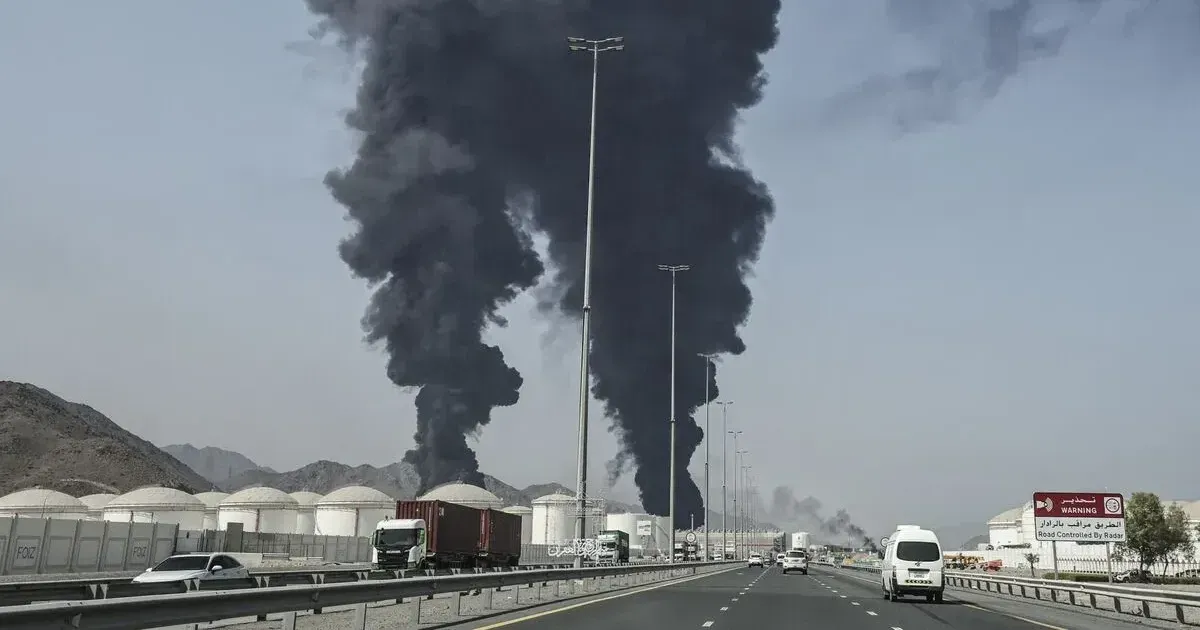
Fujairah port officials cleared tankers to resume oil loading on Sunday morning. Security teams finished assessing damage from a drone strike that had paralyzed the terminal since Saturday. The United Arab Emirates moved quickly to restore operations at its most strategic export hub, situated safely outside the Strait of Hormuz. Satellite imagery confirmed a small fire near the northern berths had been extinguished. Smoke plumes disappeared from the horizon by dawn. Crude flows through the Habshan-Fujairah pipeline resumed at a rate of 1.5 million barrels per day. But the restoration of physical flows does not erase the psychological impact on shippers. Insurers immediately hiked premiums for vessels entering the Gulf of Oman. Daily rates for Very Large Crude Carriers rose by 15 percent within hours of the fire. Crews on the ground reported that the drone hit a storage tank manifold. The resulting blaze triggered automatic shutdown protocols across the entire facility. Port authorities managed to contain the spill within the primary barrier zone.
Fujairah Restarts Oil Loading
Saturday's disruption came during a period of heightened regional tension. The Fujairah terminal acts as an essential safety valve for global energy markets. It allows the UAE to bypass the narrow and vulnerable Strait of Hormuz. Security analysts at Bloomberg noted that the drone used a low-altitude flight path to evade radar detection. This method has become a recurring challenge for coastal infrastructure in the region. Local defense systems failed to intercept the craft before it reached its target. The resilience of the port infrastructure surprised many industry observers. Engineers worked through the night to bypass the damaged manifold and redirect flows to secondary loading arms. Normal service levels returned within 24 hours of the initial explosion. The impact on global benchmarks reflected the speed of the recovery. Brent crude prices initially spiked by 3 percent on news of the fire. These gains evaporated as soon as port officials announced the restart of operations. Market participants remain on high alert for follow-up attacks. Security firms have increased the number of private maritime security contractors stationed near the Fujairah anchorage. The presence of these armed guards adds another layer of cost to every barrel of oil exported from the region.
Drone Strike Keeps Insurance Costs High
Meanwhile, the Australian government seized the moment of regional instability to pitch its own energy resources. Ministers in Canberra held emergency meetings with Japanese and South Korean trade delegations. They emphasized the reliability of Australian Liquefied Natural Gas compared to Middle Eastern supplies. Australia is now the second-largest exporter of LNG globally. The government urged trading partners to boost investment in new gas projects. Officials specifically pointed to the Browse and Scarborough basins as long-term solutions for energy security. The minister for Resources stated that geopolitical risk in the Middle East makes the Australian investment case undeniable. Buyers in Asia are looking to diversify their portfolios to avoid supply shocks. Australian gas offers a stable, though more expensive, alternative to Gulf exports. Yet the expansion of these projects faces major domestic hurdles. Environmental groups in Western Australia have launched legal challenges against new drilling sites. They argue that long-term gas investments contradict national carbon reduction targets. The Australian government must balance its global marketing push with local political pressure. The offshore gas fields require billions in capital expenditure before they can reach full production capacity.
Energy Markets Watch Physical Flows
Financial markets experienced a different kind of turbulence as retail investors rushed into energy bets. The United States Oil Fund, the largest crude-linked ETF, saw its highest daily inflow since the 2020 price collapse. Individuals are attempting to profit from the wild price swings triggered by the conflict. Financial Times reports indicate that this surge in activity is creating a meme-like environment for crude oil. Social media platforms are filled with speculative advice on how to trade the instability. This influx of retail capital often moves independently of fundamental supply and demand data. The heavy volume of retail money entering the USO ETF has created a disconnect between paper oil and the physical reality on the water in Fujairah. Institutional investors expressed concern about the potential for a liquidity squeeze. When thousands of small traders enter a market simultaneously, they can increase price movements in both directions. This instability makes it difficult for commercial hedgers to manage their risks effectively. Separate data shows that the $4.2 billion in new retail positions is largely concentrated in short-term options. These contracts expire within 30 days, creating a ticking clock for speculative gains. Most of these traders have no intention of ever taking delivery of a physical barrel. Professional commodity desks at major banks have pulled back. They cite the unpredictability of drone warfare as a reason to reduce their exposure. The gap between retail enthusiasm and institutional caution is widening daily. Strategic planners are now recalculating the cost of regional instability on a global scale. The drone strike on Fujairah proves that even bypass routes are not immune to disruption. The realization is forcing energy-dependent nations to reconsider their stockpiling strategies.
For instance, the Japanese government announced a review of its national oil reserves. It seeks to increase the number of days of supply held in domestic tanks. The shift away from just-in-time delivery marks a major change in maritime logistics.
The demand for tankers capable of long-haul voyages is increasing. Moving oil from the US Gulf Coast or Australia to Asia takes sharply longer than shipping from the Middle East. The increased transit time effectively reduces the global tanker supply.
Freight rates for clean product tankers have already begun to climb in anticipation of these shifts. Companies like Maersk and Hapag-Lloyd are adjusting their routes to avoid high-risk zones. The added fuel costs and canal fees are being passed directly to consumers.
The problem is one of geography and technology. Modern drones have leveled the playing field between state actors and non-state groups. A thousand-dollar drone can now threaten a multi-billion-dollar infrastructure project with ease.
The West Texas Intermediate price standard remains sensitive to any further reports of hardware failure or sabotage. Traders are watching the UAE's repair schedule closely for any signs of lingering damage. The port of Fujairah is now operating at 85 percent capacity.
Supply Resumes Before Risk Fades
Relying on the logistical resilience of a single emirate to anchor the global economy is a form of collective insanity. The rapid restart of the Fujairah port is being hailed as a triumph of engineering, but it is actually a symptom of a desperate system. We are watching a world so terrified of supply shocks that it ignores the fundamental vulnerability of its energy arteries. The UAE has built a bypass, but a bypass is still a target. The drone strike was not a random act of violence; it was a proof of concept.
It demonstrated that the world's most complex defense systems can be bypassed by cheap, off-the-shelf technology. While Australia tries to sell its LNG as a panacea, it ignores the reality that its own supply chains are just as vulnerable to the same technological shifts. The retail frenzy in oil ETFs is the final stage of this absurdity. When taxi drivers and teenagers are betting on the instability of a war zone, the market has ceased to be a mechanism for price discovery. It has become a casino built on top of a powder keg.
Western leaders continue to treat these disruptions as isolated incidents when they are actually the opening salvos of a new era of asymmetric economic warfare.