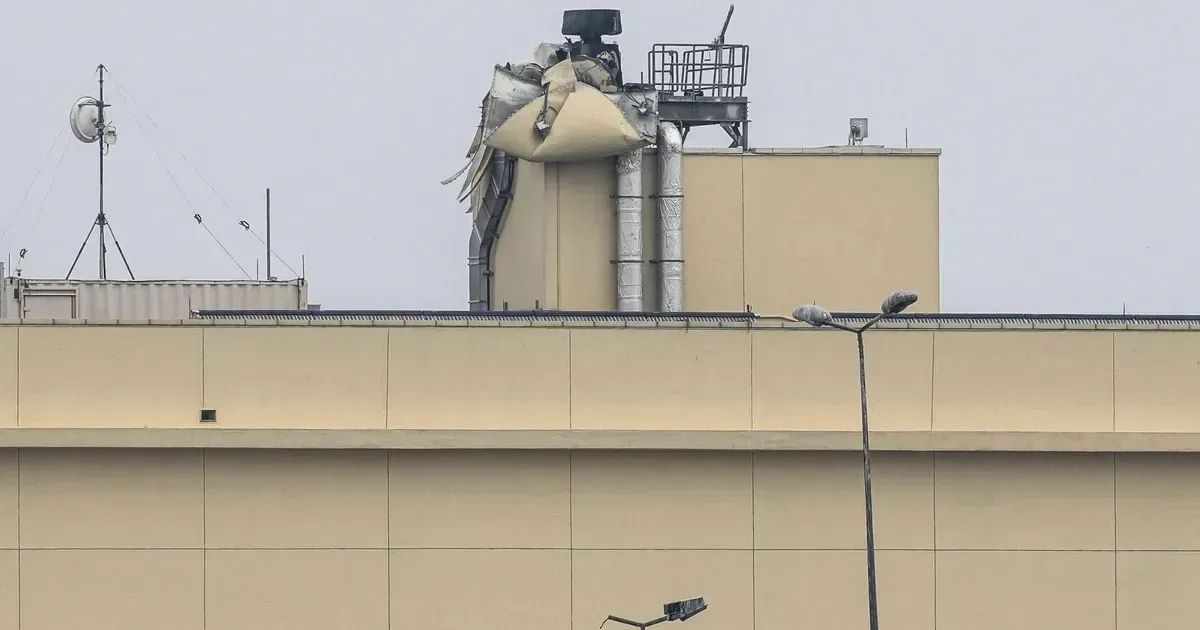
Baghdad residents watched as sirens echoed through the International Zone on Saturday. The State Department issued an urgent directive for all American citizens to leave Iraq immediately. Security conditions deteriorated rapidly as the conflict with Iran entered its third week. Militias aligned with Tehran launched a series of coordinated strikes against Western interests across the country. U.S. officials urged citizens to leave Iraq immediately, with the American Embassy in Baghdad warning in a social media bulletin that Americans should leave now. Official guidance urged any nationals choosing to remain to reconsider the lethal risks posed by paramilitary groups. These groups have intensified their efforts to destabilize the fragile security arrangement maintained by the Iraqi government. Violence has centered on the heavily fortified International Zone. For years, this district served as a symbol of American influence and Iraqi sovereignty. Rocket fire and drone incursions have now made the area nearly unworkable for diplomatic personnel. Iranian forces have used a mix of ballistic missiles and loitering munitions to pressure US assets. These strikes come in direct response to American and Israeli operations within Iranian borders. Washington has maintained that its actions are defensive. Tehran views them as an existential threat. Militia groups targeting the administrative heart of the capital have demonstrated increased technical proficiency. They are no longer relying solely on unguided Katyusha rockets. Meanwhile, complex surveillance drones now map the movements of diplomatic convoys. Security analysts note that the volume of incoming fire has increased fivefold since the start of March 2026. This development has forced a reassessment of the viability of the American presence in the region.
US Embassy Issues Iraq Exit Order
Rocket attacks have become a nightly occurrence for the diplomats and security contractors remaining in the capital. The embassy grounds have suffered structural damage from debris and direct hits. The defensive systems like the C-RAM have intercepted the majority of incoming projectiles. The constant noise of heavy machinery and explosions has created a climate of siege within the city walls. But the threat is not limited to the capital. Militias have expanded their target lists to include logistical hubs and private residences. The Iraqi security forces have struggled to contain these groups. Many units within the Iraqi military have deep ties to the very militias they are tasked with policing. This internal conflict of interest has left the central government paralyzed. Security cordons around the embassy have been reinforced with additional concrete blast walls. Local staff have been sent home indefinitely as the risk of kidnapping or assassination rises. For instance, several contractors were detained at unauthorized checkpoints on the outskirts of the city last Tuesday. Their release was only secured after high-level negotiations with local tribal leaders.
US citizens choosing to remain in Iraq are strongly encouraged to reconsider given the serious threat posed by Iran-aligned terrorist militia groups.
Intelligence reports suggest that the militias are preparing for a larger offensive. They aim to seize key infrastructure points if the conflict with Iran continues to escalate. The US military footprint in Iraq has been focused on counter-terrorism rather than conventional defense. The current surge in hostilities has caught the existing security structure off guard.
Militia Threat Narrows Safe Routes
Northern Iraq offers no sanctuary from the regional instability. The area around Erbil International Airport has been subjected to repeated ballistic missile salvos. Iranian military commanders have explicitly targeted this region due to the presence of a US consulate and intelligence-gathering facilities. The Kurdish regional government has pleaded for more advanced air defense systems to protect its capital. Consulate operations in Erbil have been suspended. Staff have retreated to hardened bunkers while awaiting evacuation orders. The local economy in the Kurdistan region has begun to crater. Foreign investment has evaporated as the risk of total war looms over the northern provinces. Energy companies have already started the process of withdrawing their expatriate workforce from the oil fields. Satellite imagery confirms that several launch sites in western Iran have been positioned to strike Erbil. These sites use the Fateh-110 missile, which has a range and accuracy that far exceeds previous militia capabilities. The US has deployed additional Patriot missile batteries to the region. The sheer number of incoming threats threatens to oversaturate these defenses. The diplomatic mission in Erbil remains a critical link for American interests. It is a gateway to the Syrian theater and a check on Iranian expansion. The decision to order an evacuation indicates a major shift in the perceived safety of this once-stable enclave. Total withdrawal from Erbil would leave a power vacuum that local forces are ill-equipped to fill.
Closed Airspace Complicates Evacuation
Leaving the country has become a complex and dangerous effort. Iraqi airspace is closed to all civilian traffic due to the threat of surface-to-air missiles. The only viable exit routes are overland. The embassy has stated that the US government will provide assistance for these land-based departures. This involves coordinated convoys moving toward the borders of Turkey or Jordan. Travelers face a gauntlet of militia-controlled territory. The main highway from Baghdad to the Jordanian border is notorious for illegal checkpoints.
Airspace over Baghdad and Erbil remains a kinetic combat zone.
Costs for private security and armored transport have surged. A single seat in an armored convoy to the border now costs upwards of ten thousand dollars. Many Americans working for non-governmental organizations are finding themselves stranded without the resources to pay for such protection. The State Department is now working on a plan to subsidize these costs using a portion of a $3.5 billion emergency regional fund.
Land routes are being monitored by US MQ-9 Reaper drones to provide early warning of militia ambushes. The vastness of the Iraqi desert makes total security impossible. Small groups of insurgents can easily set up improvised explosive devices or establish temporary blockades. The government in Baghdad has offered little help in securing these corridors.
The wider war with Iran has fundamentally changed the risk calculus for Westerners in the Middle East. Each American strike on Iranian soil triggers a retaliatory move against soft targets in Iraq. The cycle of violence shows no sign of abating as both sides harden their positions. The struggle is for regional hegemony between Washington and Tehran.
Neighboring states are watching the evacuation with growing alarm. A total American withdrawal from Iraq would embolden Iran to further pressure its rivals in the Gulf. For instance, Saudi Arabia and the United Arab Emirates have increased their own security postures. They fear that the chaos in Iraq will spill across their borders.
The diplomatic mission has effectively transitioned to a bunker footing. Recent intelligence suggests that Iran-aligned militias are now being supplied with more advanced anti-ship and anti-air weaponry. This suggests a long-term strategy to deny the US access to Iraqi territory entirely. The evacuation order is a recognition that the current security environment cannot protect civilians from these high-end threats. It is a tactical retreat designed to prevent a hostage crisis or a mass casualty event.
Warnings Matter Only If Exit Routes Exist
Why did the administration wait three weeks to admit that the Iraqi security umbrella had folded? Waiting until the third week of active hostilities to order a mandatory evacuation is more than a logistical oversight. It is a failure of strategic foresight. The State Department spent years insisting that the Iraqi government could act as a buffer against Iranian influence, but that facade has finally shattered under the pressure of real combat. We are now seeing the endgame of a policy that prioritized diplomatic appearance over the physical safety of American nationals.
Emptying the Baghdad embassy represents the final bankruptcy of two decades of American nation-building efforts in the Levant. If the most fortified diplomatic facility in the world cannot be secured, the entire project in Iraq is effectively over. Washington continues to pretend that Iraq is a sovereign partner, but the reality is a fragmented territory controlled by warlords and foreign-backed proxies. The decision to flee by land because the skies are too dangerous is a humiliating admission of weakness. It tells the world that the United States has lost control of the very airspace it once dominated. It is not a temporary relocation. It is the beginning of the end of the American era in Baghdad.