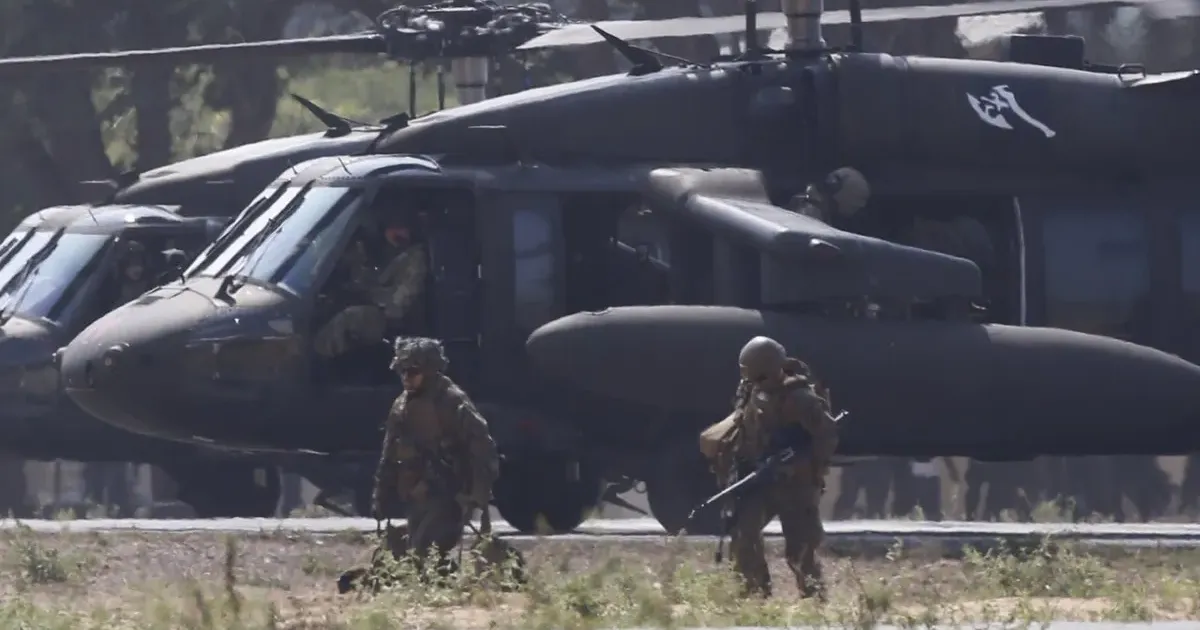
Okinawa harbors emptied this week as elite naval elements received orders for immediate deployment to the Persian Gulf. White House officials confirmed that the Pentagon has begun the strategic relocation of significant amphibious forces to strengthen the US-Israeli campaign against Tehran. At the center of this movement is the 31st Marine Expeditionary Unit, a specialized force usually tasked with maintaining stability in the East China Sea. This relocation is major recalibration of American military priorities in the Pacific.
Marines began boarding vessels in the early hours of Friday under a directive from President Donald Trump. Reports from the region indicate that at least 2,000 Marines are currently in transit. The war, now entering its third week, has consumed the attention of the administration despite previous commitments to a Pacific-first defense strategy. Combat operations have intensified along several fronts, prompting the need for rapid-response ground forces capable of amphibious insertion. The 31st MEU remains the only forward-deployed force of its kind in the Western Pacific.
Washington has made its intentions clear regarding the expansion of the conflict. Trump recently vowed to ramp up military action against Iranian interests, citing the need for a decisive conclusion to the hostilities. Military analysts point to the deployment of the USS Tripoli as a signal of intent. The Tripoli serves as an amphibious assault ship specifically designed to operate as a light aircraft carrier. It lacks a traditional well deck, focusing instead on the delivery of air power through advanced stealth aircraft.
Pentagon Redirects Pacific Assets to Iran Front
Movement of the 31st MEU marks a significant departure from standard operating procedures for the Indo-Pacific Command. For decades, the presence of these Marines in Japan served as a deterrent against regional maritime incursions. Commanders have now deemed the Middle Eastern theater a higher priority for these specific tactical assets. The USS Tripoli provides a mobile platform for F-35B Lightning II stealth fighters, which are critical for penetrating sophisticated air defense networks. These jets offer a unique capability in the current high-intensity environment.
Logistics planners are working to fill the security vacuum left in Japan after the departure of the Marines. Still, the immediate needs of the Israeli-US coalition take precedence in the eyes of the current administration. Air Force transport planes have been observed moving support equipment alongside the naval flotilla. In turn, the readiness levels of remaining Pacific units have been adjusted to compensate for the missing expeditionary force. Experts suggest that the duration of this deployment will depend entirely on the rate of attrition in the Gulf.
Naval movements are being tracked closely by regional observers in both Tokyo and Beijing. While the White House insists this is a temporary realignment, the scale of the hardware being moved suggests a long-term commitment. In fact, the inclusion of the USS Tripoli indicates that the US is preparing for sustained air operations over Iranian territory. The ship carries enough fuel and munitions to support weeks of high-tempo sorties without the need for immediate port resupply.
Chinese Tech Giants Maintain Middle East Investment
Beijing has responded to the regional volatility with a notable display of economic resilience. While the US focuses on military escalation, prominent Chinese business leaders are signaling their commitment to the region. Li Dongsheng, the founder and chairman of electronics giant TCL, told industry forums that the war has not derailed his firm's expansion plans. He remains focused on the long-term potential of Middle Eastern markets despite the presence of American strike groups. TCL has historically viewed the region as a essential bridge between Asian manufacturing and European consumers.
Investors have watched the electronics sector closely for signs of a retreat from conflict zones. But the rhetoric from Chinese corporate headquarters suggests a different path. These firms are doubling down on outbound investment in both the Middle East and Latin America. They view the current geopolitical friction as a temporary obstacle rather than a permanent barrier to commerce. Li Dongsheng specifically addressed the risks during a recent business summit in China.
The recent crisis in the Middle East had only a temporary impact on the company’s operations there and the overall outlook remains stable.
Business activity in Dubai and Riyadh continues to attract Chinese capital at record levels. To that end, TCL is joined by several other tech firms in maintaining their regional headquarters despite the proximity of the fighting. These companies are betting on a rapid stabilization once the current phase of the war concludes. Separately, the Chinese government has encouraged its domestic champions to maintain their global footprints to counter Western economic sanctions. The strategy focuses on the Global South as a primary growth engine.
Trump Strategy Shifts Focus From China To Tehran
Presidential directives have at its core altered the map of US military engagement in 2026. By prioritizing the destruction of Iranian military infrastructure, the administration has paused the long-touted pivot to the Pacific. This strategic relocation underscores the difficulty of maintaining a dual-front posture in an era of high-intensity conflict. Still, the White House maintains that it can manage both theaters simultaneously through technological superiority. The reliance on the USS Tripoli and its F-35B complement is a central pillar of this theory.
Israel has coordinated its own strike packages with the incoming Marine assets to ensure maximum efficiency. The arrival of 2,000 highly trained combat troops provides the coalition with options for coastal raids and specialized reconnaissance. And the presence of an amphibious ready group increases the pressure on Iranian naval defenses in the Strait of Hormuz. Commanders in the region are currently integrating the 31st MEU into the existing theater command structure. The integration process is expected to be completed within the next 48 hours.
Washington remains silent on the specific landing zones or mission objectives for the arriving Marines. Yet the historical role of the 31st MEU suggests they will be used for rapid intervention or embassy security should the conflict spread. The unit is self-sustaining for up to 30 days of combat operations. In turn, this allows the Pentagon to deploy them into environments where local infrastructure has been degraded by airstrikes. Each battalion is equipped with its own artillery and light armored vehicles.
USS Tripoli Leads Amphibious Strike Force
Engineering crews on the USS Tripoli are maintaining a 24-hour maintenance cycle for the aviation wing. The ship is new class of vessel that prioritizes aviation over landing craft. It functions more like a specialized carrier than a traditional troop transport. This design choice was made to support the heavy requirements of the F-35B program. In particular, the ship features expanded hangar space and increased aviation fuel capacity to support the high sortie rates required in a war against a modern adversary.
Aviation units attached to the Tripoli have already begun pre-deployment training exercises. These drills focus on over-the-horizon strikes and electronic warfare countermeasures. By contrast, the Iranian forces have spent the last decade improving their coastal missile batteries and swarm-boat tactics. The coming weeks will test the effectiveness of the American sea-basing concept against a deeply entrenched land-based defense. Ground crews are currently prepping munitions on the flight deck.
Regional energy markets have reacted with predictable volatility to the news of the Marine deployment. Oil prices jumped on the news that the US was moving specialized ground forces into the theater. Traders are pricing in the possibility of a ground invasion or an extended blockade of key shipping lanes. Still, the shipping industry continues to operate through the Gulf of Oman with increased insurance premiums. The arrival of the USS Tripoli will likely lead to new maritime exclusion zones.
The Elite Tribune Perspective
Why does the American strategic mind always default to the sand when the real competition remains in the silicon? By pulling the 31st Marine Expeditionary Unit from Okinawa, the Trump administration is effectively handing the keys of the East China Sea to Beijing on a silver platter. It is a staggering display of short-term thinking that prioritizes a tactical victory in Tehran over the long-term survival of Western maritime primacy in the Pacific.
While US Marines are diverted to yet another Middle Eastern quagmire, Chinese tech giants like TCL are quietly cementing their economic hegemony across the Global South. Li Dongsheng is not worried about the war because he understands that while Washington spends trillions on F-35B sorties, China is buying up the digital and physical infrastructure of the future. It is not a military strategy; it is a fire sale of American global influence. We are watching the voluntary dismantling of the Pacific deterrent to chase a ghost in the desert that has haunted three generations of presidents.
If the goal was to secure American interests, the Marines would stay in Japan. Instead, they are being sent to act as an expensive shield for a conflict that offers no clear exit strategy and no tangible benefit to the average American taxpayer.