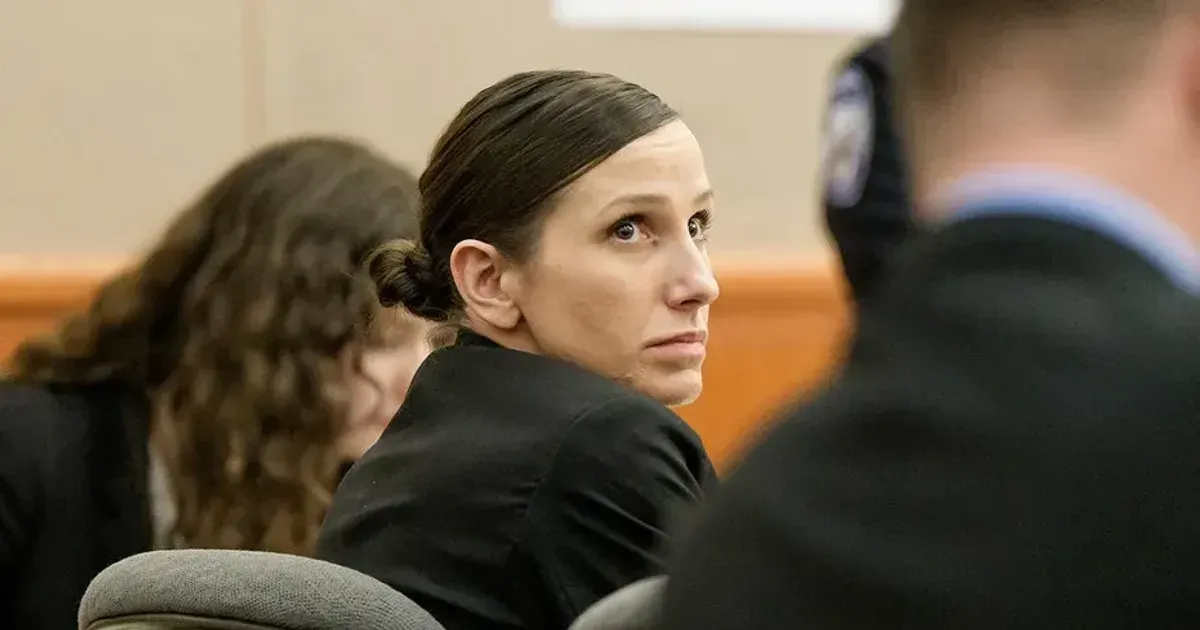
Kouri Richins stood motionless in a Park City courtroom on Tuesday as a jury declared her guilty of murdering her husband, Eric Richins, with a fentanyl-laced cocktail in March 2022. Jurors reached the unanimous decision after several days of testimony that painted a picture of a calculated financial plot hidden behind the facade of a grieving widow and successful children's author. Prosecutors presented evidence showing that Richins, 35, intentionally mixed a lethal dose of the synthetic opioid into a Moscow Mule to eliminate her husband and secure her financial future. Sentencing for the crimes is now set for May 13 at 9:30 a.m. MST.
Eric Richins died suddenly in the couple's home in Kamas, a small community where the family was well known. While his death was initially treated with the sensitivity afforded to a tragic accident, toxicology reports quickly shifted the focus of the investigation toward his wife. Medical examiners discovered that the father of three had more than five times the lethal amount of fentanyl in his system at the time of his death. Investigators also noted the presence of other substances that suggested a deliberate poisoning rather than a recreational overdose or accidental ingestion.
Prosecutors argued during the trial that the murder was the culmination of a long-term plan to gain control over the family's extensive assets and life insurance payouts. Court documents highlighted a series of financial maneuvers made by Kouri Richins in the months leading up to the death, including attempts to change the beneficiary of her husband's life insurance policy without his knowledge. Evidence suggested that Eric Richins had become suspicious of his wife's actions and had even taken steps to remove her from his will before he was killed. The jury found the prosecution's timeline of financial desperation and predatory behavior compelling enough to convict on all counts, including aggravated murder and insurance fraud.
Fentanyl Toxicity and Eric Richins' Final Moments
Toxicology results formed the backbone of the state's case, revealing a cocktail of drugs that would have been impossible to consume accidentally. Forensic experts testified that the concentration of fentanyl was not the only alarming discovery in the victim's body. Eric Richins also had 16,000 ng/ml of quetiapine in his gastric fluid, a high dose of an antipsychotic medication often used as a heavy sedative. Experts stated that the combination of a powerful sedative and a massive dose of fentanyl ensured that the victim would be unable to seek help or resist the effects of the poison.
For instance, the defense attempted to argue that the drugs could have been obtained by the victim himself, but they failed to provide any evidence of a secret addiction or a source for the illicit fentanyl. By contrast, the prosecution produced a witness who claimed to have sold the drugs to Kouri Richins shortly before her husband's death. This witness provided specific details about the transactions, which aligned with the timeline of Eric's deteriorating health and previous illnesses. Records showed that Kouri had been searching for "luxury life insurance" and other financial windfall terms in the weeks surrounding the drug purchases.
Separately, the investigation uncovered a previous attempt on the victim's life that occurred just weeks before the fatal dose was administered. Court records claim that Kouri Richins tried to poison her husband on Valentine's Day in 2022 by slipping fentanyl into a sandwich. Eric Richins survived that encounter but told friends and family members that he believed his wife was trying to kill him. Yet, despite his fears, he remained in the home to maintain stability for their three young sons, a decision that proved fatal just weeks later.
Kouri Richins and the Financial Motive Analysis
Financial investigators spent months untangling the complex web of debt and real estate investments that Kouri Richins had managed. At the time of the murder, the defendant was allegedly facing millions of dollars in debt related to her house-flipping business and personal expenditures. Documents presented in court showed that she had taken out multiple loans and was under significant pressure to close a multi-million dollar real estate deal that her husband had refused to fund. The prosecution contended that Eric's death was the only way for Kouri to access the liquidity she needed to keep her business ventures afloat.
I just think he’s been poisoned, he’s blue, he’s not breathing, please send someone right away, I don't know what happened.
In fact, the jury reviewed evidence of forged signatures on life insurance documents that would have diverted millions of dollars directly to Kouri. Witnesses from the insurance industry testified that the changes were flagged as suspicious, but the policies remained in place at the time of Eric's death. These financial records established a clear motive that countered the defense's portrayal of a loving wife. The jury in the end viewed these documents as proof of a premeditated scheme to trade a human life for a cleared balance sheet.
Still, the defense maintained that the prosecution's case was entirely circumstantial and lacked direct physical evidence linking Kouri to the act of administering the drink. They argued that no one actually saw her put the fentanyl into the glass and that the state was relying on the drug dealer's testimony, which they characterized as unreliable. To that end, the defense team spent hours cross-examining investigators about the handling of the crime scene and the possibility of cross-contamination. These efforts were not enough to overcome the mountain of digital and financial evidence compiled by the Federal Bureau of Investigation and local Utah authorities.
Children's Book Author and the Grief Narrative
Public fascination with the case grew after Kouri Richins authored and published a children's book titled "Are You With Me?" following her husband's death. The book was marketed as a tool to help children process the loss of a parent and featured a fatherly figure watching over his family from heaven. Prosecutors used the book during the trial to demonstrate the defendant's ability to manipulate public perception and perform the role of a grieving widow while concealing her crimes. They argued that the book was not a tribute to her late husband but a calculated PR move designed to deflect suspicion.
At the same time, the publication of the book led to televised interviews where Kouri spoke about the importance of being honest with children about death. These appearances backfired during the trial when prosecutors played clips of her describing her husband's final night, pointing out inconsistencies between her media statements and her testimony to police. The jury saw these discrepancies as evidence of a polished liar who was comfortable using her own children's trauma to further her own narrative. In turn, the book has been pulled from major retailers as the criminal conviction now labels it the work of a murderer.
Even so, the impact on the three Richins sons remains the most tragic element of the proceedings. Family members of Eric Richins testified about the boys' confusion and the emotional toll of losing their father and then seeing their mother arrested for his death. The prosecution emphasized that the defendant's actions destroyed the very family she claimed to be protecting in her literary work. Jurors were shown photos of the children alongside the evidence of the poison, a juxtaposition that highlighted the cold nature of the crime.
Utah Courtroom Testimony and Forensic Evidence
Witnesses throughout the trial described a marriage that was crumbling under the pressure of secrets and differing financial goals. Friends of Eric Richins testified that he was planning to file for divorce and was only waiting for the right moment to ensure he would retain custody of the children. They described him as a devoted father who was wary of his wife's escalating erratic behavior and her obsession with wealth. According to those closest to him, Eric had begun documenting his health issues and his suspicions about the food Kouri prepared for him.
In particular, the digital forensics team presented a deep dive into Kouri's search history and deleted messages. These records showed her communicating with her drug source using encrypted apps, though investigators were able to recover enough data to reconstruct the timeline of the drug deliveries. The jury also saw evidence of Kouri searching for how to detect fentanyl in an autopsy and whether certain medications would show up in a standard toxicology screen. These searches occurred just days before Eric was found dead in his bedroom.
And so, the jury's verdict brings a close to the legal chapter of a case that has captivated the nation for its blend of domestic tragedy and cold-blooded ambition. Kouri Richins remains in custody without bail as she awaits her sentencing hearing in May. She faces a maximum sentence of life in prison without the possibility of parole, a fate that prosecutors say is appropriate for a woman who poisoned her husband twice to secure a paycheck. The courtroom was silent as she was led away in handcuffs, ending a trial that revealed the dark reality behind a seemingly perfect suburban life.
The Elite Tribune Perspective
Kouri Richins did not just murder her husband; she attempted to colonize the very concept of grief to mask her own sociopathy. This case stands as a grotesque reminder that the most dangerous predators are often those who play the role of the protector with the most fervor. By writing a children's book about the very death she engineered, Richins displayed a level of hubris that is rare even in the annals of capital murder.
She believed that by packaging her husband's demise as a sanitized narrative for her children, she could bypass the scrutiny of the law and the intuition of her community. This calculated performance of mourning is perhaps more chilling than the act of poisoning itself. It suggests a person who views human relationships and even maternal bonds as mere tools for personal gain and image management. The justice system has correctly identified that her literary aspirations were a smokescreen for a brutal, mercenary heart.
While some may argue that the circumstantial nature of the evidence left room for doubt, the sheer density of the financial and forensic trail points to a single, inescapable conclusion. Society must remain vigilant against those who use the language of healing to hide the actions of a killer. There is no redemption in a book when the author is the one who created the tragedy it describes.