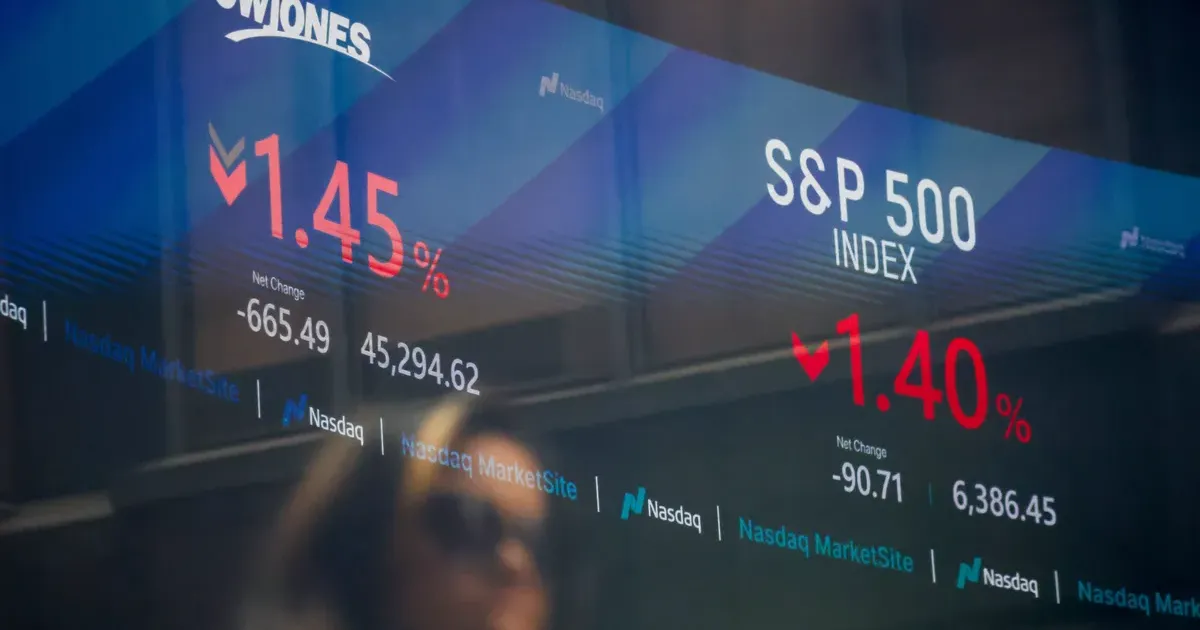
Wall Street's five-week slide has become more than a normal correction story. Mohamed A.Portfolio managers also have to separate fear selling from a durable repricing of risk. Risk desks were therefore watching both headlines and funding conditions. El-Erian warned on March 29, 2026, that traditional hedges were failing as the Iran conflict pressured equities, bonds and energy markets at the same time.
The key problem is correlation. Investors usually expect bonds to cushion portfolios when stocks fall. During this stretch, that relationship weakened, leaving diversified investors with fewer places to hide.
That is why the market mood turned so quickly. A 10 percent decline in the Dow and Nasdaq would be painful on its own; a simultaneous bond sell-off makes the damage feel broader and harder to manage.
Correction Territory Changes Behavior
A correction is usually defined as a drop of at least 10 percent from a recent peak. Once major indexes enter that zone, investors often shift from buying dips to protecting capital. That change can deepen selling because funds reduce exposure rather than add risk. The S&P 500 sitting near the same threshold adds pressure. If the broader benchmark follows the Dow and Nasdaq lower, the sell-off becomes a market-wide reset rather than a rotation out of one sector.
Coverage of the broader Wall Street slide points to the same fear: inflation, war risk and policy uncertainty are arriving together.
The 60/40 Portfolio Is Under Stress
The classic 60/40 portfolio depends on stocks and bonds behaving differently. When inflation expectations rise, interest-rate fears can push bond prices down at the same time that stock valuations compress. That is the environment investors fear now. El-Erian's warning matters because it is not simply about one bad week. It is about whether the old portfolio assumptions still work when geopolitical shocks raise both energy prices and policy uncertainty.
If bonds cannot absorb the shock, investors may move toward cash, commodities, defensive sectors or shorter-duration assets. Those moves can stabilize individual portfolios but create pressure elsewhere in markets.
Iran Risk Moves Through Oil
The Iran conflict is the transmission channel. Oil prices rise when traders fear disruption in the Persian Gulf, and higher energy costs can feed into transport, manufacturing and consumer prices. That raises the odds of sticky inflation at the exact moment investors want easier policy.
The related economic pressure from the Iran war and U.S. business costs makes the market story harder to isolate. Companies are not only facing lower valuations; they are also planning around higher input costs and weaker confidence. That can freeze hiring, delay capital spending and make earnings forecasts less reliable.
Policy Confidence Is the Missing Hedge
Barclays analysts described fading confidence in a so-called Trump put, the idea that the White House would act quickly enough to support markets. Whether that phrase is fair or not, investors clearly want proof that policy can reduce uncertainty rather than add to it.
The Federal Reserve also faces a narrower path if energy inflation remains elevated. Cutting rates into an oil shock could look reckless; staying tight while equities fall could deepen the slowdown. Markets dislike that kind of policy trap.
The editorial read is that Wall Street is not only selling because prices fell. It is selling because the usual stabilizers look weaker. Until energy risk, inflation expectations and policy credibility improve, rallies may struggle to become more than relief bounces. Portfolio managers also have to account for positioning. When many investors own the same defensive trades, those trades can stop behaving defensively once stress becomes broad. Selling in bonds can force risk-parity funds, pensions and leveraged strategies to reduce exposure at the same time equities are already falling.
That mechanical pressure can make markets look irrational. It is not only fear; it is also the need to meet risk limits, margin requirements and client redemptions. Once that process begins, good assets can be sold alongside weak ones because liquidity becomes the priority.
For individual investors, the lesson is not to abandon diversification. It is to understand that diversification can fail temporarily when inflation, war and policy uncertainty all point in the same direction. Cash, duration, energy exposure and credit quality matter more when the simple stock-bond split stops absorbing shocks. Credit conditions are the next place to watch. If companies face higher borrowing costs while revenues become less predictable, the market sell-off can move from valuation concern to balance-sheet concern. That transition is what investors fear most, because it can affect hiring, buybacks, mergers and debt refinancing at the same time.
There is also a psychological threshold. Five straight weeks of losses can change how investors interpret news. Strong data may be dismissed as a reason for tighter policy, while weak data may be treated as proof that earnings will fall. In that environment, markets need more than one favorable headline to stabilize. A clean rebound would need evidence that forced selling has slowed and that energy prices are no longer setting the tone for every asset class. Until then, volatility itself becomes part of the story because each rally is tested by the next oil headline, bond auction or policy comment. Investors are not only asking where prices should be; they are asking whether the market still has a reliable anchor. The next durable floor will likely come only when investors can see that the oil shock is contained, bond yields are stabilizing and policymakers are not improvising from headline to headline. That anchor is still missing. Investors need more than hope.