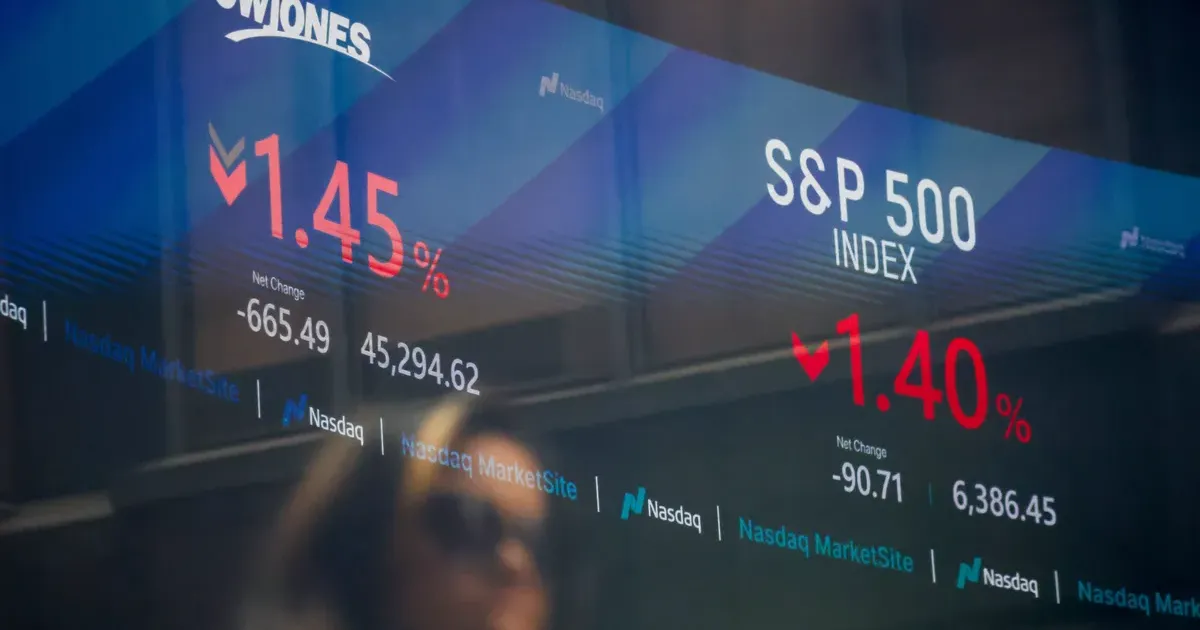
Wall Street's selloff was not only a decline in stock prices. It was a warning about portfolios that look diversified until inflation risk, war risk and policy uncertainty arrive together. The pressure was uncomfortable because stocks fell while bonds failed to provide the usual offset, and oil risk pushed inflation expectations back into the center of the trade.
That is why Mohamed El-Erian's warning about traditional hedges landed with force. The issue was not that diversification had become worthless. It was that the familiar stock-bond balance can stop protecting investors when the shock is inflationary rather than purely about growth.
The selloff became a portfolio test
A stock-market correction changes behavior once losses become too large to dismiss as noise. Risk desks tighten limits, funds raise cash and individual investors shift from asking what to buy to asking what they can still hold. This episode became more revealing because the bond market did not behave like a clean refuge.
If Treasury yields rise while equities fall, the balanced portfolio loses on both sides. That is the moment when the allocation chart becomes less comforting than the macro channel driving it. The investor is not facing two separate risks. The investor is facing one source of pressure showing up in several assets at once.
The 60/40 model needs the right conditions
The classic 60/40 portfolio works best when bonds can rally as stocks fall. That relationship is more dependable when growth fear is the main problem. It weakens when inflation fear is the main problem, because bonds then have their own reason to sell off.
An oil shock tied to the Persian Gulf can squeeze consumers, raise input costs and complicate central-bank decisions. Stocks dislike the margin and demand pressure. Bonds dislike the inflation pressure. The result is not the death of 60/40. It is a reminder that 60/40 is conditional.
Oil risk became rate risk
Energy shocks travel quickly through markets. A possible disruption in oil flows can become a fuel-price story, then an inflation-expectations story, then a bond-yield story. Once that chain starts, equity investors cannot treat crude as a side market.
Diplomatic headlines can still produce relief rallies, but they do not erase every cost already moving through companies and households. Hedging decisions, delayed investment, transport costs and central-bank caution can linger after the first oil spike fades.
The policy backstop looked less dependable
Part of the selloff was about confidence in rescue mechanisms. Investors had grown used to the idea that enough market stress would eventually produce a policy response. In this case, the backstop looked less clear.
The Federal Reserve could not easily cut rates if energy-driven inflation was still alive. The White House could not remove war risk with a statement. Diplomacy could calm markets for a session without proving that shipping routes, fuel prices and inflation expectations were repaired.
Hedges have to match the actual shock
The missing hedge was not a clever product name. It was credible stability. Investors needed evidence that energy flows were secure, inflation would not be reignited and policymakers understood the chain from oil to yields to earnings.
Gold, commodities, cash, inflation-linked bonds and active risk management can all play roles, but none of them is automatic protection. A hedge only works if it addresses the risk in front of the portfolio, not the last crisis investors remember.
Correlation needs humility
The serious point is that correlations are not permanent laws. They are market relationships shaped by the kind of shock investors are facing. When war risk lifts energy prices and energy prices lift yields, the old defensive map can fail for a period.
That does not make portfolio construction pointless. It makes it more demanding. Investors need to ask not only how many assets they own, but whether those assets are exposed to the same inflation, policy and geopolitical channel. Diversification by label is not enough when the stress is shared underneath.