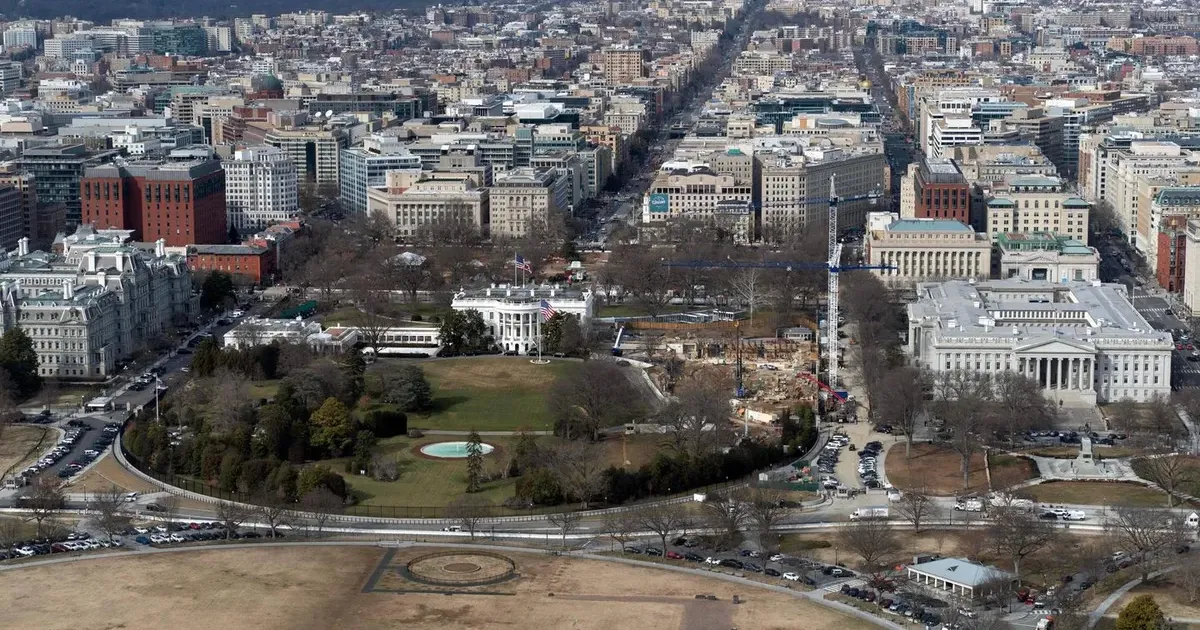
Security protocols at 1600 Pennsylvania Avenue are poised for a subterranean transformation. Plans recently surfaced indicating the Secret Service intends to construct a massive underground facility designed to screen tourists before they step onto the executive grounds. This proposal represents the latest expansion of a security perimeter that has grown more and more fortified over the last three decades.
Documents filed with federal regulators suggest the facility would sit beneath the North Lawn or adjacent Ellipse area. Public access to the White House has long been a logistical hurdle for law enforcement. Currently, thousands of visitors queue in outdoor tents or temporary structures where they are exposed to the elements and potential external threats. A permanent, hardened facility would centralize these operations in a controlled environment designed to withstand ballistic and explosive events.
Donald Trump has prioritized the overhaul of the 18 acre complex during his second term. Supporters of the move suggest the current arrangement is a relic of an era with lower threat profiles. Security experts argue that modernizing the entry point is the only way to ensure the safety of both the First Family and the public. Construction would likely require massive excavation in one of the most sensitive historical sites in the United States.
National Park Service Reviews Underground Excavation Plans
Administrative officials at the National Park Service are currently evaluating the environmental and historical impact of the project. Excavating deep into the soil of Lafayette Square and the surrounding area presents significant engineering challenges. The water table in this part of Washington is notoriously high because of the proximity to the reclaimed lands of the National Mall. Any leak or structural failure during construction could threaten the foundations of the White House itself.
Engineers must also contend with a labyrinth of existing utility lines and fiber optic cables that power the executive branch. Some of these conduits date back several decades and are not fully mapped in public records. The National Park Service requires a full archeological survey before any heavy machinery arrives on site. Historically, such digs in the capital have yielded artifacts from the 18th and 19th centuries that require preservation.
But the pressure to move forward is building as current temporary structures reach the end of their viable lifespan. Maintenance costs for the existing screening tents have climbed as officials struggle to keep climate control systems functioning in the humid D.C. summers. Permanent underground facilities would likely reduce long term operational costs despite the high initial price tag. Engineers estimate the subterranean structure would provide over 30,000 square feet of operational space.
Secret Service Seeks Permanent Buffer for Tourists
Security is no longer a matter of fences alone.
Personnel from the Secret Service insist that an underground buffer is the best way to manage the flow of 100,000 visitors who tour the building every month. By moving the screening process below ground, agents can utilize more advanced imaging technology without cluttering the aesthetic profile of the historic North Portico. The proposed center would include advanced biometric scanners and multi layered metal detection systems. These technologies require stable, vibration free environments that temporary tents cannot provide.
Critics of the plan worry about the symbolic nature of burying the entrance to the people's house. For two centuries, the White House was notable for its relative accessibility compared to European palaces. Modern security needs have slowly eroded this openness. The 1995 closure of Pennsylvania Avenue to vehicular traffic was the first major step in this direction. Adding a subterranean bunker for visitors would be the most significant physical change to the grounds since the Truman reconstruction of the 1940s.
The White House wants to build an underground center to provide security screening for visitors
Still, the logistical benefits for the agency are hard to ignore. A subterranean hub allows for a one way flow of traffic that minimizes contact between departing and arriving groups. It also provides a secure staging area for emergency evacuations if a threat is detected on the perimeter. The current setup requires visitors to be funneled through narrow gates that could become bottlenecks during a crisis. Agency planners have studied the 2008 completion of the Capitol Visitor Center as a primary reference point.
Architectural Challenges to Preserving Historic Vistas
Architects tasked with the design must ensure the underground facility remains invisible from the street. Preserving the iconic view of the White House from Lafayette Square is a mandate from the Commission of Fine Arts. This requires the entrance to the underground center to be integrated into existing topography or hidden behind new landscaping. Granite and reinforced concrete would form the primary shell of the structure. Designers are exploring ways to use skylights and light wells to prevent the space from feeling claustrophobic.
In fact, the geological profile of the site complicates these architectural ambitions. The Potomac Group clay that sits beneath the capital is prone to shifting under heavy loads. Specialized pilings will need to be driven deep into the foundation to ensure the new visitor center does not settle unevenly. This process is expected to create significant noise and vibration that will disrupt daily operations in the West Wing. Experts suggest the noise mitigation alone will cost millions of dollars.
Separately, the project must account for the intricate security sensors that already line the North Lawn. These seismic and infrared devices form a digital curtain that alerts the Secret Service to any unauthorized movement. Disabling these sensors during construction would create a vulnerability that the agency is unwilling to accept. To that end, contractors may be required to work in short shifts or during specific windows when the President is away from the residence. The timeline for completion is currently estimated at four years.
Federal Budget Allocations for Executive Branch Security
Estimates for the total cost of the project range from $200 million to $300 million depending on the final scope of the excavation. Funding would need to be approved by a Congress that is more and more scrutinized for its infrastructure spending. Proponents argue that the cost is justified by the increased safety of the executive mansion. Opponents point to the soaring costs of previous federal underground projects like the CVC as a reason for skepticism. That project eventually cost more than double its original budget.
The physical manifestation of executive isolation has arrived.
Budgetary documents indicate that a portion of the funding could be diverted from existing maintenance accounts within the Treasury Department. By contrast, some lawmakers want the project to be a standalone line item to ensure better oversight. The Secret Service has not yet provided a public breakdown of the technology costs versus the construction costs. Most of the technical specifications for the screening equipment remain classified for national security reasons. The permit remains under review by federal conservationists.
The Elite Tribune Perspective
Does a democracy truly thrive behind layers of blast-proof concrete and subterranean turnstiles? The proposal to bury the entrance to the White House is a cynical admission that the executive branch has finally abandoned the pretense of being accessible to the public. While security experts drone on about threat vectors and mitigation strategies, they ignore the profound psychological damage done when the most famous house in the world becomes a bunker. We are building a fortress not for the people, but to insulate a political class that fears the very citizens it claims to lead.
History shows that when leaders retreat into underground complexes, the distance between the governed and the governors becomes an unbridgeable chasm. The project is not about safety, it is about control and the permanent enshrining of the security state into the very soil of our capital. If the White House is too dangerous to enter through the front door, perhaps the problem is not the door, but the policies that have made the world so hostile. We should be skeptical of any plan that prioritizes the comfort of the Secret Service over the symbolic integrity of our national monuments.
A bunker is not a home, and it certainly is not a house of the people.