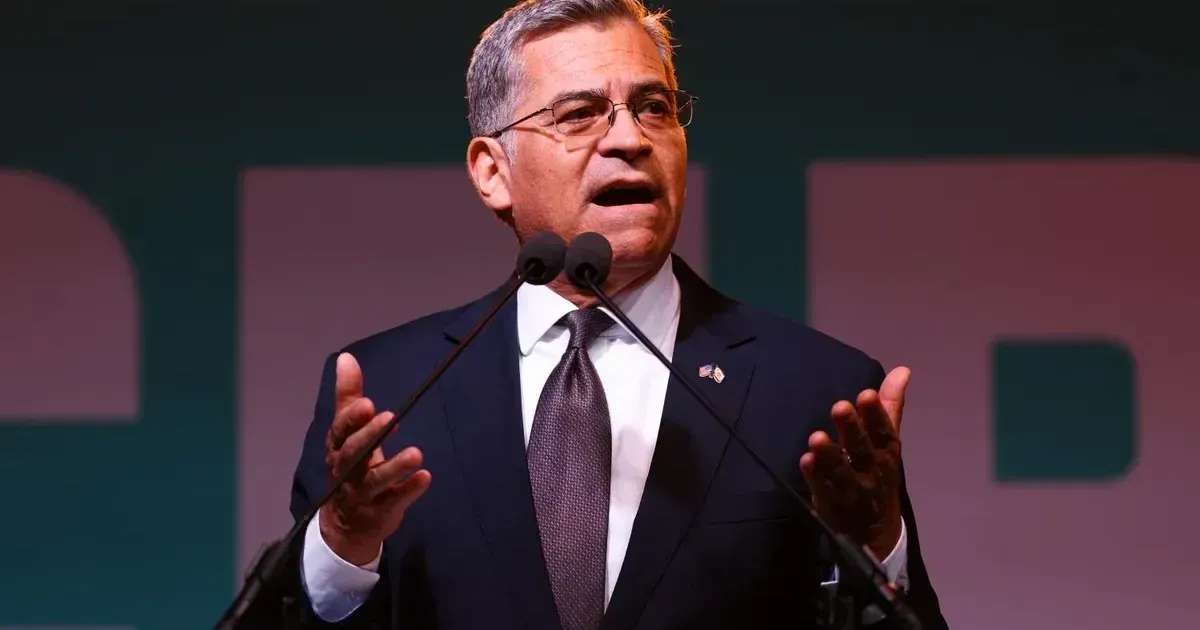
Xavier Becerra secured a commanding lead in California's gubernatorial primary, ensuring his place on the ballot for the November general election. The primary result gives California Democrats a clearer race while preserving questions about turnout and regional strength. Early returns showed the former federal official outstripping a crowded field of challengers. The Associated Press called the race on June 6, 2026, after Becerra consolidated Democratic support and moved clear of a fragmented pack of rivals.
Returns verified by election officials confirmed that Becerra garnered 26.7 percent of the vote with approximately 67 percent of total ballots processed. This performance places him at the top of the field, though his specific opponent for the autumn runoff is not yet determined. Millions of ballots across the state are still being tabulated, leaving the second-place position in a state of statistical flux.
Democratic voters appeared to rally behind Becerra's experience in both state and federal administration. His background as California's Attorney General and his tenure in President Biden's cabinet provided a platform that connected with a base seeking institutional stability. Competition within the primary was described by local observers as bitter, characterized by sharp disagreements over housing policy and public safety.
California Top-Two Primary and Runoff Dynamics
California utilizes a nonpartisan top-two primary system where the highest-polling candidates advance regardless of party affiliation. Because the vote was split among several high-profile contenders, no single candidate was expected to secure an outright majority. Becerra's advancement was anticipated by many pollsters, but the narrow margins separating the remaining candidates have delayed a full projection for the November matchup.
Election data indicates that while Becerra held a comfortable margin, the battle for the second position involves a tight cluster of Republican and Democratic hopefuls. If two Democrats emerge as the top finishers, the state could face its third intra-party gubernatorial runoff since the primary system was overhauled. Such a result would highlight the continued dominance of the Democratic Party in statewide contests, even as internal factions debate the future of the state's economic trajectory.
Officials in high-population centers like Los Angeles and San Francisco are still verifying mail-in ballots that could shift the current rankings. Progress in these counties is often slower due to rigorous signature verification requirements and the sheer volume of late-arriving envelopes. This delay prevents a clear understanding of whether a Republican challenger will make the final ballot or if the general election will be a contest between two progressives. Becerra's success was a key development in the wider California primary held across the state.
Becerra and the Path to the Governor's Office
Becerra is now positioned to potentially become the first elected Latino governor in the history of California. While the state has seen Latino governors in its early history, none have been elected to the post in the modern era of the office. His candidacy is viewed by political strategists as a meaningful moment for representation in a state where Latinos make up the largest ethnic group.
Leadership in the state legislature and various labor organizations provided early endorsements that helped stabilize Becerra's campaign during the primary's most volatile weeks. His messaging focused on expanding healthcare access and leveraging federal partnerships to address climate goals. These priorities align with the legislative record he established during his time in Washington, where he oversaw the implementation of major public health initiatives.
Opposition groups, by contrast, have criticized his record on regulatory enforcement and state-level spending. During his tenure as Attorney General, he filed dozens of lawsuits against the federal government, a history that his rivals used to paint him as a partisan figure. These arguments failed to prevent his advancement, but they are likely to resurface during the general election campaign once a definitive opponent is identified.
NPR News reported that Becerra's November challenger remains unknown because millions of ballots still need to be counted under the state's current primary timetable.
Voters in rural districts showed less enthusiasm for Becerra compared to his performance in urban corridors. The geographic divide reflects a persistent challenge for Democratic candidates who must balance the needs of coastal metropolitan areas with the agricultural and industrial concerns of the Central Valley. Whether Becerra can bridge this gap in the coming months will be a central theme of his runoff strategy.
Becerra Faces a Defining Runoff Choice
Can a single candidate truly represent the divergent interests of the world’s fifth-largest economy? Becerra’s victory in the primary suggests that a plurality of voters is currently prioritizing administrative experience and federal-state alignment over ideological purity. His success is a rejection of more radical outsiders who promised to dismantle the existing bureaucratic structures in Sacramento. By consolidating the Democratic base so early, he has forced potential rivals into a defensive posture that may drain their resources before the general election cycle even begins in earnest. The Republican Party faces a different crisis.
If no conservative reaches the runoff, the party risks further irrelevance in statewide policy discussions for the next four years. The outcome would leave a major portion of the electorate without a direct ideological representative on the November ballot. A two-Democrat runoff would transform the general election into a referendum on the specific brand of progressivism California chooses to export to the national stage. Becerra must now decide if he will tack toward the center to capture disaffected Republicans or double down on the policies that secured his primary win.
His choice will define the legislative landscape of the West Coast for the foreseeable future.