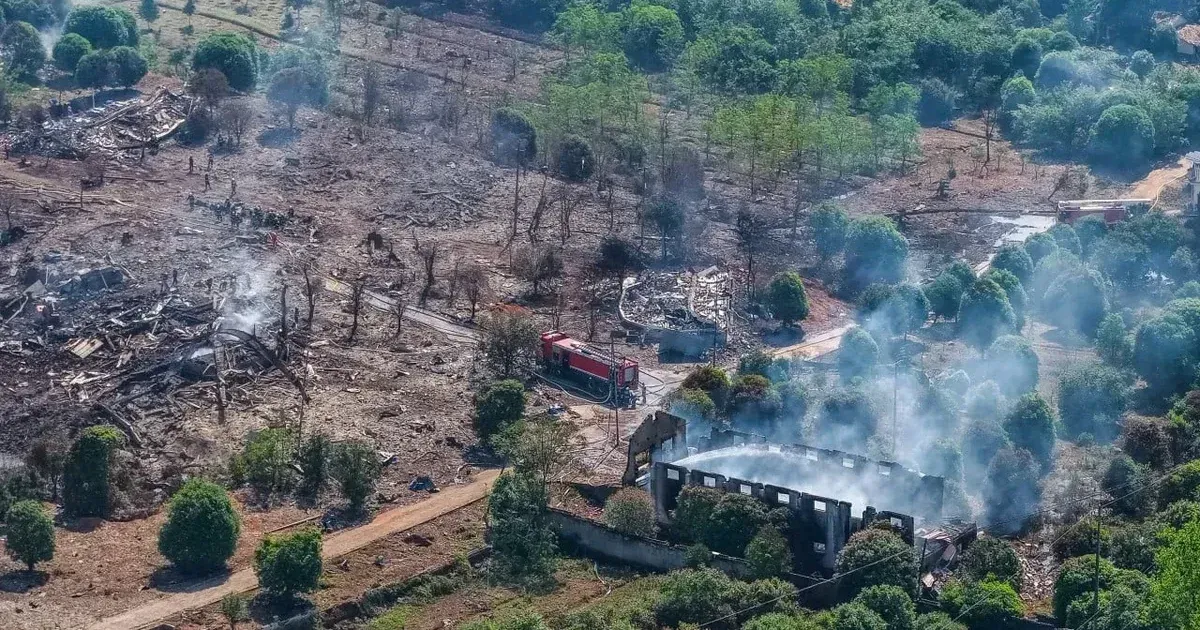
The Hunan blast has become a national safety test for China's fireworks industry. Liuyang is closely associated with pyrotechnics, which makes the death toll politically and economically sensitive. Xi Jinping's order signals that local officials will face scrutiny beyond the immediate emergency. A fireworks factory blast in central China has killed at least 21 people and injured dozens more, turning one of the country's best-known pyrotechnics hubs into the scene of a major industrial disaster. On May 5, 2026, state media said the explosion happened the previous afternoon at a plant in Liuyang, a county-level city under Changsha in Hunan province.
The blast occurred at Liuyang Huasheng Fireworks Manufacturing and Display Co., according to Chinese state media reports cited by AP and Reuters. Officials said 61 people were injured. President Xi Jinping ordered an investigation into the cause and called for rescue work, medical treatment and accountability for safety failures.
The official response is significant because fireworks factories operate under a safety regime where small lapses can produce catastrophic results. Pyrotechnic production depends on strict control of explosive powders, ignition sources, storage density and worker movement inside assembly areas. Investigators will need to determine whether the blast followed a single failure or a chain of violations.
Liuyang's local economy is deeply tied to fireworks, but that economic role also concentrates risk. A large plant accident can affect workers, nearby communities, suppliers and export contracts at the same time. That is why Beijing's order for a probe is more than administrative; it is a signal to local officials that the disaster will be judged as a governance failure if safety rules were ignored.
Liuyang is closely associated with China's fireworks industry, making the accident both a human tragedy and a warning for a sector built around combustible materials, seasonal demand and dense production networks. Authorities had not announced a final cause by the time of the first reports.
What Officials Have Confirmed
The explosion was reported around 4:40 p.m. Monday at the fireworks facility. Emergency crews moved into the site after the blast, while local authorities coordinated medical care for the wounded. State media said Xi demanded a thorough probe and urged officials to prevent similar accidents.
The official casualty count stood at 21 dead and 61 injured in the first public reports. That number may still change as hospitals update conditions and investigators complete their work at the site. For now, the confirmed facts are the location, the casualty toll, the company name and the national order for an investigation.
Fireworks production carries obvious risk because manufacturing depends on storing, mixing and handling explosive compounds. Even a local failure in storage, ventilation, static control or workflow can become a mass-casualty incident. That is why the investigation will likely focus on whether the plant followed rules for production volume, chemical handling and worker protection.
State media reports did not identify the workers who died, and officials had not released a detailed injury breakdown in the first accounts. That restraint matters. The early facts support the death and injury toll, the company name, the location and Xi's order for a probe; they do not yet support a final claim about the precise technical cause.
The unanswered cause is not a small detail in a fireworks case. Investigators must look at the sequencing of work inside the workshop, how explosive materials were stored, whether ignition controls were followed and whether managers allowed too many people or too much material into one production area. Those findings will determine whether the disaster is treated as an isolated operational failure or evidence of a broader safety breakdown.
The injury toll also means the investigation cannot be limited to machinery. Worker training, evacuation routes, emergency alarms and medical response times will all shape the final assessment. In a sector where seconds can decide survival, safety policy is only meaningful if workers understand it and managers enforce it before production pressure builds.
Industrial Safety Questions
China has repeatedly tightened oversight of high-risk industries after fatal industrial accidents, but enforcement can vary widely between regions and companies. The Liuyang blast will test whether national directives translate into specific penalties, shutdowns or safety changes at the plant level.
The immediate priority is rescue and treatment. The longer policy question is whether local officials allowed production pressure to outrun safety controls in a city whose economy is deeply tied to fireworks. Xi's order signals that Beijing wants a formal explanation, more than a local accident report.
Beijing’s Response Will Test Fireworks Safety Enforcement
The disaster exposes the central tradeoff in Liuyang's fireworks economy. The industry brings jobs, exports and cultural prestige, but it operates with a narrow margin for error. When a plant fails, the consequences are not abstract regulatory violations; they are dead workers, injured families and a national investigation.
Beijing's response will matter beyond one factory. If the probe produces only symbolic discipline, the risk cycle continues. If it forces real inspections and tighter controls on explosive materials, the cost of production may rise, but the industry will have a better chance of avoiding the next mass-casualty blast.