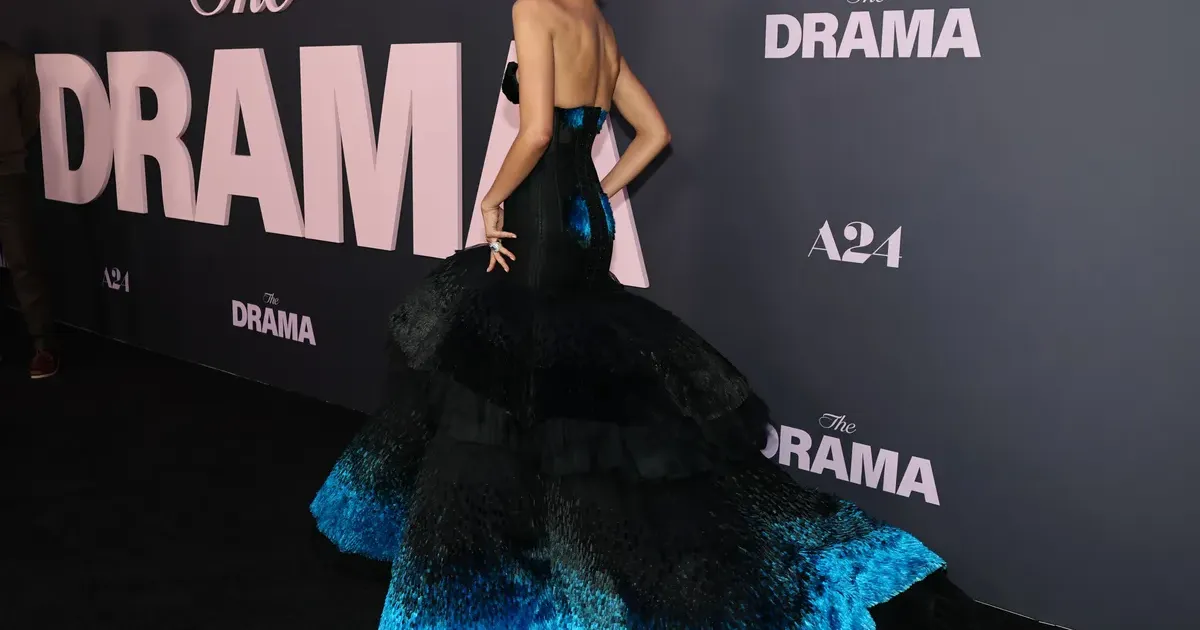
Zendaya's blue Schiaparelli couture gown for The Drama premiere worked because it made labor visible. The house described a molded bustier gown in black crin, embroidered with a radial effect of 65,000 kingfisher blue and black raw silk feathers in satin stitch across 27 shades of blue. Schiaparelli also said the look required roughly 8,000 hours of work.
The construction details are not fashion trivia. They are the difference between a celebrity wearing a color and a couture house demonstrating technique. The gown's value came from construction, surface, color discipline and the way Law Roach folded the look into Zendaya's larger press-tour identity.
Schiaparelli sold the work
Daniel Roseberry's Schiaparelli is built for surrealism, body architecture and controlled spectacle. A molded bustier covered in feather-like silk embroidery fits that language because it reads instantly in photographs while depending on labor most viewers will never see up close.
The dress was not simply blue. Its surface shifted through kingfisher tones and black depth, giving photographers a dramatic image and giving the house a visual signature that could travel across social feeds. Couture has always depended on craft. The modern red carpet asks that craft to read in one image.
Law Roach built continuity
Zendaya's red-carpet strength comes from consistency. Roach does not style isolated outfits; he builds chapters. Each appearance has to connect to the project, the star's image and the fashion history being referenced. The Schiaparelli look worked because it was clear from a distance and rewarding in detail.
Modern celebrity fashion requires both immediate impact and detail. The first image has to travel instantly, while the second and third image have to reward people who zoom in. A premiere outfit becomes a fashion story when styling, garment and public timing all point in the same direction.
Couture became search demand
A couture appearance now has to function in several markets at once. It has to satisfy fashion insiders, give photographers a clean image, travel across platforms and create search demand for the house behind it. The commercial demands do not make the craft less serious; they place it inside of a media system where one image can carry more commercial value than a traditional campaign.
For Schiaparelli, the payoff was not mass sales of the gown. It was attention to the house's codes: surreal construction, body-conscious shape, ornament and theatrical control. A couture piece becomes valuable when the public can remember the idea even if only a handful of clients could ever buy the object.
Precision protects fashion writing
The look also demonstrates the value of precise fashion language. Calling the dress a blue ballgown flattens the object. Naming the molded bustier, black crin, radial embroidery, raw silk feathers and layered tulle helps readers understand why the image carried force.
Fashion coverage loses authority when it treats couture as celebrity decoration. The garment is part of the news because it shows labor, brand direction and styling strategy. Zendaya's visibility made the look famous. Schiaparelli's construction gave it something to stand on after the first scroll.
Spectacle needed substance
Celebrity couture can become empty theater if the garment has no construction behind it. This look avoided empty theater because its spectacle rested on technical work. The dress did not win attention only because it was blue. It won attention because the blue carried discipline, time and a clear eye.
Luxury houses should read the signal clearly. Viral visibility lasts longer when the object can withstand scrutiny. Zendaya and Roach gave Schiaparelli the stage. The gown gave the stage a reason to matter.