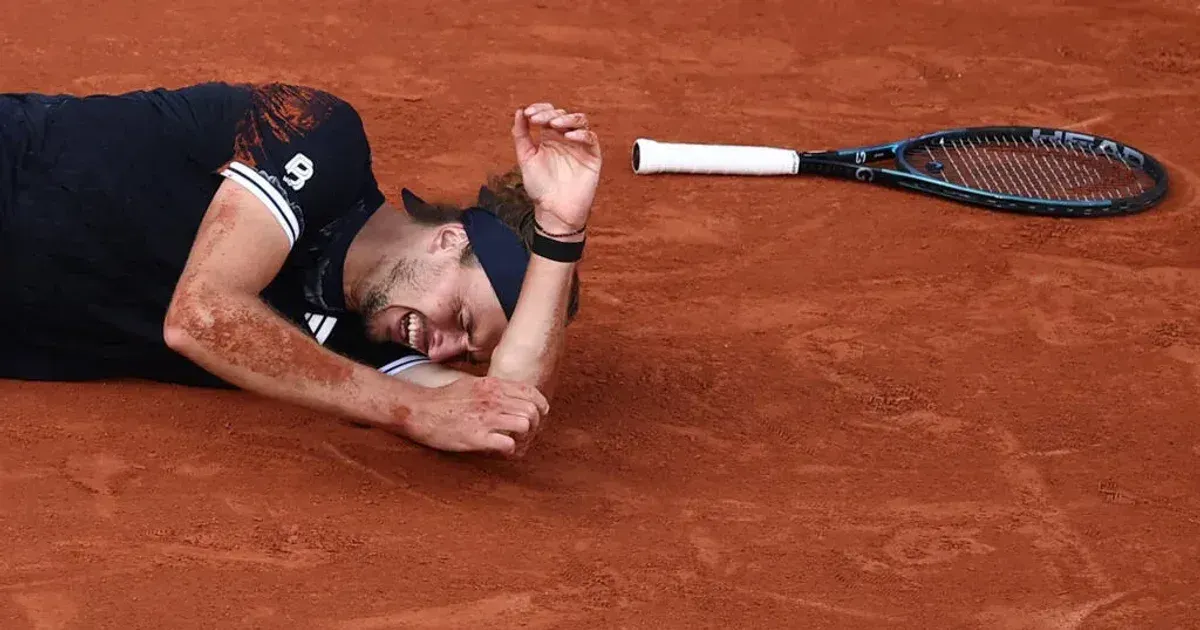
Alexander Zverev captured his first Grand Slam championship on the clay courts of Paris, ending a decade of pursuit on the professional circuit. The title gives Zverev the major trophy that had long separated his ranking from his legacy. He overcame Italy's Flavio Cobolli in a dramatic five-set encounter that tested the physical limits of both athletes for over four hours. The victory, secured on June 7, 2026, establishes Zverev as the first German male player to hoist a major trophy in three decades. Spectators at Court Philippe-Chatrier watched as the world number four recovered from a fourth-set tie-break loss to dominate the deciding frame.
Opening play with aggressive baseline strikes, Zverev took the first set 6-1 in less than thirty minutes. His serve functioned at high velocity, preventing Cobolli from establishing any rhythm in the early exchanges. Cobolli, appearing in his first major final, struggled with the scale of the occasion before finding his range in the second set. The Italian used drop shots and heavy topspin to pull Zverev out of his comfort zone, eventually leveling the match with a 6-4 scoreline. This tactical shift forced Zverev to adjust his positioning deeper behind the baseline.
Dramatic Five-Set Victory Over Flavio Cobolli
Momentum shifted frequently as the match progressed into the third hour. Zverev regained control in the third set by focusing on his backhand down the line, a shot that has defined his career since he joined the ATP Tour. He closed out that set 6-4, but Cobolli refused to concede the championship. The fourth set became a marathon of endurance, with neither player able to break serve consistently. When the set entered a tie-break, Cobolli displayed striking composure, winning it 7-5 to force a fifth and final set.
Fatigue appeared to favor the more experienced German as the fifth set began. Zverev broke Cobolli’s serve in the second game and never looked back, using his superior physical conditioning to cover the court. The final set score of 6-1 reflected a total collapse in Cobolli's resistance. Statistics from the match showed Zverev hit 52 winners compared to 38 unforced errors, a ratio that ultimately decided the outcome.
Zverev triumphed in the fifth set to secure his maiden Grand Slam title after three previous failures in major finals. The official match report noted that the final score stood at 6-1, 4-6, 6-4, 6-7 (5), 6-1.
“Alexander Zverev is the 2026 Roland Garros champion,” the tournament announcer declared to the cheering crowd as the German player collapsed onto the red clay.
Ending the Thirty-Year German Grand Slam Drought
Success in Paris carries immense weight for German sports history. No man from Germany had won a Grand Slam singles title since Boris Becker secured the Australian Open in 1996. While players like Tommy Haas and Rainer Schüttler reached finals in the intervening years, the top prize stayed out of reach for two generations of German athletes. Zverev carried the expectations of his nation into four different major finals before finally breaking the streak at Roland Garros. His victory provides a major boost to the German Tennis Federation during a period of declining youth participation.
Records indicate that Zverev entered the tournament as one of the favorites, despite lingering questions about his ability to win five-set matches against younger opponents. Cobolli represented a new wave of Italian tennis talent that has surged in the rankings over the last twenty-four months. By defeating the rising star, Zverev proved that his defensive capabilities are still elite. The match was the longest French Open final since the 2004 edition, highlighting the grueling nature of modern clay-court tennis.
Pressure on Zverev had mounted sharply since his loss in the 2020 US Open final, where he was two points away from victory. That memory often shadowed his subsequent performances in high-stakes matches. Winning in Paris silences critics who argued his window for a major title was closing. He now joins an exclusive club of active players with a Grand Slam trophy in their cabinet.
Resilience and Tactical Dominance in the Fifth Set
Preparation played an essential role in Zverev's ability to maintain his level during the fifth set. His coaching team emphasized high-altitude training and specific endurance drills in the months leading up to the 2026 season. These investments paid dividends as Cobolli began to struggle with leg cramps during the final ninety minutes of play. Zverev recognized the physical decline and deliberately extended rallies to exhaust his opponent. He won 85% of his first-serve points in the final set, a figure that made a comeback impossible for the Italian.
Conditions in Paris were unseasonably warm, with temperatures reaching 88 degrees Fahrenheit during the heat of the afternoon. The dry air made the clay courts faster than usual, aiding Zverev's powerful flat groundstrokes. Cobolli tried to counter this by using more slice, but the tactic failed to penetrate Zverev's reach. Once the final point was won, Zverev embraced his opponent at the net in a show of sportsmanship that the French crowd appreciated with a standing ovation.
Zverev became a Grand Slam champion on his fourth attempt. This victory ensures his qualification for the year-end finals and moves him closer to the world number one ranking. The German flag rose over the stadium as the national anthem played for the first time in thirty years at a men's major trophy ceremony.
Zverev's First Major Reshapes His Career
Securing a first major title changes the trajectory of an athlete's career profile. For Alexander Zverev, this victory is a validation of a professional journey that began with immense hype but was often interrupted by injury and high-profile losses. He has navigated the transition from a talented prospect to a veteran champion, finally shaking off the burden of being the most successful active player without a Grand Slam title. His success also signals that the veteran guard of the ATP can still hold off the surging younger generation in the most physically demanding environments.
European tennis continues to dominate the global stage, with Italy and Germany producing the most consistent finalists in recent years. Cobolli's run to the final proves that the Italian system is capable of developing players who can compete on all surfaces, not just clay. However, the experience of Zverev was the deciding factor in the fifth set. The result will likely inspire a new wave of investment in German tennis academies as the country seeks to capitalize on Zverev's newfound status as a national icon. The 2026 season now pivots toward the grass courts of Wimbledon, where Zverev will arrive as a major champion for the first time in his career.