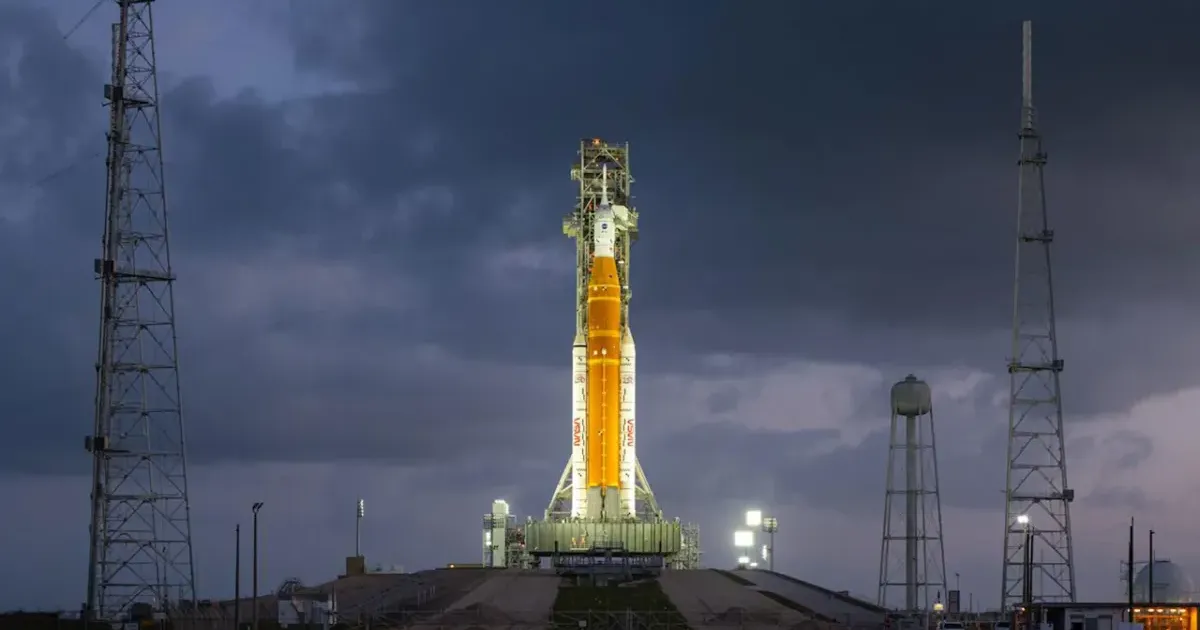
NASA mission controllers confirmed on April 2, 2026, that the Artemis II crew successfully cleared their initial orbital checks. Commander Reid Wiseman, Pilot Victor Glover, and Mission Specialists Christina Koch and Jeremy Hansen are now traveling toward the moon in a trajectory that marks the first human lunar venture since 1972. Their Orion spacecraft took off from Kennedy Space Center in Florida on April 1, carrying the expectations of a space agency that has spent decades justifying its return to deep space. Engineers at the Johnson Space Center in Houston report that all life support systems are operating within nominal parameters. Telemetry data shows the craft is currently maintaining a stable velocity as it leaves Earth's immediate gravitational pull.

Artemis II Technical Hurdles and Heat Shield Redesign

Returning to the moon proved far more difficult than the simple passage of time might suggest to a casual observer. Visitors at the National Air and Space Museum frequently ask why modern computing power, which dwarfs the technology of the Apollo era, has not made lunar travel a routine occurrence. While a modern smartphone possesses millions of times more processing power than the Apollo Guidance Computer, space flight requires hardware that can survive extreme radiation and temperature fluctuations. Complexities in modern engineering often introduce new vulnerabilities that require years of testing to resolve. Every component must undergo rigorous certification processes that did not exist during the 1960s space race.

Safety concerns regarding the Orion heat shield forced several delays in the launch schedule during the development phase. Observations from the uncrewed Artemis I mission revealed unexpected chipping of the protective material during atmospheric reentry. NASA engineers spent years researching the carbon-phenolic material behavior to ensure the safety of the four astronauts. This technical challenge required a meaningful alteration to the planned reentry angle for the current mission. Managers at NASA decided that the risk to the crew was unacceptable without a complete understanding of why the shield degraded. Failure to address such details could result in a catastrophic loss of life during the final minutes of the flight.

Technical debt from other programs also influenced the timeline for this mission. Issues with the Boeing Starliner thrusters led the agency to return that spacecraft from the International Space Station without a crew last year. Such incidents highlight the persistent difficulty of making space flight reliable and predictable for human occupants. Reliability remains a difficult metric to achieve when every mission involves thousands of custom-made parts that must work in perfect synchronization. Small defects in thruster valves or software code can derail billion-dollar programs. The agency now operates under a safety culture that prioritizes data over speed.

Financial Realities of NASA Lunar Ambitions

Political shifts across multiple presidential administrations have often redirected the focus of the American space program. Maintaining the necessary funding for a multi-decade project requires consistent support from Congress and the executive branch. Historians of human spaceflight note that the Apollo program benefited from a unique Cold War context that prioritized speed over long-term sustainability. By contrast, the Artemis program must compete for budget allocations against a backdrop of domestic economic pressures and shifting national priorities. Funding levels for the Space Launch System and Orion have fluctuated as different political parties took control of the legislative agenda. These cycles often result in stop-and-start development that adds years to the final delivery date.

Financial oversight committees in Washington have repeatedly questioned the rising costs associated with the lunar return. NASA just launched its first crewed flight to the moon since the Apollo era, yet the total price tag for the Artemis program is projected to exceed $93 billion through 2025. Taxpayers often compare these costs to the perceived benefits of deep space exploration. Agency officials argue that the technological spin-offs and national prestige outweigh the immediate fiscal burden. However, the requirement to sustain this political will over several decades is a logistical hurdle that the Apollo engineers rarely faced in their shorter timeframe. Every fiscal year brings new scrutiny to the necessity of sending humans rather than robots to the lunar surface.

“Houston, we’ve had a problem here.”, Jack Swigert, Command Module Pilot of Apollo 13

Public engagement efforts aim to convince the American public that these expenditures hold long-term value for the nation. Some analysts point to the involvement of the Canadian Space Agency as a sign of growing international cooperation in space. Including Jeremy Hansen on the crew helped secure essential technical contributions and funding from the Canadian government. International partnerships provide a level of political stability that domestic funding alone cannot always guarantee. This mission is part of a broader strategy to establish a permanent human presence on and around the moon. Success here is required before the agency can realistically plan for the Artemis IV landing mission.

Survival Suit Engineering for the Orion Crew

Astronaut safety during the 10-day mission depends heavily on the Orion Crew Survival System suits. These orange garments are not just flight suits; they are engineered to function as a lifeboat in the event of cabin depressurization. If the Orion hull is breached, the suits can sustain the crew for up to six days while they attempt an emergency return to Earth. Engineers designed these systems to provide oxygen, pressure, and thermal regulation in the vacuum of space. The suit includes advanced communication systems and biometric sensors to monitor the health of the crew in real-time. Such precautions are essential because the Artemis II mission does not carry a lunar lander to serve as a backup habitat.

Apollo 13 demonstrated the necessity of having a secondary survival environment when a spacecraft suffers damage. When an oxygen tank explosion crippled the Apollo command module, the astronauts used the lunar lander as a makeshift lifeboat for the trip home. Artemis II lacks this redundancy because it is a flyby mission intended only to test the Orion spacecraft and its integration with the crew. Engineers at the Kennedy Space Center focused on making the OCSS suits as resilient as possible to compensate for this lack of a secondary vehicle.

Every suit is custom-tailored to the specific dimensions of the individual astronaut to ensure maximum mobility and seal integrity. A single puncture in the suit material could compromise the entire safety protocol for the mission specialist.

Testing these suits involved thousands of hours in vacuum chambers and underwater simulation tanks. Commander Reid Wiseman participated in multiple pressure tests to verify that the OCSS could maintain life support during the high-stress phases of launch and reentry. The suit design incorporates a simplified donning process that allows astronauts to seal themselves inside in less than two minutes. Reliability in these life-critical systems is the primary goal of the mission development team. Any mishap during the lunar flyby would leave the crew entirely dependent on these suits for survival. The weight of this responsibility is evident in the exhaustive pre-flight certification records.

Comparison of Apollo and Artemis Mission Architectures

Modern mission planners have adopted a sharply different architectural approach than their predecessors in the 1960s. Apollo missions used a single huge rocket to send the command module and the lander to the moon in one shot. The Artemis program relies on a distributed architecture that involves the Space Launch System and eventually the Gateway station in lunar orbit. This strategy allows for more modularity and the potential for long-term expansion. Future missions will use different launch vehicles to deliver supplies and habitats before the crew arrives. Such a method increases the complexity of the logistics but lowers the risk of a single launch failure ending the entire program. Each launch is a specific step toward a more permanent infrastructure.

Propulsion systems have also evolved to include more efficient fuels and computerized engine monitoring. While the Saturn V remains the most powerful rocket ever successfully flown, the SLS provides greater precision in its orbital insertion. NASA flight controllers can now adjust the trajectory with much smaller margins of error than was possible fifty years ago. The precision is necessary for the free-return trajectory that Artemis II will follow. If the main engines fail after the lunar flyby, the gravity of the moon will naturally pull the craft back toward Earth for a splashdown in the Pacific Ocean.

Passive safety features like these are integrated into the core flight plan. The crew is currently monitoring these systems as they approach the halfway point of their journey.

Navigating the transition from Earth orbit to lunar space involves eight key mission milestones. These include the initial launch, the translunar injection burn, the lunar flyby, and the eventual atmospheric reentry. Each phase requires specific maneuvers that test the limits of the Orion navigation software. Ground crews in Houston are currently tracking the spacecraft with an array of deep space antennas located around the globe. Continuous communication is essential for real-time problem-solving if a system deviates from its expected performance. The mission timeline is structured to provide maximum data collection for the subsequent landing missions. Every hour of flight provides information that cannot be gathered through simulations on the ground.

The Elite Tribune Strategic Analysis

Is Artemis II a mission of discovery or a museum exhibit funded by a desperate bureaucracy? We must ask why the United States is spending nearly $100 billion to repeat a feat accomplished by men in 1969 using slide rules and sheer grit. The current pace of NASA development suggests an agency that is terrified of its own shadow, paralyzed by a safety culture that arguably prevents the very progress it seeks to achieve.

The picture emerging is a government-run program struggles to match the agility of private competitors who are already eyeing Mars while NASA celebrates a simple loop around the moon. The technical setbacks regarding the heat shield and the Boeing Starliner reveal a systemic rot in the traditional aerospace industrial complex. It is a slow, expensive, and risk-averse machine that prioritized job preservation in congressional districts over the rapid colonization of the lunar surface.

The mission is essentially a high-stakes public relations campaign designed to maintain the flow of taxpayer dollars. If the agency fails to land a human on the moon by 2028, the entire program will likely be cannibalized by private entities that can do the work for a fraction of the cost. The OCSS suits are engineering marvels, but they are also symbols of an architecture that lacks the redundancy of the Apollo era. We have traded the lunar lander for a fancy jumpsuit and called it progress. NASA must decide if it wants to be a pioneer or a government contractor that specializes in expensive nostalgia. The era of the bureaucratic space monopoly is over.