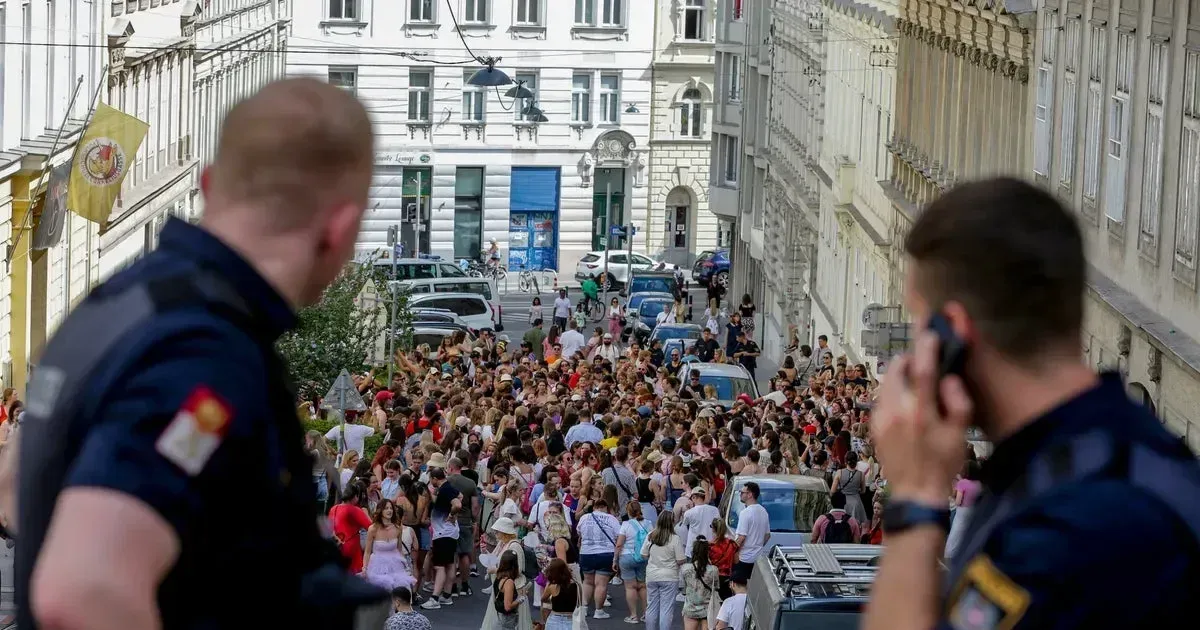
Beran A entered a high-security courtroom in Vienna to answer charges involving a foiled attack plot that prosecutors say targeted thousands of music fans. Proceedings opened on April 28, 2026, marking the legal culmination of an investigation that began when Taylor Swift canceled three sold-out shows in the Austrian capital nearly two years ago.
Judicial officials allege the 21-year-old defendant intended to use explosives and knives to maximize casualties outside the Ernst Happel Stadium. Prosecutors presented evidence showing Beran A had fully radicalized online before swearing an oath of loyalty to the Islamic State. Evidence from digital devices indicates the suspect sought to kill a large number of people to mirror previous jihadist attacks in Europe. He reportedly quit his job in the weeks before the planned event, telling colleagues he had big plans. Police arrested the suspect in Ternitz in August 2024, leading to the immediate discovery of chemical substances and technical equipment.
Prosecution Details Islamic State Training and Explosives
Prosecutors contend the defendant received specialized instruction from active members of the Islamic State regarding the assembly of viable explosive devices. Court documents suggest this training took place via encrypted communication channels where senior militants provided step-by-step guidance on handling volatile precursors. Analysts for the state found that the 21-year-old had successfully synthesized TATP, a highly unstable explosive frequently used in coordinated terror attacks. The defendant reportedly focused his efforts on the stadium perimeter where fans without tickets usually gathered by the thousands. His digital footprint revealed searches for stadium layouts and peak crowd densities during specific tour segments.
Prosecutors said evidence submitted to the court showed that Beran A received explosives training from members of the Islamic State.
Security services in Austria collaborated with international intelligence agencies to monitor the suspect's communications before his apprehension. This cooperation allowed the Directorate of State Security and Intelligence to intervene before the chemicals could be moved to the capital city. Investigators recovered a machete and knives alongside the chemical components during the raid on his residence. While the defense argues the plot was a teenage fantasy rather than a functional plan, the presence of weaponized chemicals remains a central foundation of the state's case. Records show the defendant had already recorded a martyrdom video intended for release after the attack.
Impact on European Security and Mass Events
Vienna police implemented multi-layered security cordons around the courthouse to prevent disruptions during the opening testimony. The trial has revived discussions regarding the safety of open-air venues and the difficulty of protecting crowds outside official security perimeters. Since the 2024 plot, Austrian authorities have increased their surveillance of online extremist hubs to identify similar patterns of rapid radicalization among young adults. National security laws were subsequently updated to grant agencies broader access to encrypted messaging platforms when a clear threat to life is established. Public interest in the case persists due to the global profile of the intended target and the scale of the potential tragedy.
The defense team maintains that their client was a vulnerable individual manipulated by sophisticated online actors. They argue the explosive materials were insufficient to cause the widespread devastation described by the prosecution. However, forensic experts for the government are expected to testify that even a small amount of the recovered TATP could have triggered a fatal stampede in the packed fan zone. Swift performed elsewhere in Europe after the Vienna cancellations, but the events of 2024 changed how major tour organizers coordinate with local law enforcement. A verdict is expected later this year after the court hears from dozens of witnesses and forensic analysts.
Security at the stadium was sharply heightened during subsequent concerts held in the region. The proceedings are set to continue May 12 with further examination of the defendant's radicalization timeline.
European Security Risks
Mass gatherings represent a permanent vulnerability for European security services tasked with monitoring decentralized radicalization. The Beran A case illustrates how the intersection of global celebrity culture and extremist intent creates high-value targets that require more than traditional perimeter policing. Intelligence agencies now face the challenge of "lone actor" threats who receive remote technical training without ever visiting a conflict zone. This shift in tradecraft makes the detection of explosive precursors more critical than tracking physical travel to foreign battlefields.
If the court establishes that digital training alone suffices for a conviction of this magnitude, it will set a precedent for how the EU handles online radicalization cases. Future event security must likely incorporate broader exclusion zones and sophisticated signal intelligence to reduce these evolving threats. Protecting the fan experience has become more than a logistical task but a counter-terrorism priority.