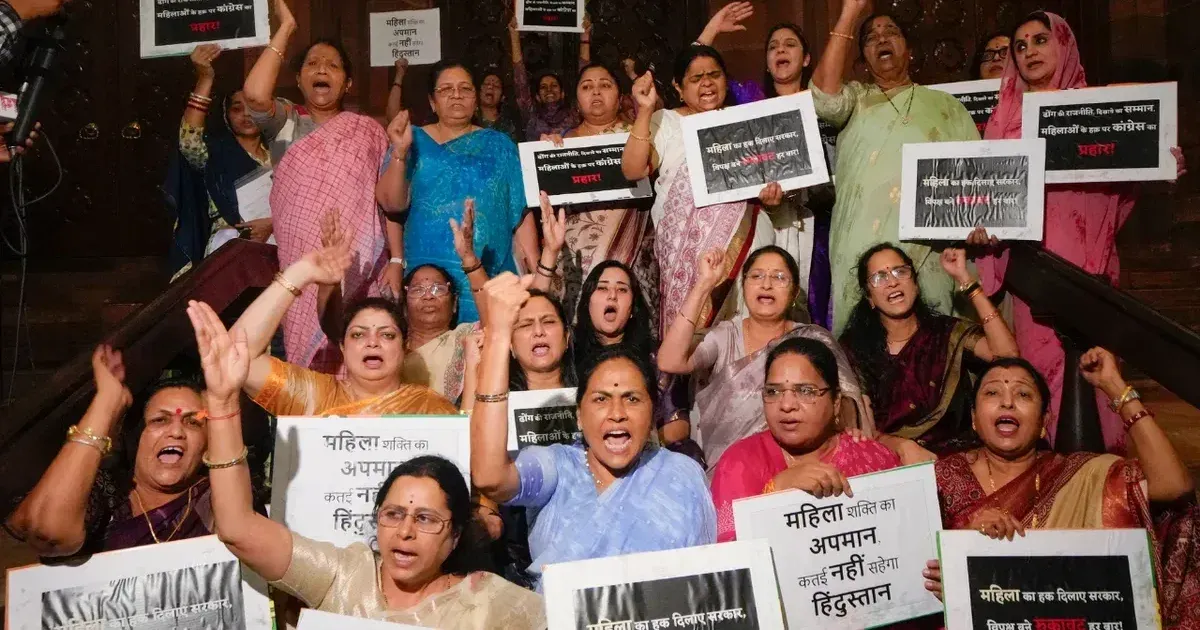
The BJP response to the quota defeat turned parliamentary procedure into a campaign weapon. On April 18, 2026, BJP supporters descended upon the New Delhi residence of Rahul Gandhi. Protesters carried high-definition banners and shouted slogans condemning the legislative collapse of the Nari Shakti Vandan Adhiniyam. Large posters adorned with the word 'Dhokebaaz', meaning traitor, were held aloft to convey the ruling party's stance on the failed vote. These demonstrations occurred simultaneously with a digital blitz targeting opposition leaders across social media platforms. High-ranking officials from the governing party characterized the legislative outcome as a betrayal of the female electorate. Delhi police deployed additional units to maintain a 500-yard security perimeter around the Gandhi compound.
Government messaging shifted immediately to a rhetoric of victimization and obstruction. BJP leadership used official accounts to label those who voted against the bill as enemies of progress. One specific post on X reached millions of impressions within hours of the march. It sought to energize female voters by framing the opposition as a barrier to institutional equality. Security forces remained on high alert throughout the afternoon as the crowd size increased. The march concluded without major violence, though several activists were detained for breaching barricades.
"Half of the country's population will never forgive these villains who stopped the 33% reservation for women power," the BJP stated in an official communication.
Political theater is the primary currency in New Delhi's high-stakes election cycles.
BJP Protests Target Rahul Gandhi Residence
Conflict over the women's reservation policy has entered a vitriolic phase. Supporters of Narendra Modi argue that the opposition intentionally sabotaged a generational reform. By marching on the Gandhi residence, the ruling party redirected public frustration away from the legislative failure and toward specific individuals. Tactical use of the 'villain' label suggests an intent to personify the policy's defeat in the minds of voters. Campaign strategists within the ruling coalition view this as a necessary step to protect their image as reformists. This strategy relies on the high visibility of street protests to dominate the 24-hour news cycle. Reporters on the ground noted that most of the protesters were members of the party's women's wing.
Legislative failure is rarely a byproduct of poor planning for a party with a meaningful majority. Prime Minister Narendra Modi has historically maintained strict control over the Lok Sabha. Observers suggest that the defeat was a calculated maneuver rather than an organizational error. By bringing the bill to the floor despite knowing the opposition would reject the specific conditions, the government forced a public record of every lawmaker's stance. This database of 'yeas' and 'nays' provides a ready-made list for campaign attack ads in upcoming regional contests. Documents leaked to local media indicate that the ruling party prepared these social media graphics days before the final vote occurred.
Legislative Gridlock Over Delimitation Linkage
Disputes over the bill's implementation timeline became the primary friction point during the debate. The proposed law included a clause linking the 33% quota to the completion of a census and a subsequent delimitation exercise. Delimitation involves redrawing constituency boundaries based on updated population data. Opposition parties, particularly those representing Southern states, expressed fear that this process would diminish their regional influence. States like Kerala and Tamil Nadu have seen slower population growth compared to the North, leading to concerns about losing parliamentary seats. Critics argued that linking the quota to such a disputed process was a poison pill designed to ensure the bill's failure. The government, however, maintains that delimitation is a constitutional necessity for fair representation. Opposition parties were central to the decision to block the Women's Reservation Bill in the house.
Southern regional parties remained unified in their rejection of the linkage clause. They demanded the immediate implementation of the quota without waiting for a census that has already faced years of delays. Leaders from the Congress party and the DMK stated that the 33% reservation could be applied to existing seat configurations. Government ministers countered that such a move would lead to legal challenges and procedural chaos. Tension between the North and South regarding political representation persists as a central theme in Indian federalism. Parliamentary records show that the debate lasted for over twelve hours before the final tally was announced.
Control over the narrative often outweighs the actual passage of law.
Strategic Voting Records as Campaign Weapons
Failure in the Lok Sabha provides the government with a potent narrative of 'intent versus obstruction.' Since 2014, the Modi administration has rarely lost a vote on key legislation. Analysts at the Times of India suggest that this specific defeat serves a broader electoral purpose. It allows the BJP to present itself as a champion of women's rights while casting the opposition as the sole reason for the policy's stagnation. This approach aims to capture the female vote bank, which has become increasingly decisive in recent state elections. Internal polling suggests that women voters prioritize representation more than ever before.
The ruling party intends to leverage this sentiment by highlighting their 'sincere attempt' to pass the bill. Records of the vote are now being distributed to grassroots workers in rural districts.
Electoral data from previous cycles shows that the BJP has consistently gained ground among women. Tactics used in the April 18, 2026, protests are designed to solidify this lead. By focusing on the 'villainy' of the opposition, the ruling party avoids answering questions about why the bill was not introduced earlier in their tenure. Every member of Parliament who voted against the measure now faces a localized campaign highlighting their specific choice. This detailed level of targeting is a hallmark of modern Indian electioneering. Political observers believe this will be the primary talking point for the Prime Minister's upcoming rallies. The official tally recorded exactly two votes in favor of the bill in its final amended form.
Historical Weight of Gender Quotas in India
Efforts to reserve seats for women in the Indian parliament date back to 1996. The United Front government first introduced the concept, but it faced violent opposition within the house. Successive administrations under the NDA and UPA failed to build a consensus on the matter. In 2010, the Rajya Sabha successfully passed a version of the bill, yet it never reached the Lok Sabha for a final vote. Historical context reveals that the bill has always been a tool for political leverage. Various parties have used it to signal progressivism while quietly allowing it to lapse due to internal pressure.
The current iteration is the most serious attempt in over a decade to revive the issue. Recent debates have been less about the quota itself and more about the technicalities of its execution.
Constitutional amendments require a two-thirds majority of members present and voting. The bill failed because it could not meet this high threshold after the opposition walked out. India continues to rank lower than several neighboring countries for female representation in national legislatures. Women currently occupy less than 15% of seats in the lower house. Proponents of the quota argue that only a mandatory reservation can break the patriarchal grip on candidate selection. Opponents claim that quotas within quotas for marginalized castes are a necessary requirement. The 2026 deadlock suggests that these internal divisions are nowhere near resolution.
Quota Defeat Becomes Campaign Weapon
Legislative failure is rarely an accident for a party that commands a disciplined parliamentary majority. By presenting a bill closely linked to the volatile issue of delimitation, the BJP effectively designed a trap for its opponents. The subsequent march on the home of Rahul Gandhi confirms that the goal was never the immediate enactment of a quota, but rather the creation of a powerful campaign grievance. It is the weaponization of legislative impotence. The ruling party has traded a policy victory for a narrative cudgel that they will use to beat the opposition for the next eighteen months. It is a brilliant, if cynical, application of political theater that prioritizes optics over outcomes.
Southern states are the real targets of this maneuver. By forcing the opposition to defend their stance against delimitation, the government has painted regional defenders as anti-women. It complicates the coalition-building efforts of the Congress party, which must now explain why it chose regional seat security over gender parity. The BJP, meanwhile, can campaign on a platform of 'failed but faithful' reformism. They have correctly identified that many voters will remember the intent of the bill instead of the technical reasons for its failure. It is a classic move from the Modi strategy: manufacture a confrontation, record the dissent, and then market that dissent as betrayal. The opposition fell for the bait with predictable precision. Narrative dominance remains the only prize that matters in New Delhi. Dead on arrival.