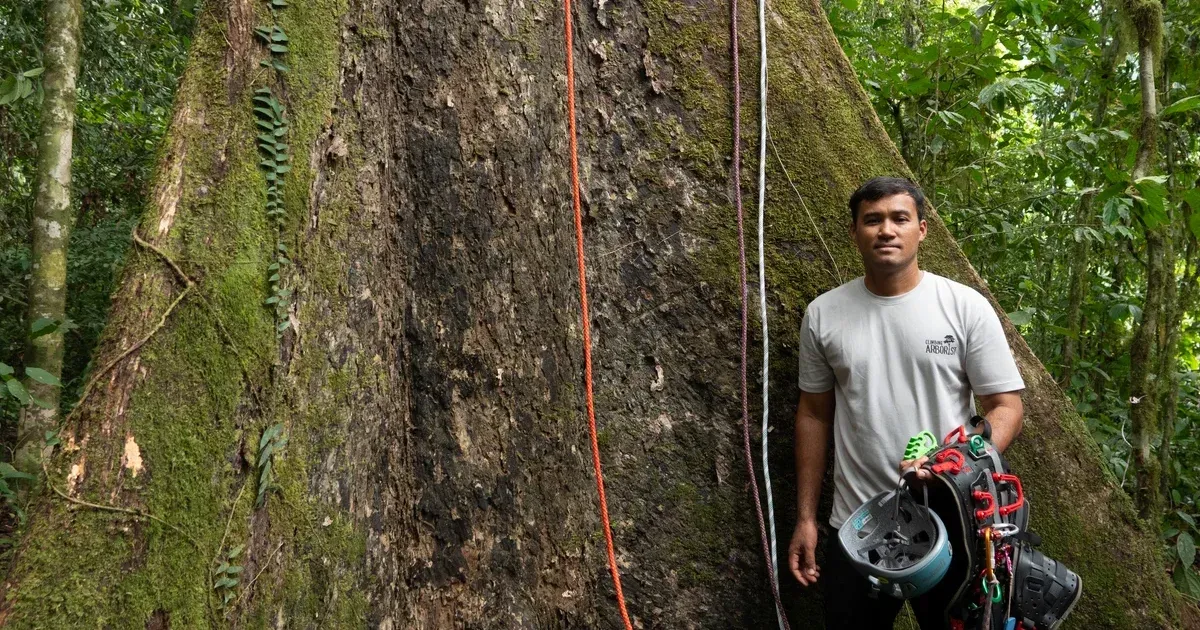
Unding Jami reached the summit of a Yellow Meranti tree known as Menara in the Danum Valley that week to conduct maintenance on remote sensing equipment. Jami, a lead climber for the South East Asia Rainforest Research Partnership, represents a generational shift in how residents of Sabah view their natural resources. Born in Tawau, a city on the southeastern coast of Malaysian Borneo, he grew up in the shadow of an industry that defined the regional economy for decades.
Childhood memories for Jami revolve around the widespread hum of logging camps where his father worked. During the early 1990s, vast swaths of the surrounding jungle were methodically cleared to make room for commercial timber operations and expanding plantations. By April 3, 2026, the climb had renewed attention on the scientific value of Sabah’s remaining rainforest giants. Young residents at the time often viewed the disappearance of the primary forest as an inevitable consequence of progress. Perception shifted for Jami during his teenage years when he secured a position with a local conservation group.
Working in the Danum Valley, he spent his early career planting seedlings in degraded zones where the canopy had been stripped bare. Knowledge regarding the complex interdependence of the rainforest ecosystem eventually replaced the industrial mindset of his youth. Protecting the remaining primary forest became his professional objective. Menara, the tree Jami climbed, is the tallest known tropical tree in the world at 100.8 meters.
Scientists from the University of Nottingham and the University of Oxford discovered the specimen in 2019 using high-resolution LiDAR technology. Experts named it Menara, which translates to tower in Malay. The Yellow Meranti belongs to the species Shorea faguetiana, which is currently classified as endangered due to historical over-harvesting for its high-quality timber. Conservationists argue that these giants are essential for the survival of specialized canopy fauna.
Menara and the Yellow Meranti Species
Yellow Meranti trees are the scaffolding of the Bornean rainforest. These trees are characterized by their straight, cylindrical trunks and the ability to reach heights that exceed those of most other tropical species. A height of 100.8 meters equals the height of roughly 22 London buses stacked end to end. High-resolution lasers first identified the height of Menara from an aircraft during a mapping survey of the conservation area.
Ground confirmation required a physical ascent to drop a tape measure from the highest branch. Scientists found that the tree is growing on a steep slope, a topographical feature that may provide protection from high-velocity winds. Wind speed often limits the maximum height a tree can achieve before mechanical stress leads to structural failure. Menara weighs an estimated 81,500 kilograms, excluding its extensive root system. This specific individual is evidence of the resilience of the Shorea genus.
Hazardous Ascent Through the Canopy Layers
Climbing a tree of this magnitude requires specialized equipment and intense psychological focus. Jami utilizes a double-rope technique to navigate the vertical distance, moving slowly to avoid disturbing the various inhabitants of the trunk. Canopy research involves serious physical risk, especially in a primary rainforest where the vertical structure is home to aggressive wildlife. Protective gear is mandatory but offers limited defense against some of the more persistent insects.
Wasps frequently build nests in the crevices of the bark or on the undersides of large branches. A single sting at a height of 80 meters can lead to a dangerous situation for a climber suspended by ropes. Snakes, including various species of pit vipers and tree snakes, use the higher branches for hunting and resting. Scorpions often hide in the epiphytes and mosses that cling to the Meranti surface. Every movement must be calculated to minimize interaction with these territorial species.
Rope management becomes increasingly difficult as the climber ascends further from the forest floor. Weight from 200 meters of rope creates considerable drag on the harness. Heat and humidity in the Danum Valley regularly exceed 90 degrees Fahrenheit with nearly 100 percent saturation. Physical exhaustion can lead to errors in safety protocols, making mental discipline as important as physical strength. Jami often spends several hours in the crown to complete his data collection tasks.
Protecting giants like Menara ensures the survival of the many species that exist only in the upper reaches of the canopy. Large trees provide critical habitat for orangutans, hornbills, and thousands of species of insects. Older trees also function as enormous carbon sinks, storing considerably more atmospheric CO2 than younger, smaller trees. Research conducted by the South East Asia Rainforest Research Partnership provides the data necessary to lobby for expanded protected areas across the island.
Government officials in Sabah have used the discovery of Menara to promote the Danum Valley as a premier site for global ecological study. Maintaining these corridors allows for genetic exchange between isolated populations of endangered fauna. Data retrieved from the crown of Menara helps climatologists understand how tropical forests respond to rising global temperatures. Sensors placed in the highest branches monitor humidity and transpiration rates throughout the day. Tall trees create their own microclimates which buffer the understory against extreme heat.
Menara Keeps Rainforest Science Visible
The ascent is more than a feat of endurance because Menara has become a symbol of what intact rainforest still contains. Keeping the tree measured and protected gives conservationists evidence they can use beyond one famous trunk.