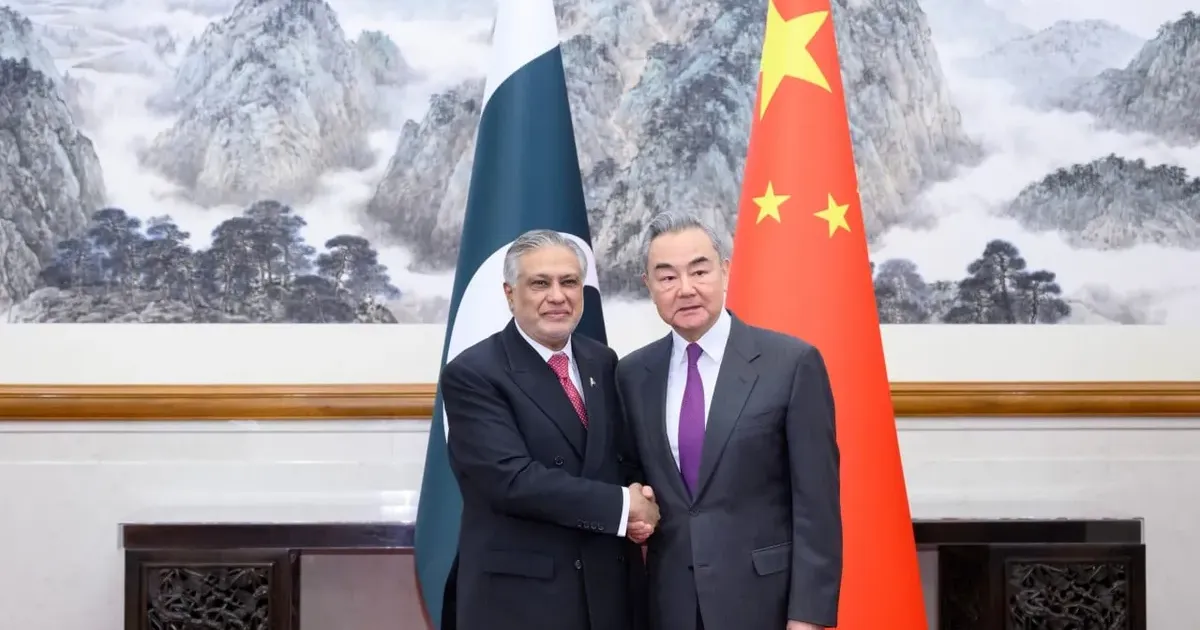
China and Pakistan's five-point initiative for the Gulf and Middle East gave Beijing a visible diplomatic role in the Iran war without making it the owner of the conflict. Wang Yi and Ishaq Dar issued the plan in Beijing on March 31, calling for an immediate end to hostilities, a return to peace talks, protection of non-military targets, security for shipping lanes and respect for the United Nations Charter. On paper, the formula was broad enough to sound responsible and narrow enough to avoid direct pressure on any single party.
The broad formula was both the strength and the weakness of the initiative. It allowed China to present itself as a stabilizing power while protecting energy and trade interests tied to the Gulf. It allowed Pakistan to show that it could still serve as a diplomatic channel between larger powers and regional actors. But by July, renewed fighting around Hormuz and fresh U.S.-Iran escalation had exposed the limit of a plan that offered language without a clear enforcement mechanism.
Pakistan Needed the Channel
For Islamabad, mediation was not only a prestige exercise. Instability around Iran can hit Pakistan through fuel costs, border security, Balochistan risk, sectarian pressure and relations with Gulf partners. Ishaq Dar's trip to Beijing let Pakistan place itself inside the diplomatic conversation rather than outside it.
The balancing act matters for a country trying to balance several relationships at once. Pakistan has reasons to avoid a wider U.S.-Iran war, reasons to keep Gulf partners close, reasons to maintain its Chinese strategic partnership and reasons to avoid domestic blowback from appearing indifferent to the conflict. A peace initiative gave Islamabad a practical script: de-escalation, talks, shipping security and UN principles.
China Supplied the Weight
China gave the proposal international scale. Beijing has deep reasons to care about Gulf stability. Its economy depends on energy imports, shipping security, predictable insurance costs and reliable trade routes. The Strait of Hormuz is therefore not a distant maritime issue for China. It is part of the supply chain that feeds its industrial system.
At the same time, China avoided becoming the front-line guarantor of the outcome. It could support ceasefire language, back Pakistan's channel and criticize escalation while keeping distance from direct confrontation with Washington. The distance is careful statecraft. Beijing wants the benefits of being seen as a responsible power, but it does not want every military and political cost that comes with forcing restraint on armed rivals.
The Five Points Were Deliberately Broad
The plan's five elements were easy to support in public. Few governments will oppose ending hostilities, protecting civilians, safeguarding shipping or returning to diplomacy. The wording created room for multiple audiences: Iran could hear respect for sovereignty and UN principles; Gulf states could hear shipping security; Pakistan could hear mediation; China could hear energy stability.
The breadth made the initiative useful as a diplomatic marker. It also made it less powerful as a plan. The hardest questions were left outside the frame: who would verify a ceasefire, what would happen if shipping was attacked again, how U.S. operations would be restrained, what Iran would receive, and whether China would use real leverage on partners that ignored the appeal.
Hormuz Tested the Proposal
The July escalation around Hormuz showed why language alone was not enough. U.S. strikes, Iranian retaliation, blockade threats, tanker attacks and renewed oil-market anxiety all pushed the conflict back into the zone the March initiative was meant to calm. If the plan had created a durable channel, the crisis should have had a clearer off-ramp. Instead, the same maritime-security issue returned with more force.
The failure to halt escalation does not make the China-Pakistan initiative meaningless. It shows that diplomatic positioning is different from conflict management. A proposal can improve a country's image and still fail to change battlefield or maritime behavior. The difference is enforcement, and enforcement is where Beijing has been more cautious.
Beijing's Image Strategy Has a Cost
China has spent years presenting itself as an alternative diplomatic organizer in regions where U.S.-led efforts are distrusted or exhausted. The Gulf is an obvious arena for that ambition because energy, trade and U.S. military power all overlap there. A joint plan with Pakistan let Beijing signal that it could convene ideas outside the Western track.
But visibility creates expectations. If Beijing says it is a stabilizer, states will ask what pressure it is willing to apply when escalation resumes. Will it lean on Tehran, shield shipping, coordinate with Gulf governments, push Washington through back channels, or mostly issue language? The answer determines whether the initiative is remembered as diplomacy or branding.
The Plan Earned a Seat, Not Control
The peace plan gave China and Pakistan a seat near the conversation. It did not give them control of the conflict. The distinction is crucial. Islamabad gained relevance, Beijing gained diplomatic visibility, and both governments placed themselves on the side of restraint. None of those gains guaranteed that the U.S., Iran or Gulf states would accept the discipline required for a lasting pause.
The strategic value for China is clear: it can show concern for stability while the United States carries the immediate military burden. The risk is just as clear: the more Beijing advertises itself as a diplomatic alternative, the more it will be judged by outcomes rather than statements. The March initiative was a useful entry point. The July violence showed that entry is not the same as authority.