Beijing officials accelerated efforts on April 24, 2026, to dismantle American financial and technological hegemony through a synchronized push for currency autonomy and open-source artificial intelligence. DeepSeek, the leading Chinese laboratory, released its most sophisticated model today, signaling a departure from the proprietary, closed-door development cycles favored by Silicon Valley giants. Access to these advanced weights allows developers globally to bypass Western restrictions, effectively neutralizing the hardware advantages currently held by the United States. Engineers across the Pacific believe that by making their models free to use, they can establish a Chinese technical standard before Washington can implement new export controls.
DeepSeek Sequel Redefines Global AI Competition
Model architecture within the newest DeepSeek release utilizes a mixture-of-experts framework that drastically reduces the energy requirements for training and inference. Scientists note that this efficiency allows the software to run on older semiconductor generations, reducing the impact of U.S. bans on high-end GPUs. Open-source software distribution ensures that even if the White House restricts physical chip sales, the logic and intelligence of Chinese systems will persist in the global developer ecosystem. Proprietary models like those from OpenAI and Google now face a competitor that offers comparable performance without the subscription fees or usage limitations.
Technical reports suggest that Beijing is subsidizing the cloud infrastructure necessary to host these models for international users. Exporting intelligence through code creates a dependency on Chinese technical stacks throughout Southeast Asia and the Middle East. Developers in these regions are increasingly building their sovereign AI applications on top of Chinese foundations. Data indicates that the DeepSeek sequel outperforms several flagship American models in complex mathematical reasoning and multilingual translation tasks.
Capital flows are following the technical shift as venture firms in the Gulf region pivot toward Chinese partnerships. Silicon Valley once enjoyed a near-monopoly on global AI talent, yet the accessibility of open-source weights is decentralizing the industry. This strategy allows China to collect vast amounts of international training data as users interact with their systems. Local hardware manufacturers in Shenzhen are already improving their next generation of chips specifically for the DeepSeek architecture. Market analysts expect this optimization to create a hardware-software feedback loop that excludes American competitors.
Renminbi Infrastructure Bypasses Dollar Sanctions
Financial authorities at the People’s Bank of China have expanded the Cross-Border Interbank Payment System to include forty new participating banks this quarter. Transitioning away from the SWIFT messaging system provides a direct conduit for trade that avoids the scrutiny of the U.S. Treasury. Crude oil transactions between Russia and China are now almost entirely settled in the renminbi, a trend that is spreading to other commodities. Sanctions once viewed as the ultimate tool of American diplomacy are losing their efficacy as alternative rails become operational. Total renminbi clearing volumes surpassed $11 trillion in the previous fiscal year, a record high for the currency.
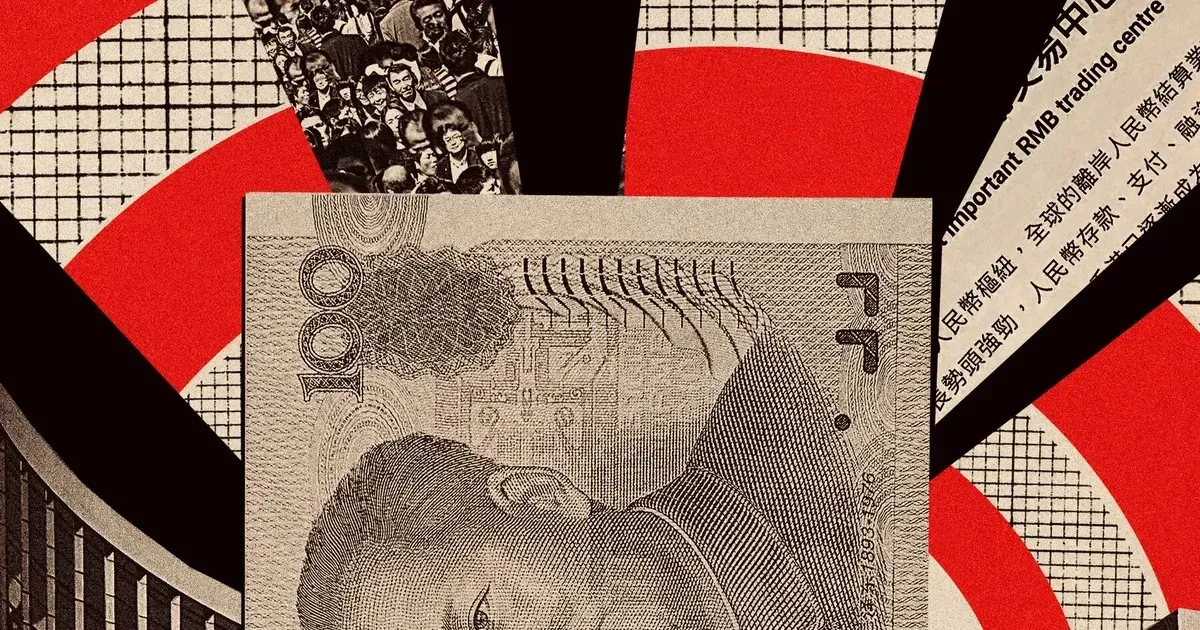
China’s bid to build a renminbi-based financial system beyond the U.S. dollar’s reach is gaining traction as a way to sidestep sanctions, according to a report by the New York Times on the current trade environment.
Trade partners in the BRICS+ alliance are testing a unified digital ledger that would eliminate the need for any intermediary currency. Using the e-CNY, China’s central bank digital currency, allows for instantaneous settlements that bypass the multi-day delays inherent in traditional banking. Central banks in Brazil and Saudi Arabia have increased their renminbi reserves while simultaneously reducing their holdings of U.S. Treasuries. Global markets are reacting to this diversification by demanding higher yields on American debt instruments. Sovereignty in finance is becoming a primary objective for nations wary of the dollar’s weaponization.
Beijing Targets Global South Integration
Infrastructure projects under the Belt and Road Initiative are now being bundled with digital and financial services. Contractors in African nations are receiving payments in renminbi through mobile apps developed by Chinese tech firms. These apps incorporate the DeepSeek AI to provide real-time translation and project management tools for local workers. Integrating these two foundations of power ensures that the entire lifecycle of development is shielded from Western influence. Data centers powered by Chinese hardware are rising in cities like Lagos and Jakarta to support this expanding digital web.
Public opinion in these emerging markets has shifted as Chinese technology becomes more affordable and less restrictive. Washington’s insistence on ethics-based AI guidelines often conflicts with the practical needs of developing nations. Beijing offers a pragmatic alternative that prioritizes industrial output and surveillance efficiency. Educational partnerships between Chinese universities and their counterparts in the Global South are training the next generation of engineers on Chinese software. Graduates are returning home to lead ministries that are now closely linked to the Beijing technical ecosystem.
Energy security remains a critical component of this integration strategy. China has secured long-term liquefied natural gas contracts denominated in its own currency to stabilize its domestic power grid. This stability allows for the continuous operation of the large server farms required to maintain global AI services. Domestic manufacturing of solar panels and batteries further reduces the reliance on Western supply chains. The total value of green energy exports from China reached a new peak in early 2026.
Washington Response to China Dual Expansion Strategy
Defense officials in the United States are struggling with the reality that open-source AI cannot be easily contained. Banning a physical chip is a straightforward administrative task, but stopping the propagation of code across the internet is nearly impossible. Regulatory frameworks currently under debate in Congress focus on the liability of developers who release autonomous agents. These legal maneuvers do little to deter foreign labs that operate outside of American jurisdiction. Intelligence agencies have warned that the combination of private financial channels and advanced AI will make tracking money laundering extremely difficult.
Economic advisors to the President are urging a revitalization of the domestic manufacturing sector to counter the renminbi push. High-interest rates have made the dollar expensive for foreign buyers, inadvertently pushing them toward the yuan. The Federal Reserve is monitoring the decline in foreign appetite for Treasury auctions with increasing concern. Reversing this trend would require a sweeping shift in fiscal policy that currently lacks bipartisan support. The trade deficit with China persists despite multiple rounds of tariffs and trade restrictions.
Multilateral organizations like the IMF are seeing their influence wane as China provides alternative lending facilities. These loans often come with fewer conditions regarding governance or human rights compared to Western packages. Developing nations are choosing the path of least resistance to fund their infrastructure and technology needs. Competition between these two global systems is no longer a future projection. The divergence is happening in real-time across every major sector of the global economy.
China Links AI Access to Financial Autonomy
Western analysts who view Chinese technological advancements as mere mimicry are ignoring the structural reality of the current geopolitical environment. Washington is fighting a two-front war with tools designed for a previous century. Export controls and financial sanctions were effective when the United States controlled the only highway in town, but Beijing has built a second road that is faster, cheaper, and increasingly crowded. By making high-end AI open-source, China has effectively invited the entire world to help it beat Silicon Valley, and the world is accepting that invitation with open arms.
The dollar is not going to collapse tomorrow, but it is being demoted to a regional preference for the Western bloc. We are entering a fragmented reality where the Global South no longer needs to ask permission from New York or London to conduct business. DeepSeek is not just a software model; it is a declaration of independence from the American hardware stack. If the U.S. continues to rely on restrictive policies rather than out-competing China in the open market, it will find itself the administrator of a very sophisticated, but very lonely, walled garden. The era of the single global standard has ended.