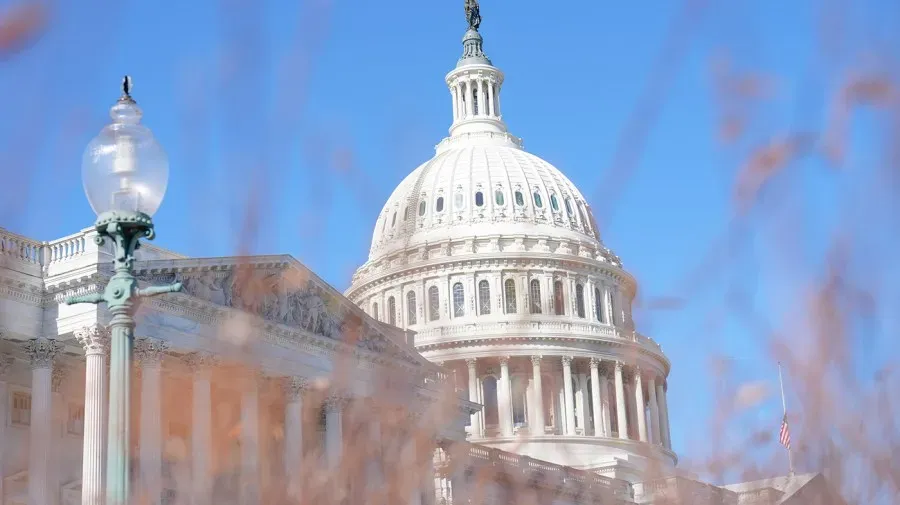
Democrats are pressing for answers after sanctioned Russian officials reportedly entered the United States Capitol. The request puts congressional oversight on a collision course with sanctions enforcement. The central question is whether official access, informal diplomacy and sanctions credibility can coexist when the people involved are supposed to face U.S. restrictions.
Rep. Dina Titus and other lawmakers demanded a formal inquiry into how members of Russia's State Duma were able to visit Capitol spaces despite restrictions tied to federal sanctions. Their request seeks documentation from the State and Treasury departments, including whether any waivers, visas or exceptions were issued. Without that paper trail, the visit becomes a direct test of how seriously Washington enforces its own pressure campaign.
Sanctions do not enforce themselves. They depend on visa screening, Treasury restrictions, agency communication and the willingness of officials to treat restricted individuals as restricted in practice, not only in databases. A Capitol visit by sanctioned lawmakers therefore carries symbolic weight far beyond one tour.
Visa Issuance and Treasury Oversight
The first issue is how the Russian officials entered the United States. Sanctioned individuals can sometimes receive limited exceptions for specific diplomatic or national-security reasons, but those exceptions should be documented and justified. Lawmakers are asking whether such a waiver existed and, if so, who approved it.
The second issue is whether any U.S. person or office provided services that could conflict with sanctions rules. A congressional meeting, staff assistance, security escort or logistical help may sound routine, but sanctions law can make routine services legally sensitive when the visitor is on a restricted list. That is why Treasury's role matters as much as State's.
Officials have not provided a public account that resolves the chain of approval. Until they do, the incident will continue to look like either an administrative failure, a deliberate exception or a political workaround. Each possibility raises a different problem for U.S. sanctions credibility.
Security Questions at the Capitol
The Capitol security question is separate from the visa question. A person may enter the country under one process and enter the Capitol under another. If visitor-management systems did not flag sanctioned status, that suggests a data-sharing gap between executive-branch sanctions lists and congressional security operations. If staff knowingly hosted restricted visitors, that is a different and more serious issue.
Foreign delegations often move through the Capitol under controlled conditions. But sanctioned lawmakers from an adversarial state are not ordinary guests. They create counterintelligence, propaganda and legal concerns. Even if no classified information is involved, photographs, meetings and symbolic access can be used to show that sanctions are porous.
That is why lawmakers are demanding a timeline: who invited the delegation, who cleared it, which offices were notified, which spaces were accessed, and whether sanctions officials were consulted before the visit. The answer will determine whether this was a paperwork failure or a policy choice.
Legislative Response to the Russian Delegation
Rep. Brian Fitzpatrick joined the request, giving the inquiry bipartisan weight. That matters because sanctions against Russia have depended on cross-party credibility. If enforcement becomes another partisan loophole, the message to Moscow and to U.S. allies weakens immediately.
"The presence of sanctioned Russian lawmakers in the U.S. Capitol is a blatant violation of our commitment to holding those who undermine democracy accountable," the letter from lawmakers stated.
Rep. Anna Paulina Luna has defended dialogue with Russian figures as a channel for unofficial diplomacy, according to the original account. Dialogue can have value, especially during periods of high tension. But unofficial diplomacy does not erase sanctions law. If a member believes contact is necessary, the process should be transparent, lawful and coordinated with the agencies responsible for the restrictions.
The reputational cost extends beyond Washington. European allies have mirrored many U.S. sanctions and depend on consistent enforcement. If sanctioned officials can appear in the Capitol without a clear explanation, other restricted individuals may test the limits. The sanctions regime works only when the rules look predictable.
What Sanctions Lose
Why should anyone accept this as a simple administrative error before the government produces the documents? The presence of sanctioned Russian legislators in the heart of American democracy is not a minor scheduling problem. It is a warning that Washington's sanctions machinery may be dangerously fragmented. For years, the United States has used sanctions as a low-cost alternative to military force, treating a Treasury designation as a hard barrier. This episode shows how soft that barrier can become when agencies and congressional offices do not operate from the same rulebook.
Bureaucratic finger-pointing between State, Treasury and Capitol security would be a distraction. The real issue is whether the political consensus behind sanctions is strong enough to survive inconvenience, personal diplomacy and factional foreign-policy experiments. If the executive branch cannot clearly explain who entered the country, and Congress cannot clearly explain who entered the Capitol, the structure of U.S. sanctions enforcement begins to look theatrical. The right question is not only how this happened. It is who approved it, who knew about it, and whether the optics of Russian officials inside the Capitol were treated as a cost or as the point.
The fallout will not be measured only in diplomatic cables. It will be measured in the confidence of every sanctioned official watching for weakness. A sanctions wall does not crumble all at once. It erodes through exceptions, excuses and unexplained access.