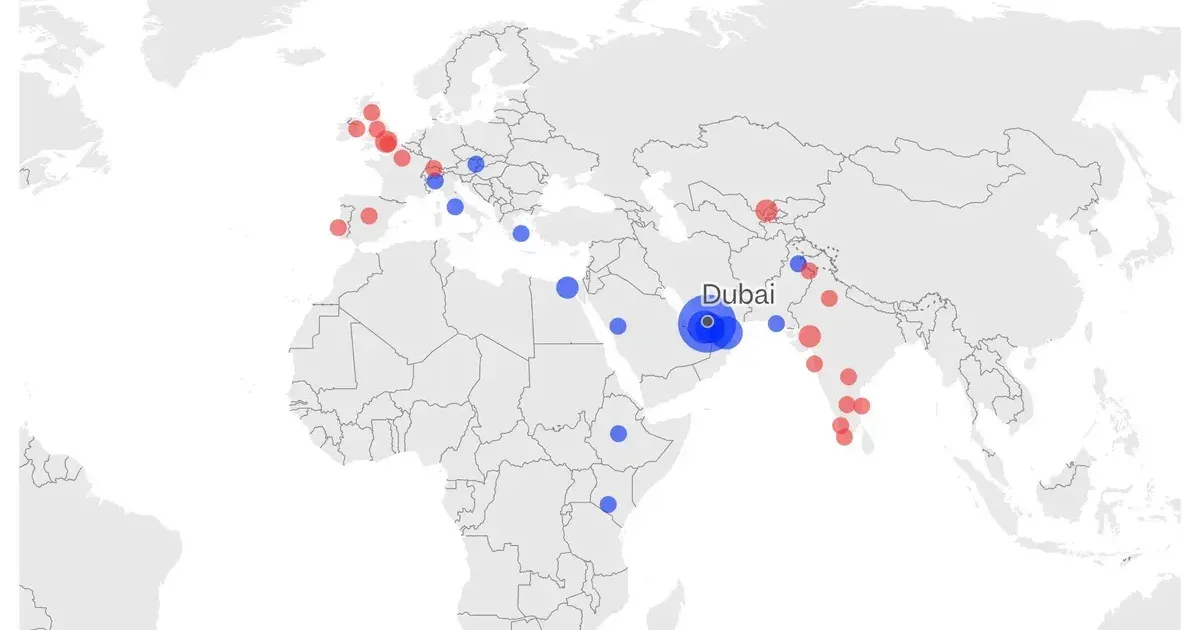
Dubai International Airport suspended all operations on March 16 after a drone strike ignited a fire near the terminal. Security forces cordoned off the facility while emergency crews battled the blaze near the northern perimeter. Logistics experts noted that the disruption forced aviation authorities to halt arrivals and departures at a facility that acts as the world's primary connection point between East and West. Chaos spread across global flight paths as 65 planes diverted to 34 different countries. Data from Flightradar24 indicated that 22 flights became so-called flights to nowhere after returning to their original departure gates. One Emirates A380 traveling from Paris spent nearly eleven hours in the air only to land back at Charles de Gaulle Airport. Similar U-turns occurred for long-haul routes originating in Edinburgh, Dublin, and Manchester. These aircraft were tracked over the Saudi desert and Egypt before turning back toward Europe.
Dubai Airport Suspends Operations
17 of the diverted flights eventually landed at Dubai World Central, a secondary airport located 30 miles from the primary hub. Other aircraft found refuge in Abu Dhabi, Al Ain, and Muscat. These diversions strained ground handling services and left thousands of passengers stranded in transit lounges across the Middle East. Fuel burn for these extended flight paths creates a heavy overhead burden for carriers like Emirates. The map of the disruption illustrates how integrated the region has become in the global aviation network. A flight from Toronto was forced to land in Rome. A Boeing 777 from Dallas-Fort Worth ended its journey in Milan. Another aircraft from Tokyo ended up in Karachi, Pakistan. These geographic outliers highlight the systemic vulnerability of the hub-and-spoke model when a single node fails. But the airport closure was only one half of a coordinated assault on regional logistics. Just hours before the aviation shutdown, a separate strike hit the Port of Fujairah. This facility is the only export route for the country that lies outside the narrow and contested waters of the Persian Gulf. Damage to the loading arms caused a temporary cessation of all oil exports from the terminal.
Fujairah Port Strike Hits Energy Routes
Bloomberg reported that operations at Fujairah resumed late Monday after technical teams repaired damaged infrastructure. While the port is now active, the repeated nature of these strikes has heightened anxiety among global energy traders. The facility is essential for the United Arab Emirates because it allows tankers to avoid the narrow chokepoint controlled by Iranian naval forces. It connects to the Habshan oil fields via a 220-mile pipeline. The shift toward inland or bypass-oriented strikes shows that geography alone no longer guarantees safety for Gulf exports. The pipeline from Habshan was designed expressly to reduce the risk of a naval blockade. If the terminal at the end of that pipeline is vulnerable to cheap, mass-produced drones, the multibillion-dollar investment in bypass infrastructure loses its strategic value. Oil prices responded immediately with Brent crude futures climbing over 3%. Security analysts at Lloyd's List Intelligence noted a sharp increase in maritime insurance premiums for vessels operating in the Gulf of Oman. These costs reflect the growing physical risk to tankers and the potential for prolonged supply chain interruptions. Most vessels anchor for days near Fujairah while waiting for loading windows or refueling services. These stationary targets are particularly vulnerable to loitering munitions.
Insurance Costs React Fast
Regional stability now hangs on the integrity of these two critical infrastructure nodes. Meanwhile, the military situation in the Strait of Hormuz remains a primary concern for the Pentagon and the British Ministry of Defence. Naval patrols have increased near the Musandam Peninsula to protect commercial shipping from harassment. Roughly 20% of the world's daily oil consumption passes through this narrow waterway. Any perception of a total blockade would trigger an immediate global energy crisis. Statistics from the regional energy ministry suggest that Fujairah handles roughly 70% of the crude oil exported by the United Arab Emirates. Disruption at this terminal forces tankers back into the Strait of Hormuz, where the threat of seizure or mine attacks is sharply higher. Federal officials in Abu Dhabi are now reviewing their coastal defense posture to address these multi-domain threats. Identifying launch points for the drones remains the primary intelligence objective.
The logistical recovery at Dubai International Airport was strikingly swift. Ground crews cleared debris and aviation authorities reopened the runways six hours after the initial fire. Passengers were re-booked on subsequent flights, though the backlog is expected to take several days to clear. Every hour of closure at such a hub results in millions of dollars of lost revenue for the airport authority. The financial impact on Emirates and other regional carriers is likely to exceed hundreds of millions of dollars in operational losses. Aircraft repositioning and passenger re-accommodation are logistically complex and expensive. These costs eventually trickle down to consumers through higher ticket prices and cargo surcharges. Corporate travelers in the US and UK are already seeing price spikes for upcoming routes to the Gulf.
For instance, the cost of war-risk insurance for aircraft flying into the Persian Gulf has doubled in the last 24 hours. Underwriters are cautious about the possibility of sustained drone campaigns targeting civilian infrastructure. If these strikes become a weekly occurrence, the viability of Dubai as a global transit hub will be called into question. Major corporations rely on the reliability of these connections for their regional headquarters.
The United Arab Emirates has signaled its intention to buy advanced counter-drone systems from international defense contractors. Current air defense batteries designed for ballistic missiles are often ineffective against small, low-flying drones. Closing this technological gap is now the top priority for the national security council. Diplomacy is also underway to de-escalate tensions with regional rivals through third-party mediators.
The quick resumption of services at both the airport and the port indicates a high level of strength in Emirati contingency planning. Maintenance crews and security personnel have undergone extensive training for exactly these types of kinetic events. Strength does not negate the long-term psychological impact on foreign investors and tourists who view the region as a safe haven. The coming weeks will determine if this was an isolated incident or the start of a new campaign.
The UAE Shock Hit Aviation and Oil
What happens when the world's most expensive airport becomes a flight-to-nowhere machine? The United Arab Emirates built its entire brand on being the neutral, safe, and efficient middleman of the world. By hitting DXB and Fujairah, the attackers are not just breaking glass; they are breaking the illusion of safety that underpins the petrodollar economy. If you cannot land a plane or fill a tanker, you do not have a country; you have an expensive parking lot in the desert.
The West continues to offer thoughts and prayers while the real war is fought with $500 drones against $500 million facilities. This is not a military problem. It is an existential business crisis that threatens the very foundation of the Gulf model. We see this as the beginning of the end for the Switzerland of the Sands myth. Investors who think they are insulated from Middle Eastern instability by staying in the UAE are about to receive a very expensive education.
The regional strategy has shifted from naval posturing to the precision strangulation of the commercial nodes that make these nations relevant on the global stage. If the hub fails, the entire network collapses with it.