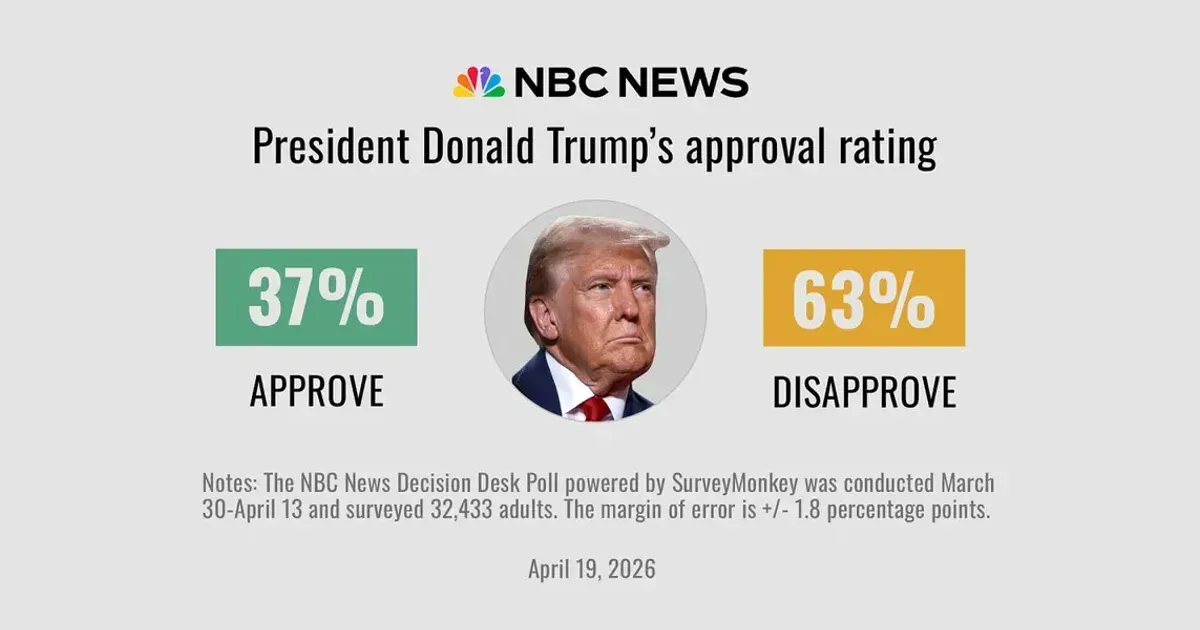
Trump’s approval slide turned the Iran war into an economic confidence problem. The polling matters because household costs now shape the political reading of foreign policy. Donald Trump saw his political support reach a second-term low on April 19, 2026, because intensifying economic worries and the prolonged war in Iran soured the national mood. Results from the NBC News Decision Desk Poll conducted in partnership with SurveyMonkey indicate that a combination of foreign intervention and domestic instability has eroded the president's core support. Voter confidence is dropping rapidly as the November midterm elections approach.
Public dissatisfaction is no longer confined to traditional opposition strongholds. Independent voters in critical swing states have begun to distance themselves from the administration. High fuel costs and the lack of a clear exit strategy in the Middle East are the primary drivers of this shift. Survey data suggests that nearly 60% of Americans now disapprove of the executive branch's handling of the economy.
Simultaneously, the administration is struggling to maintain its narrative of military success. Fighting in the Persian Gulf has entered a stalemate that few analysts predicted last year. Costs for the conflict continue to climb, pulling resources away from domestic infrastructure projects. Recent casualties have further dampened public enthusiasm for the intervention. Deployment cycles have been extended twice since January.
War in Iran Strains Domestic Support
Combat operations in Iran have triggered a wave of skepticism that now fills both sides of the aisle. Republican lawmakers are privately expressing concern that the conflict has become a political liability. While initial support for the military action was broad, the lack of measurable progress has turned the tide of opinion. Voters are increasingly questioning the long-term objectives of the mission.
"Americans are souring on the economy and the war," according to the NBC News report released on April 19, 2026.
By contrast, White House officials maintain that the military pressure is necessary to ensure regional stability. They argue that withdrawing now would embolden adversaries and jeopardize global energy supplies. Critics, however, point to the rising human and financial toll of the campaign. Defense spending has surged by 14% over the last fiscal year. This fiscal expansion is occurring while social programs face substantial cuts.
National security advisors have briefed the president on the declining morale within civilian populations. Reports from the NBC News investigative team suggest that even military families are becoming vocal about their frustrations. Protests have emerged in several major cities including Raleigh and Phoenix. Local law enforcement agencies have increased patrols around federal buildings in response. Public opinion of the conflict hit a record low last Tuesday.
Rising Consumer Costs Fuel Voter Frustration
Economic anxiety is currently the most potent threat to the administration's longevity. Gasoline prices have surpassed $5.50 per gallon in many Midwestern states, a threshold that historically triggers political upheaval. Families are feeling the squeeze at the grocery store and the pharmacy. Inflation remains a persistent challenge that the Federal Reserve has struggled to contain. Supply chains are still recovering from regional disruptions. Congressional pressure is mounting as key lawmakers demand a clear exit strategy in the Middle East to curb the conflict.
Instead of the promised economic boom, many workers are seeing their wages stagnate against rising costs. Consumer sentiment has plummeted to levels not seen since the 2008 financial crisis. Small business owners report a sharp decline in customer spending. Energy costs are forcing manufacturers to scale back production. Commercial bankruptcies rose by 8 percent in the first quarter of the year.
Earlier projections from the Department of Labor offered a more optimistic outlook. These figures have since been revised downward to reflect the impact of international trade sanctions. Trade with traditional partners in the region has effectively ceased. Import tariffs on critical components are further inflating prices for electronics and automobiles. Automotive production in Michigan has slowed sharply.
Midterm Election Risks for the Republican Party
Republican strategists are bracing for a difficult season as the November midterms loom. Internal polling reveals that the party could lose its majority in both chambers of Congress. Vulnerable incumbents are beginning to distance themselves from Donald Trump in their local advertisements. Some candidates have even skipped scheduled appearances with the president. The party's fundraising advantage has narrowed over the last three months.
Beyond the top-line approval numbers, the SurveyMonkey data shows a worrying trend for the GOP among suburban women. This demographic was instrumental in the last election cycle. Many now cite the war and the cost of living as their primary concerns. Democratic challengers are capitalizing on these anxieties with targeted messaging. Direct mail campaigns in Pennsylvania are focusing almost exclusively on fuel prices. Messaging is shifting away from social issues toward pocketbook realities.
Historically, second-term presidents face a difficult midterm cycle. Donald Trump is now confronting the same historical headwinds that hampered his predecessors. Without a sharp shift in economic conditions, the legislative agenda for the next two years could be effectively dead. Opposition leaders are already preparing for a series of high-profile investigations. Subpoenas for economic records have been drafted by minority committee members. Political paralysis is a distinct possibility for the winter session.
SurveyMonkey Data Reveals Shifting Demographics
Analysis of the latest SurveyMonkey results indicates a fracturing of the president's base. Rural voters, who have been the most loyal supporters, are starting to voice complaints about the cost of agricultural supplies. Fertilizer prices have tripled since the conflict began. Many farmers are facing the prospect of operating at a loss this year. This economic pressure is overriding previous ideological loyalty.
While NBC News polling shows a sharp drop, some administration allies argue the numbers are skewed. They claim the methodology does not account for the silent majority. Most independent analysts disagree with this assessment. They note that the trend lines have been consistent for six months. Data points across multiple polling organizations show nearly identical declines. Consistency in these figures suggests a genuine shift in public perception. Younger voters are also showing record levels of engagement against the current administration. Turnout projections for the under-30 demographic have reached historic levels for a midterm year. Student loan interest rates and the prospect of a wider draft are the main motivators. Activism on college campuses has increased tenfold since the start of April. University administrators in California have reported daily demonstrations. Polling among college students shows an 82% disapproval rating.
Approval Slide Tests Trump Coalition
Political survival rarely hinges on grand strategy when the price of gasoline exceeds the tolerance of the working class. Donald Trump has discovered that even a conflict in Iran cannot distract from an empty wallet. Voters have historically forgiven military stalemates, but they never ignore the erosion of their purchasing power. It is the reality of the American electorate. Republicans now face a choice between supporting a declining president or distancing themselves to save their own seats in November. The administration’s gamble on foreign policy as a domestic unifier has failed. National pride is a luxury that few can afford when basic necessities are priced as premium goods. The political cost of the Persian Gulf stalemate is finally being realized at the ballot box. Midterms will likely be a reckoning. Voters have lost their appetite for open-ended wars and the inflation that follows them. Leadership requires more than rhetoric; it requires the delivery of stability. That stability has vanished. The verdict is coming.