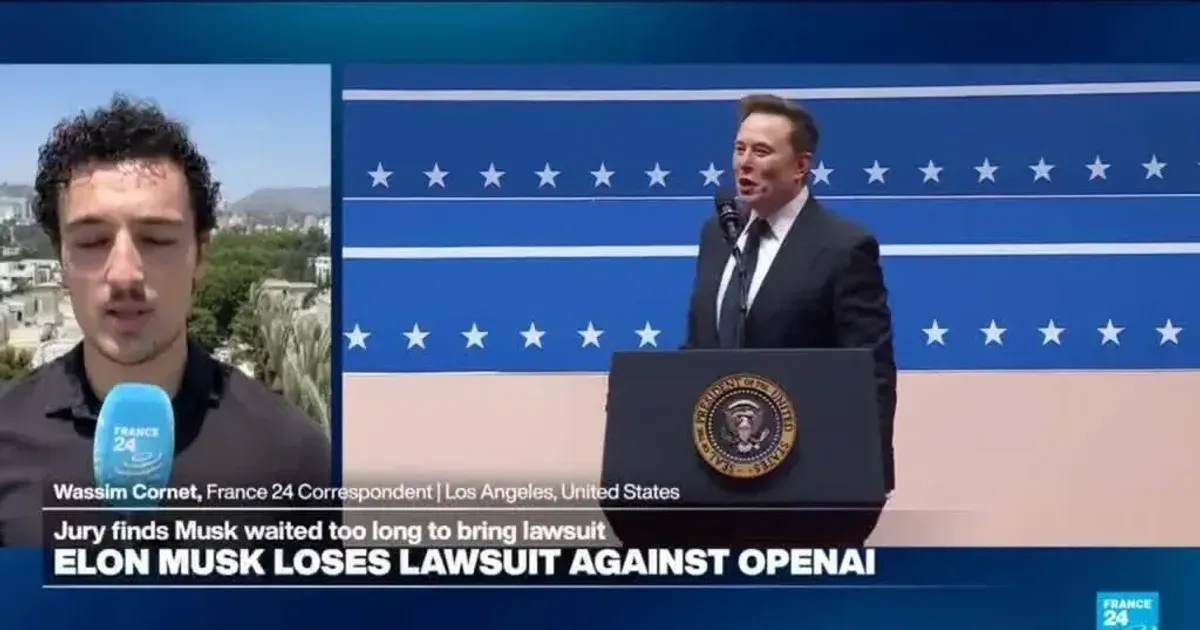
Elon Musk failed to convince a federal jury that OpenAI abandoned its founding mission, ending a multi-year legal battle that threatened the corporate structure of the world's leading artificial intelligence firm. The ruling keeps the OpenAI fight focused on governance rather than an immediate corporate reversal. It also leaves Musk to pursue narrower claims instead of forcing a full structural reset. A nine-member jury in a California federal court delivered the unanimous verdict on May 18, 2026, following a high-stakes trial that spanned three weeks. Jurors spent less than two hours in deliberation before concluding that the statute of limitations had already expired on the claims brought forward by the billionaire.
Jurors reached a unanimous verdict in less than two hours.
Musk filed the lawsuit seeking up to $134 billion in damages, alleging that Sam Altman and other co-founders breached a foundational contract to keep the technology open-source and non-commercial. Testimony during the eleven-day proceedings featured a parade of technology executives who detailed the early days of the laboratory and its subsequent pivot toward a profit-oriented model. Defense attorneys argued successfully that the grievances Musk described occurred too far in the past to justify a modern legal intervention. California law typically requires contract-related claims to be filed within four years of the alleged breach, a threshold the jury found was not met.
Witnesses testified about the shifting relationship between the founders starting in 2015. While Musk provided large early funding, his departure from the board in 2018 coincided with the organization's move to create a capped-profit subsidiary. Microsoft later invested billions into this entity, a development Musk claimed was a betrayal of the original nonprofit mandate. Evidence presented in court suggested that Musk was aware of these structural changes as they happened, yet he did not seek legal redress until the commercial success of ChatGPT drove the company's valuation to historic heights.
The jury decided Musk waited too long to sue.
Legal experts observed that the swiftness of the jury's decision highlights the weakness of the procedural basis for the case. Beyond the financial damages, Musk had sought the removal of Altman and a court order to force the company to return to its nonprofit status. Attorneys for OpenAI countered that no formal, written "founding agreement" ever existed in the way Musk described, characterizing his claims as a case of buyer's remorse after he chose to walk away from the project years ago. This defense focused on the lack of a signed contract that explicitly prohibited the eventual commercialization of the technology.
Axios reported that Musk sought up to $134 billion in damages, along with leadership changes, while other filings and coverage framed the requested remedy as an attempt to restore value to OpenAI's nonprofit branch rather than to Musk personally. Despite this charitable framing, the court remained focused on the timeline of the filing. Judge-led instructions to the jury emphasized that regardless of the merit of the contractual arguments, the law prevents litigants from reviving old disputes once a specific timeframe has passed. This procedural wall proved overwhelming for the plaintiff's legal team.
OpenAI expressed satisfaction with the outcome, stating that the verdict allows the company to focus on its mission of developing safe and beneficial artificial intelligence. The victory preserves the existing partnership with Microsoft and protects the intellectual property rights that Musk sought to make public. Market observers had closely watched the case, fearing a verdict against OpenAI could have destabilized the broader AI investment ecosystem. Instead, the ruling reinforces the current industry trend of private, profit-driven research and development.
OpenAI's defense emphasized that Musk knew about the restructuring years earlier and waited too long to challenge it.
Jury Cites Statute of Limitations in Rapid Verdict
Attorneys for the defense successfully pivoted the focus from the philosophy of open-source software to the rigid requirements of civil procedure. By establishing that the core changes Musk complained about were public knowledge by 2019, the defense team rendered the 2024 filing irrelevant under California statutes. Jurors were asked to determine exactly when Musk should have known a breach occurred. Their rapid return with a verdict suggests they found the timeline provided by the defense more credible than the billionaire's claims of recent discovery.
Litigation of this scale often lasts months, but the focus on the statute of limitations shortened the process sharply. The jury found that the 2019 partnership with Microsoft was a clear marker of the company's new direction. Because Musk did not act within the four-year window following that partnership, his right to claim a breach of contract dissolved. The technicality spared the court from having to issue a definitive ruling on whether the "founding agreement" actually constituted a binding legal document.
Evolution of OpenAI Funding and Corporate Strategy
Altman and his colleagues maintained throughout the trial that the transition to a profit-capped model was the only way to compete with giants like Google. They presented internal emails showing that the cost of training large language models exceeded the original nonprofit budget by several orders of magnitude. The infusion of capital from Microsoft allowed the firm to secure the hardware necessary for the ChatGPT breakthrough. Musk, however, argued that this capital came at the cost of the public's interest.
Financial records introduced during the trial showed that OpenAI's valuation surged as it moved away from the pure nonprofit model. The jury's refusal to penalize this growth suggests a legal tolerance for organizational pivots, provided those changes are transparent and challenged in a timely manner. With the lawsuit concluded, the company faces fewer obstacles in its pursuit of further private funding and technological expansion. The ruling effectively shuts the door on Musk's attempts to use the court system to influence the direction of his former laboratory.
AI Market Impact
The dismissal of Musk's claims on procedural grounds provides OpenAI with more than a legal victory; it secures the status quo for the entire artificial intelligence sector. By upholding the statute of limitations, the court has signaled that early-stage contributors cannot wait for a company to achieve unicorn status before claiming a breach of original intent. It creates a needed layer of protection for startups that must evolve their business models to survive the capital-intensive reality of modern tech development.
For Microsoft, the verdict validates a multi-billion-dollar bet that was once considered a legal risk. The partnership can now proceed without the threat of a court-mandated divestiture or the forced release of proprietary code. While Musk may still pursue appeals, the unanimity and speed of the jury's decision suggests a high barrier for any reversal. The case is a lesson in the importance of contemporaneous legal action. In the fast-moving world of Silicon Valley, waiting for a competitor to succeed before filing a grievance is a losing strategy. The era of the "founding mission" dispute for OpenAI has likely reached its final chapter.