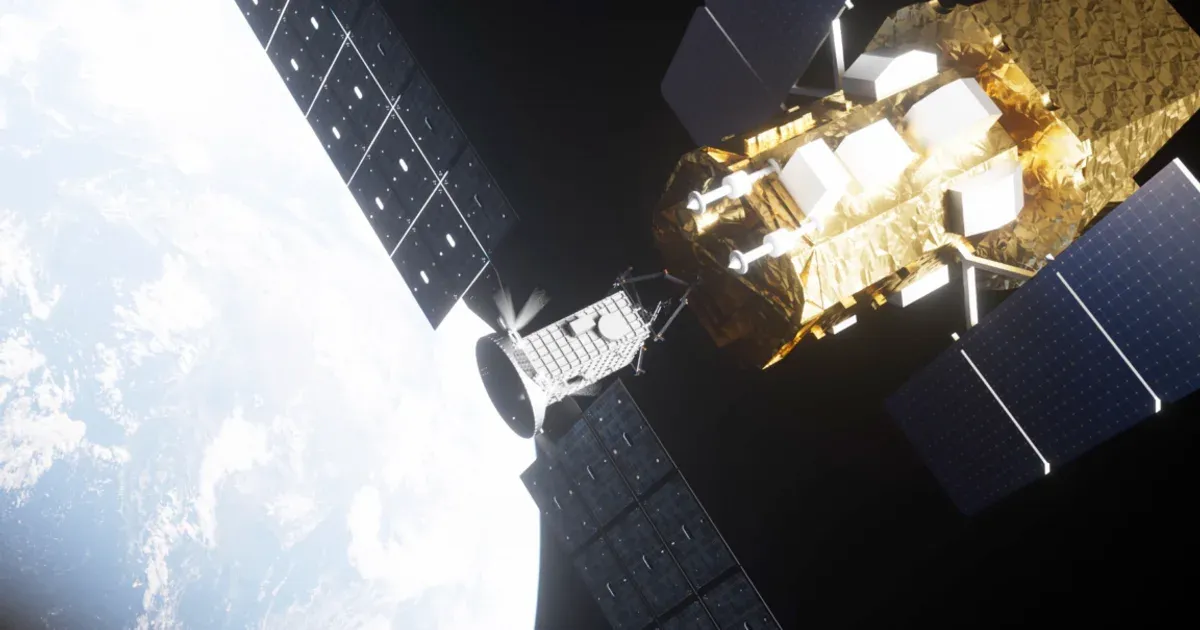
Engineers have slowed the uncontrolled rotation of Link, a servicing satellite launched to rescue NASA's Swift gamma-ray observatory. By Friday, Link was turning at about 4 degrees per second, down from roughly 9, after its operators redirected electric thrusters that were designed primarily to raise its orbit. That reduction is the clearest recovery milestone so far, but Link has not yet returned to stable three-axis pointing.
Link launched on July 3, 2026. The recovery follows a failure that began while the refrigerator-size spacecraft was more than 200 miles above Earth. Link started rotating around several axes during a pass without ground contact. Two of its three reaction wheels stopped functioning, some cold-gas thrusters developed problems and the tumbling made reliable communications difficult. Losing those components at the same time denied controllers both their usual pointing system and the steady radio link needed to diagnose it quickly.
Katalyst Space Technologies built and operates Link under a $30 million NASA contract. Its assignment is to reach Swift, attach to the observatory and lift its orbit before atmospheric drag brings the roughly $500 million science mission down. The mission had been following its plan until the control emergency. The assignment is NASA's first satellite-servicing deal with a private operator, giving the recovery consequences beyond this single observatory.
Electric Thrusters Became an Improvised Control System
The spacecraft's three xenon-fed electric engines survived the incident, along with its power supply, rendezvous equipment and robotic capture hardware. Those engines produce efficient but gentle thrust. Their two-axis gimbals let controllers aim that thrust against Link's rotation, although the low force means reducing the spin is a gradual process rather than a quick correction. Controllers have effectively repurposed an orbit-raising system as a temporary steering system while the normal wheel-based architecture remains impaired.
Stable pointing would improve the radio connection and allow Link to return more detailed engineering data. Katalyst and NASA guidance, navigation and control specialists are also rewriting the control software around the hardware that remains available. The proposed arrangement combines one working reaction wheel with thrusters instead of relying on the original three-wheel configuration. A stronger connection is also needed to download the richer telemetry that can show the precise condition of the wheels and thrusters.
The sequence after the initial failure complicated the diagnosis. Mission control went without contact for more than 24 hours before Link performed an automatic power reset. Katalyst chief executive Ghonhee Lee said the abrupt restart produced a thermal spike in electronics associated with the reaction wheels. He described the cold-gas thruster trouble as a separate issue, while acknowledging that engineers still lack enough data for a final conclusion. Because the loss of contact, reset, heat event and component failures occurred close together, the team has not separated the original trigger from later consequences.
Investigators are therefore keeping more than one cause open. The initiating event could have come from inside the spacecraft or from a collision with orbital debris. Once Link is steady, two onboard cameras are expected to check its exterior for damage. Engineers may also try to recover the two disabled reaction wheels, but regaining dependable three-axis control comes first.
A Recovery Would Still Leave the Hardest Maneuver Ahead
Time limits every step. Swift continues to lose altitude, leaving only a few months before orbital decay closes Katalyst's opportunity to perform the planned boost. The company is still aiming to move Link toward the observatory around the end of August. That schedule depends on first reducing the rotation further, widening the communications link and validating the replacement control method.
Even a stabilized Link would not immediately mean Swift is safe. The servicing craft must navigate to the observatory, approach to within a few dozen meters, inspect the target and then attempt a physical capture. Each stage demands controlled pointing from a vehicle now operating with a reduced set of actuators.
The progress from 9 to 4 degrees per second shows that Link can respond to commands through its electric propulsion system. It does not yet prove that the spacecraft can hold the precision needed for rendezvous and capture. The mission's next threshold is therefore measurable: stable three-axis control and stronger communications must come before Katalyst can decide whether the first commercial rescue attempt of a NASA satellite remains executable.