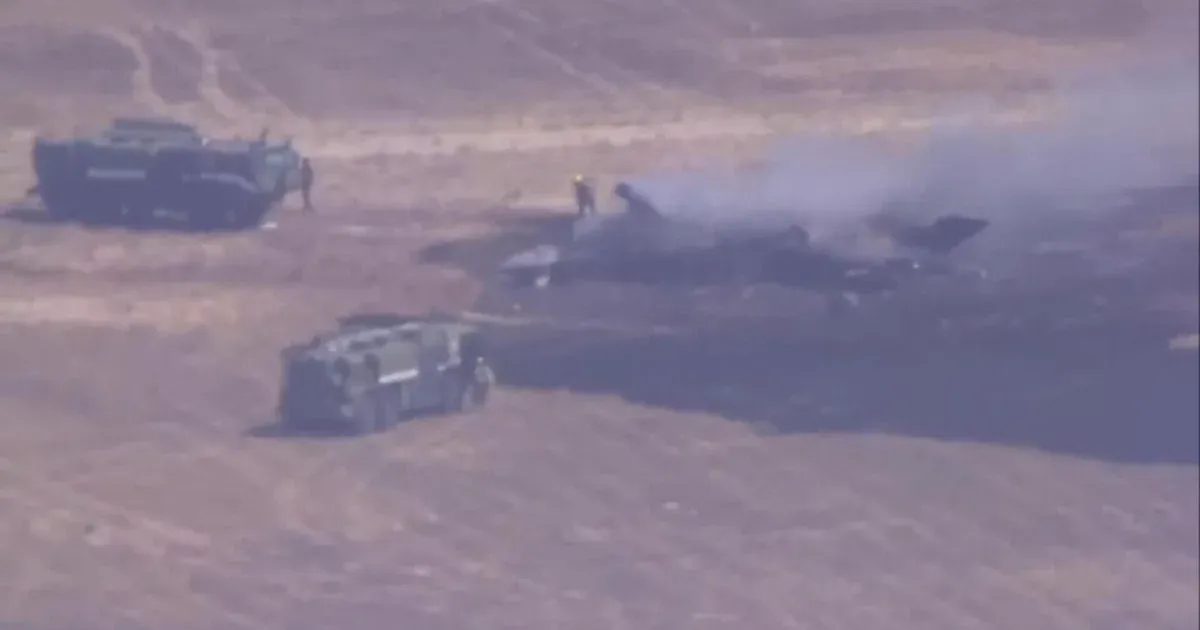
An F-35B came down inside MCAS Miramar in San Diego after its Marine Corps pilot escaped by ejection. The service said the aviator reached a hospital, remained stable and faced no life-threatening injury. The impact set off a brush fire and brought military and city emergency crews to the scene. The accident occurred on July 31, 2026, and its cause remained under investigation.
The aircraft belonged to Marine Aircraft Group 11 within the 3rd Marine Aircraft Wing. Emergency personnel responded at about 10 a.m. local time, according to a Marine spokesperson cited by Fox News. The service had not identified the pilot or explained what phase of flight preceded the crash when the reports were published.
Wreckage and Fire Drew a Joint Response
Aerial images gave the first clear view of the impact area. A separate still showed several response vehicles around the airframe and its hatch apparently open. CBS footage showed smoke rising from the aircraft as responders sprayed fire retardant, while images cited by Fox showed the wreckage in two pieces inside a scorched area roughly the size of a football field. A blaze north of State Route 52 could be seen by drivers on the freeway.
City firefighters helped control the vegetation fire; ownership of the crash scene and inquiry stayed with the military. That division matters because crews first had to suppress the immediate hazard and secure the flight line, while the Marine Corps retained responsibility for the aircraft and the investigation. CBS also verified social-media video showing black smoke from the wreck as the response continued.
Several basic operational details were still open. Officials could not say whether the jet had been inbound, outbound or on a training sortie. No timetable for additional investigative findings had been announced. Those omissions define the limit of the early account: the location and response were visible, but the sequence inside the flight operation was not.
The Pilot Survived a High-Energy Impact
The most important confirmed outcome was the pilot's recovery. Fox attributed the pilot's stable hospital status to a Friday Marine Corps release. CBS reported that the ejection occurred before responders reached the smoking aircraft. The sources did not describe the pilot's identity, the exact injuries or the altitude and speed at ejection.
Within the F-35 Lightning II family, the B model gives the Marine Corps short-takeoff and vertical-landing capability. Marine missions for the model span combat against aircraft, attacks on ground targets and intelligence collection through surveillance and reconnaissance. The wider F-35 family is also operated by the Air Force and Navy, and CBS put the cost of each aircraft at about $100 million. The B model's ability to use shorter runways and amphibious ships distinguishes it from the other variants, but the reports did not connect that capability to Friday's accident.
Miramar is about 10 miles north of central San Diego and serves as headquarters for the 3rd Marine Aircraft Wing. More than 15,000 Marines, sailors and civilian personnel work at the installation, according to CBS. The base supports fixed-wing and rotary-wing training and operational missions, placing the crash inside an active aviation complex rather than at a civilian airport.
Other F-35 accidents show why an early survival report does not answer what happened to the aircraft. In July 2025, a pilot ejected from an F-35 in California's Fresno County before the crash caused a grass fire. An Air Force pilot also ejected safely during a January 2025 training emergency in Alaska, where video showed the jet spinning before impact.
A 2024 Marine Corps case followed a different path. After the pilot ejected during technical problems in heavy rain, the F-35 continued flying for more than 11 minutes and traveled about 70 miles before crashing. The pilot landed in a driveway and called 911; searchers located the crash site the next day. Investigators later found that the pilot had ejected improperly. That history does not establish a cause at Miramar, but it illustrates how flight data, aircraft behavior and the ejection decision can produce findings that are not visible in first-day footage.
The Investigation Must Reconstruct the Missing Minutes
Miramar has also seen a fatal military aviation accident. In 2023, a Marine pilot died after ejecting from an F/A-18 Hornet that crashed on government property near the base. The Coast Guard and San Diego Fire-Rescue searched for hours before the pilot, Maj. Andrew Mettler, was found. Friday's successful recovery is a different outcome, though both events required coordination beyond the flight line.
The available evidence now falls into three separate records: the pilot's medical recovery, the fire and wreckage response, and the aircraft's operational data. Only the first two were substantially visible on Friday. Investigators still need to establish the jet's intended mission, whether it was taking off or landing, what systems were functioning and when the pilot chose to eject. The cause remains unassigned, so the meaningful next milestone is not another image of the wreckage but an official timeline that connects the flight phase, aircraft condition and ejection. Until that record is released, comparisons with earlier F-35 crashes can show the questions investigators usually face, but they cannot supply the answer in this case.