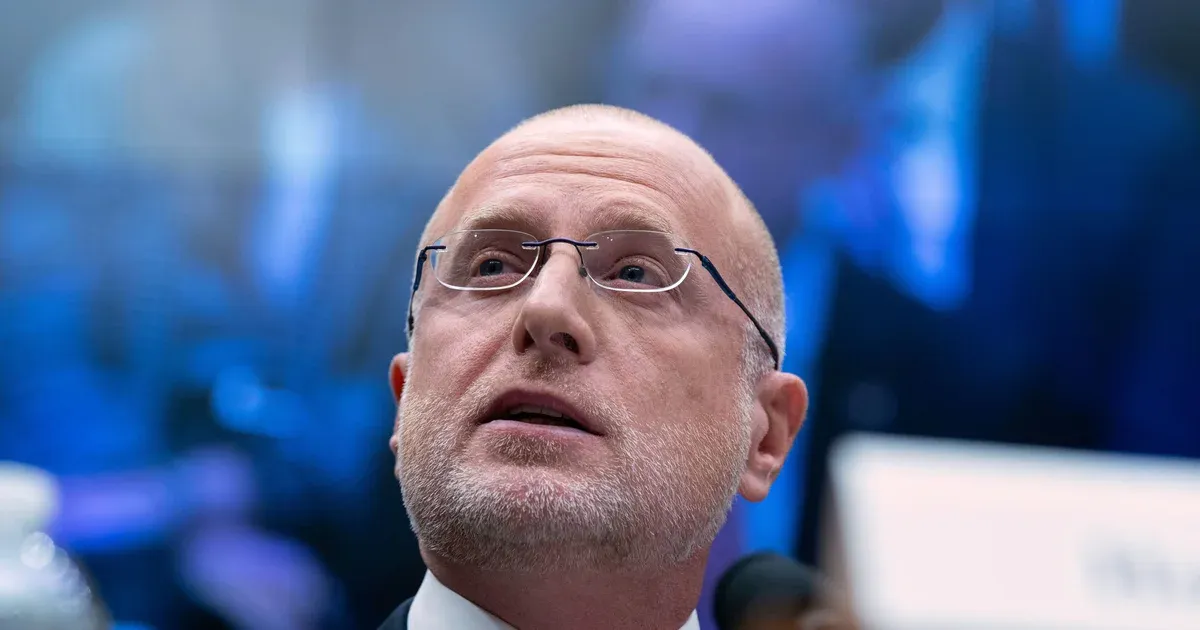
Brendan Carr arrived at the Federal Communications Commission headquarters on Monday with a message that sent a chill through the media industry. He stood before a room of broadcast executives and stated that the federal government is prepared to revoke operating licenses for outlets that fail to provide what he termed accurate coverage of the ongoing war in Iran. Carr holds the chairmanship of the Federal Communications Commission and wields broad power over the airwaves. He argued that the privilege of using public spectrum comes with an enforceable obligation to serve the national interest. This administrative posture aligns with a broader effort to tighten oversight of news organizations during periods of military conflict. Donald Trump has spent the last several weeks criticizing major networks for their reporting on the Persian Gulf. He claims that television news outlets are prioritizing casualty counts over strategic victories, which he describes as a form of media malpractice. The president frequently uses social media to call for investigations into the licensing of companies like Comcast and Disney. Carr is now providing the regulatory muscle to back that language. He emphasized that the agency will scrutinize every renewal application with a new focus on factual integrity and national security impacts. Every major network now faces a period of extreme regulatory scrutiny.
The FCC warning risks turning war coverage from a journalistic question into a licensing threat.
FCC Warning Targets War Coverage
Broadcasters operate under a structure established by the Communications Act of 1934. Under Section 309 of this act, the commission must determine if a license renewal serves the public interest, convenience, and necessity. Carr suggested that the definition of public interest has shifted during the Iran conflict. He noted that the commission has broad discretion to define what constitutes a violation of these terms. Critics argue that this interpretation is a radical departure from decades of hands-off regulation regarding news content. The commission traditionally avoided content-based restrictions to prevent political interference. Licensing cycles occur every eight years, and several major station groups in large metropolitan areas are now approaching their renewal deadlines. These stations are the primary revenue drivers for their parent companies. If a single flagship station in New York or Los Angeles loses its license, the financial chain reaction would be devastating. Carr indicated that the commission will no longer treat these renewals as rubber-stamp procedures. He pointed to specific examples of war coverage that he believes crossed the line into active disinformation. The agency is now drafting a new set of guidelines for wartime reporting standards. Broadcasters have been put on notice that their failure to report accurately on the national defense effort is a breach of their public trust.
Legal experts suggest that any attempt to revoke a license based on editorial content will face immediate challenges in the D.C. Circuit Court of Appeals. The First Amendment provides strong protections against government-led censorship. Brendan Carr maintains that the commission has the statutory authority to act when the public interest is at stake. He cited historical precedents where licenses were revoked for technical violations or lack of candor. By expanding these criteria to include news accuracy, the commission is entering uncharted legal territory. The administrative process for revocation can take years to resolve in the courts.
Licensing Power Raises Press Concerns
Donald Trump has focused his criticism on specific segments of evening news broadcasts and Sunday morning talk shows. He has labeled certain reports on Iranian drone capabilities as intentional efforts to weaken American morale. White House officials have met with Carr multiple times to discuss the feasibility of using regulatory levers to influence media behavior. These meetings focused on the legal vulnerabilities of media conglomerates that rely on federal approval for their telecommunications operations. Trump has argued that the press should be treated as a hostile entity when its reporting contradicts official military briefings.
Republican lawmakers in the House of Representatives have echoed these calls for accountability. They argue that the media has been given a free pass to report unverified claims from foreign adversaries. Democrats on the commission have dissented, claiming that Carr is turning the agency into a political weapon. Commissioner Geoffrey Starks warned that using license renewals to punish speech is a hallmark of authoritarianism. The internal divide at the commission has reached a boiling point, with staff members reporting an atmosphere of intense political pressure. Public comment files for pending license renewals are already filling with thousands of complaints from viewers.
Market stability depends on the predictability of the rule of law.
Networks Face Market and Legal Risk
Investors have reacted with caution to the escalating tension between the regulator and the regulated. Media stocks have shown increased instability as the threat of license challenges becomes more real. Analysts at Goldman Sachs estimate that the top three broadcast groups have a combined market valuation of over $140 billion, much of which is tied to the stability of their local affiliate licenses. A move to revoke even a single license would trigger a major sell-off in the sector. This fiscal reality has forced media executives to reconsider their editorial tone in recent days. Advertising revenue is also at risk as brands worry about being associated with controversial news programming.
The commission is looking into the ownership structures of networks that have foreign investment. Carr has suggested that foreign capital may be influencing the editorial slant of certain newsrooms. The investigation adds another layer of complexity to the licensing debate. The commission has requested detailed financial records from several prominent media organizations. The inquiry is expected to last through the summer months. Industry lobbyists are working around the clock to prevent the adoption of these new reporting mandates.
Constitutional scholars are debating the limits of the FCC's power in this new environment. The Supreme Court has historically allowed some regulation of broadcast media that would be unconstitutional for print or digital platforms. The distinction is based on the scarcity of the electromagnetic spectrum. But many argue that the rise of cable and internet has rendered the scarcity argument obsolete. If the Supreme Court chooses to revisit this doctrine, the commission's power could be severely curtailed. For instance, the landmark Red Lion case once upheld the Fairness Doctrine, but that precedent has been weakened over time.
Administrative compliance has become the new metric for journalistic survival. The commission is effectively asking newsrooms to prove a negative by showing their coverage is not harmful to the national interest. The burden of proof is difficult to meet when the definition of harm is subjective. Many news directors have reported a surge in internal memos urging caution when reporting on sensitive military data. The long-term impact on investigative journalism could be serious if reporters fear that a single story could end their station's existence. Licensing hearings for the next round of renewals are scheduled to begin in May.
Accuracy Cannot Become a Threat Tool
Administrative aggression often masquerades as a defense of the public good. The current maneuvers by Brendan Carr and the White House are nothing less than a targeted strike on the structural foundation of the American free press. By weaponizing the mundane process of license renewals, this administration is attempting to achieve through bureaucracy what it cannot achieve through the courts: a compliant media. The pretense that this is about accuracy or the public interest is a transparent fiction. It is about control.
For decades, the FCC has served as a neutral arbiter of technical standards and localism, but that era is dead. What we see now is the transformation of a regulatory agency into a Ministry of Truth. If the industry does not fight back with every legal resource available, the very concept of an independent broadcast newsroom will become a relic of the past. The financial markets are already pricing in the cost of this submission, and the public will pay the price in the form of sanitized, state-approved information.
It is not a policy shift; it is a hostile takeover of the airwaves by a government that views dissent as a threat to national security. The time for polite industry pushback has passed.