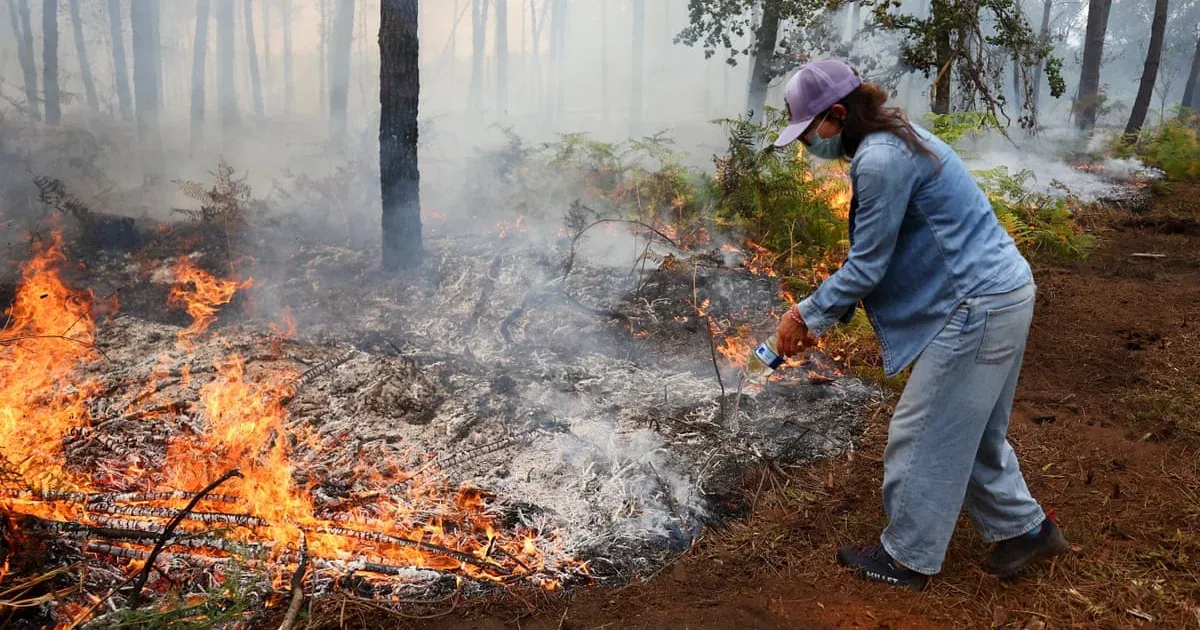
Europe's wildfire emergency has widened from a fight around separate fire lines into a mass movement of residents, tourists and emergency personnel. Authorities in France and Spain now report that 267,000 people have been evacuated, while smoke from the Spanish fires has pushed the public-health response into Madrid.
The latest totals were reported on July 25, 2026, after another 25,000 people were ordered out of communities west of the Spanish capital. France counted 197,000 evacuees around Bordeaux and Spain counted 70,000, nearly doubling the combined figures available when the Madrid fire fronts merged a day earlier.
The 267,000-person evacuation has become the central fact of the emergency. Fire crews still have to defend homes and contain new fronts, but national authorities must also move people through limited road networks, maintain shelters, supply medical care and keep instructions current as wind changes the direction of the threat.
France Adds Military Lift as Spain Clears the Tiétar Valley
France has assigned 1,500 soldiers to the south-western response. Their work includes helping with evacuations, transport, temporary accommodation and medical support. The armed forces are also contributing earth-moving equipment, drones, helicopters and an A400M transport aircraft adapted to carry water, giving civilian commanders more ways to move supplies and attack fire beyond the reach of ground teams. Prime Minister Sébastien Lecornu called another crisis meeting after the government accelerated the aircraft deployment and widened military support.
Gironde's burned area has passed 32,000 hectares. That regional total alone is about 46 percent of all the land recorded as burned in France this year. Data from the European Forest Fire Information System put the national 2026 figure at 69,473 hectares. The earlier annual high in the record, which starts in 2006, was 66,337 hectares in 2022. The comparison measures total area burned, not the cause of individual fires, but it shows the cumulative demand placed on crews before the current fronts are contained.
An evacuation order covering about 30,000 people cleared the Tiétar Valley in Ávila province. Other departures included the Entrepinos estate and the Madrid-area communities of Cenicientos, Cadalso de los Vidrios and Las Rozas de Puerto Real, as well as Piedralaves, La Adrada and several neighboring towns in Ávila. The breadth of the list shows how a fast-moving perimeter can turn several local departures into one regional transport operation. Spain's Civil Guard also warned that unrelated fire images and false information were circulating, making verified evacuation notices part of the safety response.
Smoke added a second hazard away from the flames. Spain's health ministry said fine-particle pollution in Madrid had climbed well above World Health Organization recommendations. Residents were told to reduce outdoor activity, use protective masks and eye protection in smoke or ash, and seek medical attention for breathing difficulty or chest pain. That advice extends the affected population beyond people facing immediate evacuation, including residents with respiratory illness and workers who would otherwise remain outdoors.
European support is now divided between the two national responses. The EU's rescEU fleet has placed five planes and two helicopters in France, with four more planes due in Spain. Copernicus emergency mapping is also being used to track the changing fire zones. Aircraft can widen the area crews reach, while the maps help officials decide which roads, towns and reception centers may come under pressure next. The two tools serve different clocks: water drops target active flames, while updated mapping supports decisions that must be made before a route or settlement becomes unsafe.
The Emergency Is Now a Test of Civilian Logistics
France and Spain have crossed the point where firefighting strength alone describes the response. The movement of 267,000 people requires a parallel system of buses, shelters, medical teams, traffic control and verified public information. France's troop deployment matters because those jobs continue even when aircraft are grounded by smoke or crews are reassigned to a new fire edge.
The next operational measure is whether that system remains ahead of the wind. Madrid's air warning shows that risk travels beyond an evacuation boundary, while the Gironde record shows how quickly a long fire season can consume national reserves. If authorities lose time moving people or supplies, additional engines cannot reopen a blocked route. The hard limit is now the speed at which a changing fire map can be converted into safe movement on the ground.