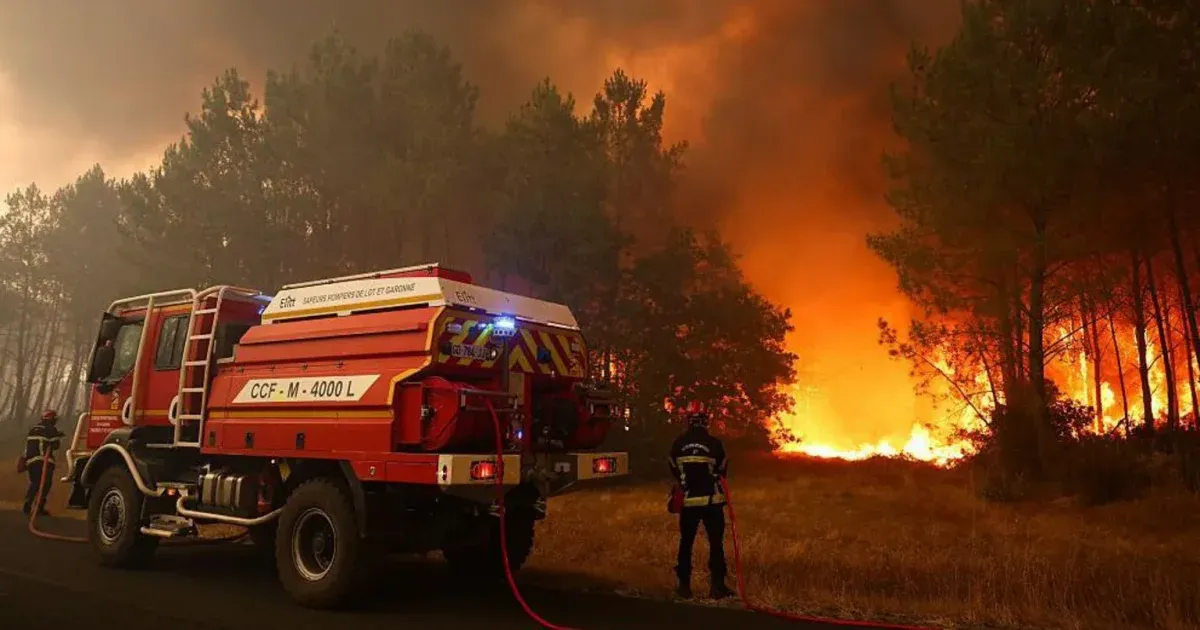
Wildfires around France's Arcachon Bay have forced about 12,000 people to leave and prompted authorities to move another 8,800 from exposed communities. Roughly 700 firefighters were working across the Gironde region on July 23, 2026, after flames burned through about 3,400 hectares of land.
The largest movement centered on campsites and villages along the Lège-Cap-Ferret peninsula. No injuries had been reported by Thursday, but officials closed roads and forest sites as rising temperatures and strengthening winds made the fire harder to predict. The operation included thousands of summer visitors unfamiliar with local evacuation routes.
Campsites Emptied as Wind Complicated the Fire Line
Gironde prefect Sophie Brocas said 10,000 campsite visitors were among those evacuated overnight. A further transfer was proceeding in Claouey on the shore of Arcachon Bay. The peninsula's normal holiday traffic added a practical risk: a single main route had to carry people away while emergency crews and equipment moved toward the fire. Officials also had to keep reception sites ready for travelers who might not have nearby relatives or alternative accommodation.
Fire service chief Marc Vermeulen said crews had worked through the night and could not ease their response as the wind changed. Variable direction can push flames toward areas that looked safer only hours earlier, while dry vegetation can create new fire fronts faster than residents can judge from smoke alone. That uncertainty explains why officials ordered precautionary moves before reporting casualties.
Residents described ash and pieces of burned bark falling in Le Porge before police directed families to a neighboring town. One family told the BBC that the speed of departure forced them to leave pets behind. The account illustrates the narrow window between recognizing danger and joining an organized evacuation, especially when a fire advances through forest around scattered coastal settlements. Reuniting families with animals and retrieving essential belongings will become part of the recovery only after officials decide that return routes are safe.
The Gironde response followed the deaths of two firefighters battling a separate blaze near Bordeaux airport earlier in the week. In the Var region of south-east France, residents were allowed to inspect their homes but were asked to limit travel because stronger wind could reignite the fire. Those incidents unfolded during Europe's prolonged heatwave emergency, which has strained public services across several countries.
Spain and Italy Face Their Own Evacuations and Losses
The French fires were part of a wider southern European emergency. West of Madrid, authorities ordered about 3,500 residents of Aldea del Fresno to leave as an uncontrolled blaze approached. People in nearby Almorox received similar instructions a day earlier. Officials said about 890 hectares had burned there even though firefighting work kept the perimeter from expanding.
Spain's largest fire of the year had already burned more than 35,000 hectares in Guadalajara, north of Madrid. Temperatures reached at least 42C in parts of the country, and European monitoring data indicated that Spain had recorded more fires in 2026 than during all of 2025. Some residents were returning home, but the separate fire zones showed that relief in one province did not end the national pressure on crews.
Italy also recorded more than 350 fires in Sicily, including 10 major incidents that led to precautionary evacuations. Firefighter Alessandro Marchi died while responding near San Cataldo, and another firefighter was injured. Regional civil protection officials said the fires had human causes, placing prevention and public order alongside weather and suppression as parts of the response.
The current season follows a year in which wildfire-burned area and fire emissions reached record levels in Europe, according to a Copernicus report cited by the BBC. Copernicus also found above-normal annual heat across at least 95 percent of Europe during 2025 and described the region as warming more rapidly than any other continent. Those figures do not establish the cause of any individual ignition, but they describe conditions in which fires can spread more aggressively once they begin.
The Gironde Evacuation Shows the Price of Uncertain Fire Movement
Gironde's immediate success is measured first by the absence of reported injuries, not by the number of hectares crews can save. Moving residents and visitors before the wind peaks gives firefighters room to work without dividing aircraft, vehicles and personnel between rescue and containment. It also reduces the chance that holiday traffic will block the same roads needed for water trucks and evacuation buses.
The next operational burden will last beyond the first safe return. Authorities must verify damaged roads and utilities, prevent flare-ups, account for displaced visitors and keep routes open while weather conditions change. The 20,000-person movement near Arcachon Bay shows why wildfire planning in tourist regions has to include temporary populations: the people most likely to need rapid instructions may also be the least familiar with the landscape, the exits and the speed at which a forest fire can redraw both.