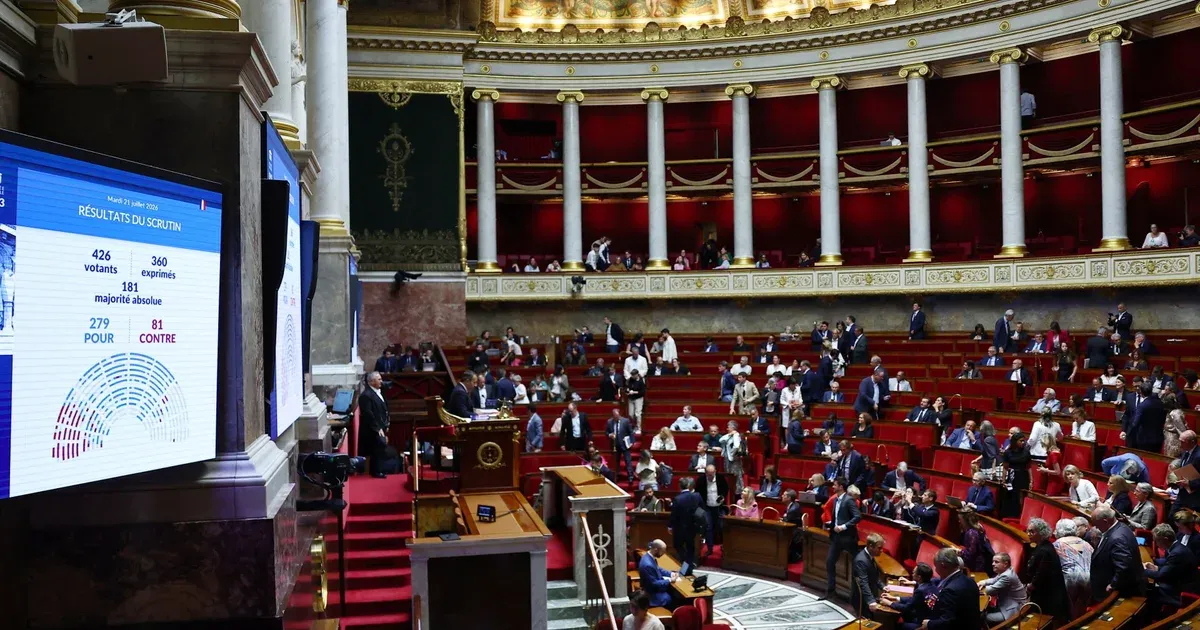
France has approved a national ban on social media accounts for children younger than 15, moving ahead of a wider European debate over screen time and online safety. The legislation also extends the prohibition on mobile phones in schools to high schools, where students had remained outside rules already applied at younger levels. It combines limits on personal devices during the school day with an account rule that follows children beyond the classroom.
Both chambers backed the bill on Tuesday. The National Assembly passed it by 279 votes to 81 after the Senate gave its approval, making France the first European Union member to adopt a blanket social media age cutoff. President Emmanuel Macron has made the proposal a major domestic initiative and wants the restrictions operating before the next school term.
New accounts held by children below the cutoff are due to be barred from September 1, 2026. Platforms would then have four months to identify and close existing profiles, bringing those accounts under the rule in January 2027. That split schedule prevents a single-day closure of every affected account while giving services a firm deadline for older registrations.
New Accounts Close First, Existing Profiles Follow
The ban covers the social features of large platforms rather than every digital service used by a child. Online encyclopedias and educational or scientific directories are exempt. Laure Miller, the bill's rapporteur in the National Assembly, said services such as YouTube and WhatsApp would need age checks where they operate like social networks, including public channels, shared content and comments.
Passive video viewing and private exchanges between individuals would not be caught in the same way under Miller's explanation. The distinction matters because it asks a multipurpose service to separate social publishing from basic communications instead of treating its entire product as a prohibited network. The final boundaries will influence which screens require verification and which remain available without it. A teenager might be able to watch a public video or message a relative while being barred from posting comments or running a channel.
France is following Australia, which introduced a cutoff for users under 16, while Britain's under-16 restriction has also been approved for younger teenagers. The French threshold is lower and its start is nearer. Those differences deny platforms a single international rulebook: an account that is permitted in one market may require a different age test, product design or access setting in another. Cross-border travel and children who created accounts abroad will also test how platforms assign a user to the French regime.
Age Checks Put Enforcement in Platforms' Hands
Social media companies will have to use an age-verification method accepted by France's privacy regulator. Digital Minister Anne Le Hénanff argued that usable tools already exist and others are being developed. Opponents questioned whether a dependable system could be deployed across major services during the summer and who would perform the checks in practice. Approval will have to cover accuracy as well as privacy because a weak estimate could lock out adults or admit children.
Verification creates a second policy problem alongside child safety: proving age can require information that users do not ordinarily hand to a platform. France Unbowed lawmakers warned that the measure could weaken online anonymity and said enforcement may be unworkable. The government says personal data will be protected, but the technical standard will determine how much information a service sees and whether an adult can verify without surrendering an identity document to each company.
Platforms have generally favored account controls and age-specific settings over national bans, though they say they will obey local laws. A public health assessment in France previously linked TikTok, Snapchat and Instagram to harm among adolescents, particularly girls, while stopping short of treating social media as the sole cause of declining mental health. Families have also brought lawsuits against TikTok alleging that harmful material contributed to teenage suicides.
Two Legal Reviews Stand Between the Vote and Enforcement
Parliamentary approval does not guarantee the September start. France's Constitutional Council can examine the law before implementation, and Macron acknowledged that step when celebrating the vote. A referral could preserve the measure, narrow it or delay the timetable if judges find that age verification or account closures conflict with constitutional protections.
European Union law supplies another layer of scrutiny. The European Commission is developing rules on minors' access to social networks and will assess whether France's approach fits existing obligations for online platforms. A national measure that overlaps the EU's digital framework could face pressure over which authority sets verification duties and how services operating across the bloc must comply. France cannot settle that conflict by domestic vote alone when the same platform serves users through a single European system.
The September deadline therefore depends on more than technical readiness. Regulators must settle a privacy-preserving age check, courts must leave the core restriction intact, and platforms must distinguish public social functions from exempt communications. If any one of those pieces remains unresolved, France may hold the first EU vote for a blanket child-account ban without becoming the first country to enforce one on the date promised.