Rescue crews found 67 people alive after the government ferry MV Barima capsized off Guyana with 133 passengers and crew aboard. The vessel overturned late on July 18, 2026, during a voyage from Georgetown to Port Kaituma. The confirmed survivor count left 66 others unaccounted for as boats and aircraft continued searching the Atlantic coast.
The manifest listed 116 passengers and 17 crew members. Prime Minister Mark Phillips said the rescued group included 41 men, 11 women and 15 children. The public count rose quickly from eight people found in the first response to 53 and then 67 as private boats reached the area. Each figure described a different point in the operation; 67 was the latest total confirmed across the main news-agency reports. Authorities had not announced any confirmed deaths or released a list of the missing while the search remained active.
The Distress Call Came Nearly Eight Hours After Departure
The MV Barima left Georgetown at about 3:15 p.m. and sent a distress call at 11:01 p.m., according to Guyanese officials. Nearly seven hours and 46 minutes had passed between departure and the alert. The call reached an air-traffic control tower and triggered a response by the coast guard, government agencies and privately operated boats. Officials placed the capsizing near the Pomeroon River on Guyana's North Atlantic coast, along the route toward the country's northwest.
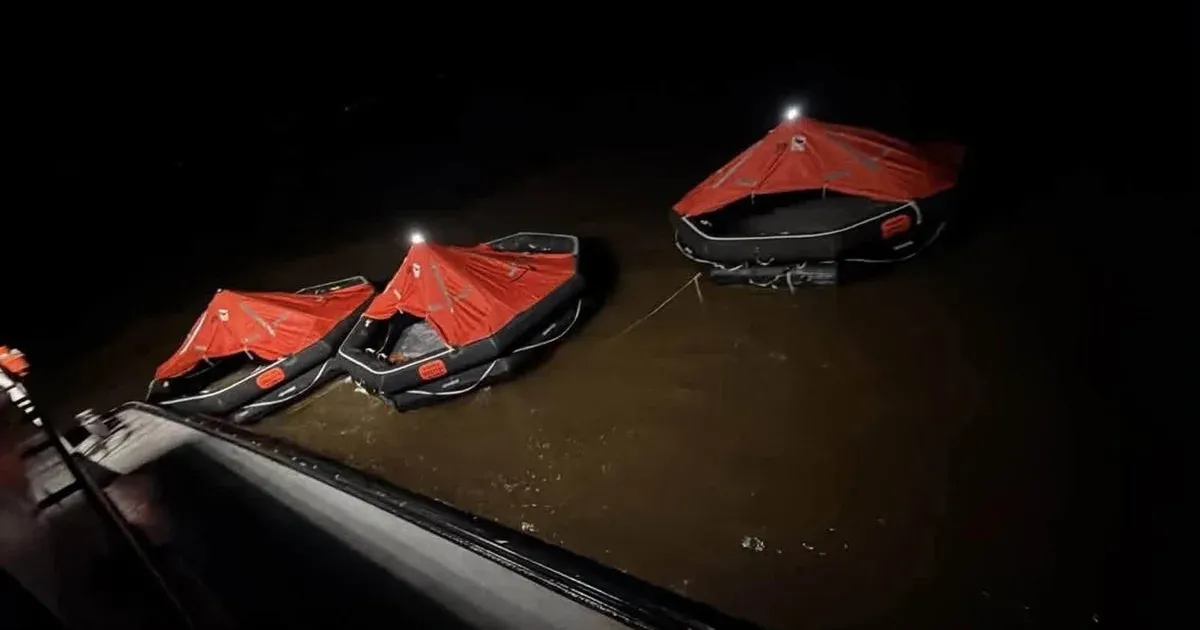
Early rescue reports said emergency signals and flares helped crews locate the ferry about 10 nautical miles from shore. The vessel carried 250 life jackets, two rigid life rafts and six inflatable rafts, Public Works Minister Juan Edghill said. Photos distributed by the Guyanese government showed red covered rafts on the dark water beside a rescue vessel.
Edghill rejected claims that excess passengers or cargo caused the ferry to capsize. He said survivor accounts pointed to the tide, but authorities had not published a technical finding. Vessel-tracking records describe the MV Barima as an approximately 40-meter ship built in 1939. Its age does not establish a cause; maintenance records, loading data and a physical inspection are needed before investigators can connect the condition of the vessel to the loss. Access to safety equipment will also require evidence from the crew, survivors and the wreck rather than an explanation drawn from the first night alone.
Aircraft and Fishing Boats Spread Across the Search Area
Helicopters, fixed-wing aircraft, coast guard vessels and fishing boats were assigned to a search area of roughly 1,000 square miles. The mix reflected both the scale of the missing-person count and the distance that people or rafts could move after the capsizing. Aircraft supplied broad visual coverage, while fishing and patrol boats could recover people from the water. Medical teams were sent toward the landing points where survivors were being brought ashore.
The MV Barima makes weekly trips to Port Kaituma and communities in Guyana's North West District, including largely Indigenous settlements near the Venezuelan border. The ferry carries cargo as well as passengers, making the route a transport link for places that have fewer overland connections to Georgetown. Its scheduled service also means passenger and crew records should provide the starting list for reconciliation. Emergency family-assistance centers were opened so relatives could seek official information while names were being checked.
Nightfall, coastal currents and the gap between departure and distress complicated the first search pattern. A person in a raft, a person wearing a life jacket and debris from the ferry would not necessarily follow the same path. Aircraft could scan wider areas in daylight, while smaller vessels could approach survivors and transfer them to medical care. Search planners therefore had to keep revising the area as each rescue supplied a new position and time.
The passenger and crew breakdown is essential to reading the figures correctly. Reports referring only to 116 people were counting passengers and leaving out the 17 crew members; the full number aboard was 133. With 67 rescues confirmed, authorities still had to locate or account for 66 people before the manifest could be closed. Questions about the cause and the ferry's equipment remain necessary, but they do not replace the immediate task of matching every name to a survivor or a verified search result.