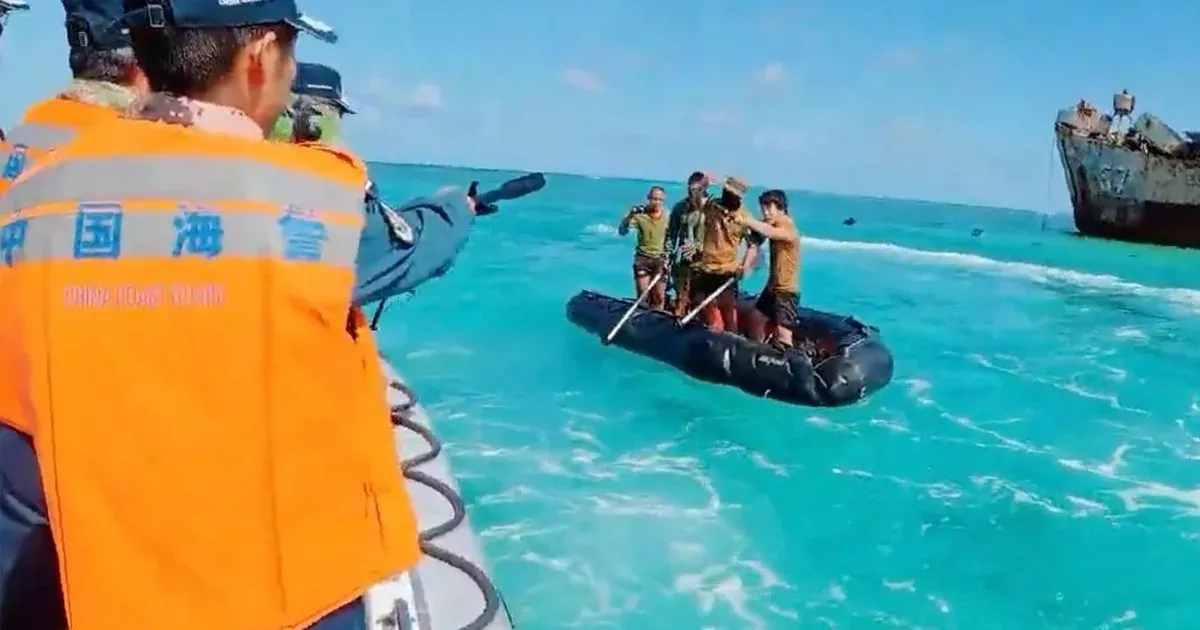
Chinese and Philippine personnel confronted one another at close range near Second Thomas Shoal, turning a disputed patrol into a physical clash captured in competing videos. The Philippine military said a Filipino crew member was hit in the head with sticks and injured. The China Coast Guard countered that Philippine boats rammed its patrol craft and struck first.
The confrontation occurred on July 20, 2026, near the rusting Philippine warship that has anchored Manila’s presence at the reef for nearly three decades. Both governments described their own crews as responding to aggression. Their accounts agree on the place, the small boats involved and the use of sticks or similar objects, but they assign responsibility in opposite directions.
The timing gives the encounter weight beyond the injuries and damaged equipment. Manila is scheduled to host Chinese Foreign Minister Wang Yi for an ASEAN foreign ministers’ meeting, with separate talks expected between him and his Philippine counterpart. A maritime dispute that diplomats might have discussed in procedural language will now arrive with fresh footage and an injured service member.
Two Videos Present Opposing Accounts of the Encounter
According to the China Coast Guard, one of its small vessels was patrolling near Second Thomas Shoal at about 9 a.m. when two rubber dinghies left the grounded Philippine ship. Beijing’s account said the dinghies ignored warnings, approached dangerously and rammed the Chinese craft from the front. It said Chinese personnel used verbal warnings, evasive maneuvers and proportionate countermeasures. The agency demanded an end to what it called Philippine provocation and false publicity, while promising to continue patrols intended to enforce China’s maritime claims.
The Armed Forces of the Philippines released a different video sequence. Manila said men on the Chinese speedboat hit one of its sailors several times around the head and damaged the Philippine dinghy. Philippine reports said the injured man received first aid after returning to the Sierra Madre. The available report did not provide an independent medical assessment or a complete, uninterrupted recording of the encounter.
That evidentiary gap matters because short clips can establish that contact and blows occurred without settling how the confrontation began. China circulated four clips through a Beijing-based maritime tracking group and said they proved the Philippine side initiated the action. Manila’s footage focused on the strikes against its crew. Neither presentation, as described in the available report, supplies a neutral camera angle or an agreed timeline covering every maneuver. The dispute therefore turns on sequence as much as the visible use of force. Each release supports the allegation its government wants regional audiences to see, while leaving the moments before the clash contested.
The Sierra Madre Keeps a 27-Year Dispute in Motion
The shoal is called Ayungin by the Philippines and Renai Jiao by China. In 1999, Manila deliberately grounded the BRP Sierra Madre, a World War II-era landing ship, on the reef and stationed marines aboard it. The deteriorating vessel functions as a military outpost, making supply and repair voyages recurring tests of access rather than routine trips.
Beijing has repeatedly demanded the ship’s removal and has intercepted Philippine missions heading toward it. Those encounters have made water cannons, blocking maneuvers and collisions familiar features of the contest. Physical blows between personnel narrow the distance between coercive patrol tactics and an incident that political leaders may struggle to contain.
The clash also followed the tenth anniversary of the Hague tribunal ruling that rejected most of China’s asserted historic and economic rights across the South China Sea. Beijing refused to participate in the case and does not accept the decision. Manila continues to treat the ruling as legal support for its maritime position. That unresolved divide is why a single meeting at sea is interpreted through incompatible claims of lawful enforcement and unlawful intrusion.
The danger is not confined to the boats seen in Monday’s footage. An earlier examination of how the South China Sea dispute could draw in the United States showed how local confrontations can acquire wider strategic consequences. The immediate facts here remain narrower: two claimants, small craft and contradictory accounts. Yet repetition makes every new contact part of a larger calculation about which side will yield access.
Manila Talks Must Separate De-escalation From Competing Claims
The coming meeting gives Wang Yi and Philippine officials a prompt opportunity to address the operational conduct that produced the clash. They do not need to resolve sovereignty to establish clearer distances between small boats, workable warning procedures or a method for handling injuries and property damage. Such measures would not concede either government’s claim, but they could reduce the chance that a crew-level decision dictates the diplomatic agenda.
Neither video release is likely to change the legal positions held in Beijing or Manila. The more practical measure of the talks will be what happens during the next Philippine mission to the Sierra Madre. If patrol crews return to the same close-range methods, formal expressions of restraint will carry little operational value. A durable result requires rules that remain usable when both sides believe they are enforcing the law in the same stretch of water.