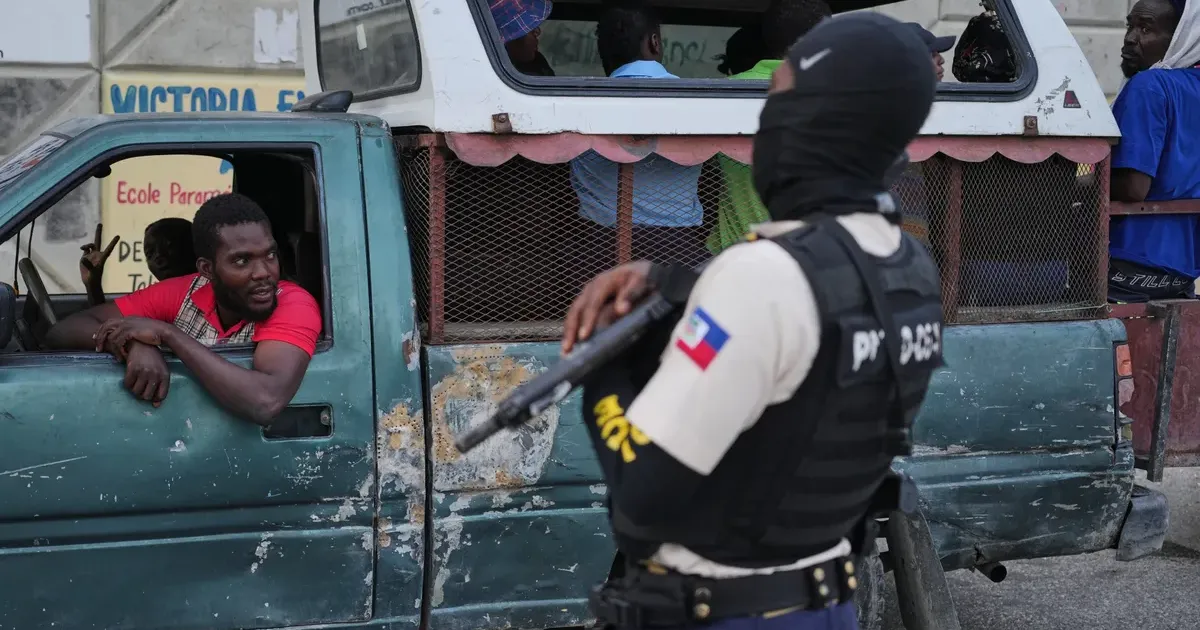
The Gran Grif attack near Petite-Riviere de l'Artibonite showed that Haiti's gang crisis can no longer be treated as a Port-au-Prince emergency with rural consequences. The violence has moved into Artibonite, the country's agricultural heartland, where roads, fields, markets and river crossings are now part of the fight for power.
The March 29, 2026 attack left a death toll that remained contested in the first reports. Haitian police initially reported at least 16 people killed and 10 wounded. Human rights groups and UN-linked reporting later put the possible toll at about 70, with at least 30 wounded, dozens of homes burned and nearly 6,000 people forced to flee. That gap in figures is itself part of the crisis: when armed groups control roads and communications fail, even counting the dead becomes dangerous.
The Numbers Are Preliminary, Not Minor
The lower official count should not soften the scale of what happened. Rights monitors described bodies left in the streets, homes burned and families fleeing without reliable access to medical care, food or shelter. Amnesty International said authorities had confirmed at least 16 deaths while the UN's representative in Haiti reported that at least 70 people may have been killed.
The discrepancy requires careful wording, not hesitation. The responsible frame is that dozens were killed, the toll may be far higher, and the attack produced mass displacement. In Haiti's current security environment, preliminary figures are often shaped by the simple fact that police, civil protection teams and journalists cannot safely enter attacked communities quickly.
Jean-Denis Shows How Control Works
AP reporting from activists in the area said Gran Grif remained in control of the Jean-Denis neighborhood after the attack and had set up roadblocks. Haitian police, backed by Kenyan personnel from the UN-supported mission, rescued some residents but were delayed by barriers and damaged access routes.
"Only the gangs have control," activist Bertide Horace said.
The quote explains the policy failure. A massacre is not only a burst of killing. It is a method of territorial rule. If residents flee, crops are abandoned. If roads are blocked, food and medicine do not move. If bodies cannot be collected safely, fear becomes another weapon. Gran Grif does not need to occupy every house to govern the area; it needs enough checkpoints, firepower and fear to decide who moves.
Artibonite Is A Food-Security Front
Artibonite is important because it is Haiti's breadbasket. The department is tied to rice production, rural trade and routes linking central Haiti with the capital and the north. When gangs expand there, the effect is not limited to the immediate victims. Farmers lose planting time, families lose tools and livestock, and markets lose the food that would normally travel through contested roads.
The attack should therefore be read as both a security event and an economic shock. A roadblock in Artibonite can become a tax point, a kidnapping site, a smuggling route or a choke point for food. The capital remains central to Haiti's collapse, but the countryside is no longer just absorbing people displaced from Port-au-Prince. It is becoming a battlefield with its own strategic value.
Vigilante Defense Carries Its Own Risk
Gran Grif's latest violence also grew out of a wider pattern of gang clashes with local self-defense and vigilante groups. Many communities have turned to such groups because police protection is thin or absent. In the short term, that can feel like the only possible answer to armed impunity.
The danger is that self-defense can become permanent local militarization. Haiti's Bwa Kale movement emerged from the same vacuum, with many residents seeing it as protection after years of kidnappings and killings. But where courts, police and prosecutors cannot function, revenge killings, mistaken accusations and rival checkpoints can harden into another layer of violence. The state disappears, and every armed group claims to be order.
International Support Has Not Matched The Spread
The UN-backed security effort has struggled to keep pace with the geography of the crisis. International attention and operations have focused heavily on Port-au-Prince, where gangs control much of the capital. But AP, UN and rights reporting show that criminal groups have also seized swaths of central Haiti and pushed into departments that once felt more distant from the main conflict.
By July, later reporting described an even wider national picture: violent incidents rising across rural departments, nearly 6,000 people killed in gang violence in 2025, and more than a tenth of Haiti's population displaced. The Kenyan-led mission had not stopped the expansion, and the transition toward a larger UN-backed force left a gap that gangs could test.
The Rural Collapse Is Now The Warning
Gran Grif has long been described by the UN as the largest gang in Artibonite and a major source of civilian deaths in the department. The March attack did not come from nowhere. It followed years of massacres, kidnappings, extortion, sexual violence and the use of roads as instruments of control.
Haiti cannot stabilize if Artibonite keeps falling deeper into armed rule. A government that cannot protect its food-producing region cannot protect its future supply lines, schools, clinics or local economies. Port-au-Prince still matters, but treating the capital as the whole crisis leaves rural families exposed and gives gangs room to learn that massacres can move borders.
The most damning part of this story is not that Gran Grif killed again. It is that the attack fit a pattern everyone could already see: weak state presence, delayed international capacity, blocked roads, displaced families and armed groups turning territory into income. Once that pattern reaches the breadbasket, the crisis is no longer only about security. It is about whether Haiti can still function as a country.