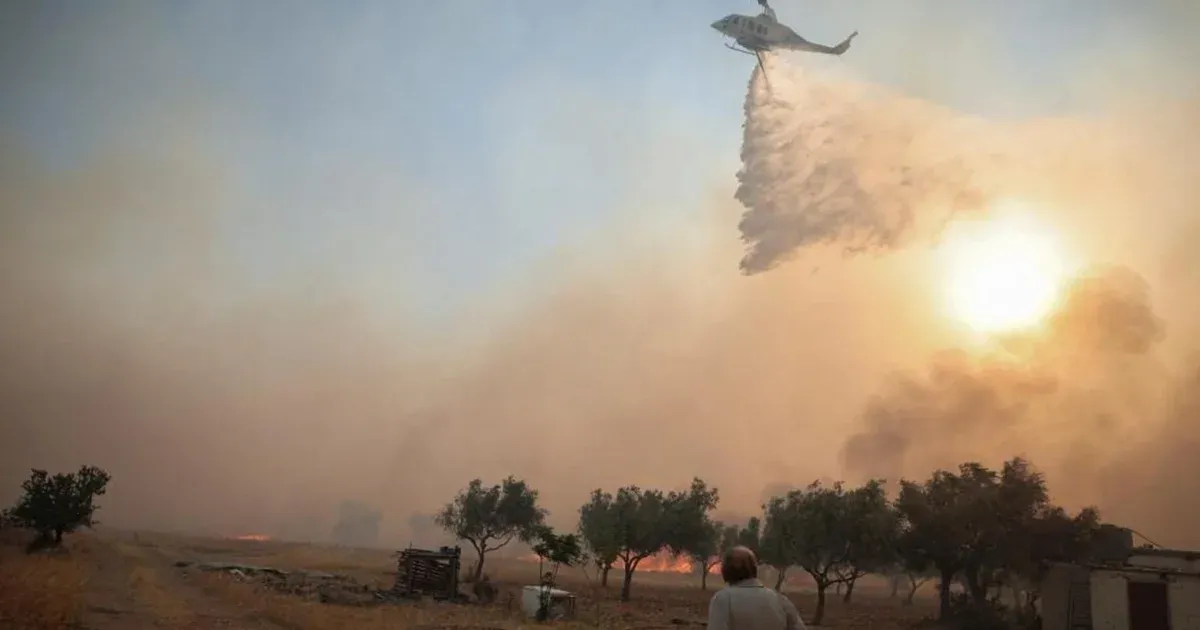
Two crew members were killed when firefighting helicopters collided west of Athens, adding a fatal aviation accident to a wildfire response already stretched across several fronts. Greece's fire service said the other helicopter's two crew members survived the crash near Psatha, where aircraft had been supporting crews on the ground.
The collision happened on August 2, 2026, during an operation in the Attica region. The Independent's latest account identified those killed as a Greek and a Danish national. It said a British pilot and a Greek liaison officer aboard the second aircraft were taken to hospital for imaging and laboratory tests.
Footage described by the three reports appeared to show the helicopters crossing at low altitude. In the recorded sequence, the rotor on the lower helicopter made contact with the aircraft above; the lower machine then dropped burning toward the ground. The second helicopter released its water load and continued away from the point of contact. The footage established the visible sequence, but the reports did not provide an official finding on why the aircraft came so close.
The Collision Came During a Multi-Front Fire Response
The accident did not occur over an isolated blaze. More than 500 firefighters had been working for 72 hours across an area including Porto Germeno, Psatha, Fokida, Megara and Kefalonia, according to the BBC. Near Porto Germeno, a contingent of almost 500 was defending communities on Athens's western approach after flames moved over high ground.
Strong wind was shaping what crews could attempt. DW reported gusts of up to 100 kilometres per hour, conditions that accelerated the flames and restricted when firefighting aircraft could fly safely. Prime Minister Kyriakos Mitsotakis said in a social media message that even a large aerial fleet could not always operate when winds reached that force. The fatal collision therefore hit a response in which air support was already weather-dependent.
On the ground, police rode through Agios Nektarios sounding sirens and checking homes as they urged residents to leave. Coastal evacuations also became part of the operation: firefighters moved 254 people by sea on Friday and another 12 on Saturday. Those journeys reflected the geography of communities that can lose their road escape routes when fire reaches steep or isolated stretches of coast.
The scale was visible in both property damage and burned land. The Independent reported that the wider wildfire northwest of Athens had destroyed more than 100 homes. The tracker operated by the National Observatory estimated the combined Gulf of Corinth footprint of several blazes at more than 6,500 hectares. Those figures describe different measures and should not be combined into a single loss total. They do, however, show why resources were moving among aircraft missions, house-to-house warnings and coastal rescues rather than concentrating on one fire line. The collision removed crews and equipment from that already dispersed effort at its most demanding point.
Aircraft Loss Compounds the Human Cost
The helicopter deaths followed three other firefighter fatalities in Greece within days. Two firefighters died after becoming trapped between fire fronts in Crete, while a third was found unconscious near Gytheio in the Peloponnese and later pronounced dead. Five emergency workers had therefore died across separate incidents during the same period of extreme fire activity. The cases were not reported as sharing one cause.
Authorities were also dealing with new ignition risks away from the main Attica front. A separate Kefalonia case added an enforcement task: police detained a 44-year-old suspected of setting a new blaze intentionally, DW said. That arrest does not explain the larger fires or the helicopter collision, but it shows why the response remained divided among suppression, evacuation and enforcement tasks.
The immediate record is clearest on the people aboard the aircraft: two died in one helicopter and two survived in the other. What remains unanswered in the available reporting is how separation between the aircraft was lost and whether the wind, visibility, flight coordination or another factor played a role. Any authoritative explanation will require findings beyond the video sequence. The next official account will need to separate the collision inquiry from the fire response itself, since the visible contact between the aircraft does not establish its cause. It will also need to clarify what the loss means for aerial capacity while dangerous winds persist. Until then, the collision stands as a distinct operational disaster inside Greece's wider battle to keep fast-moving fires away from populated areas.