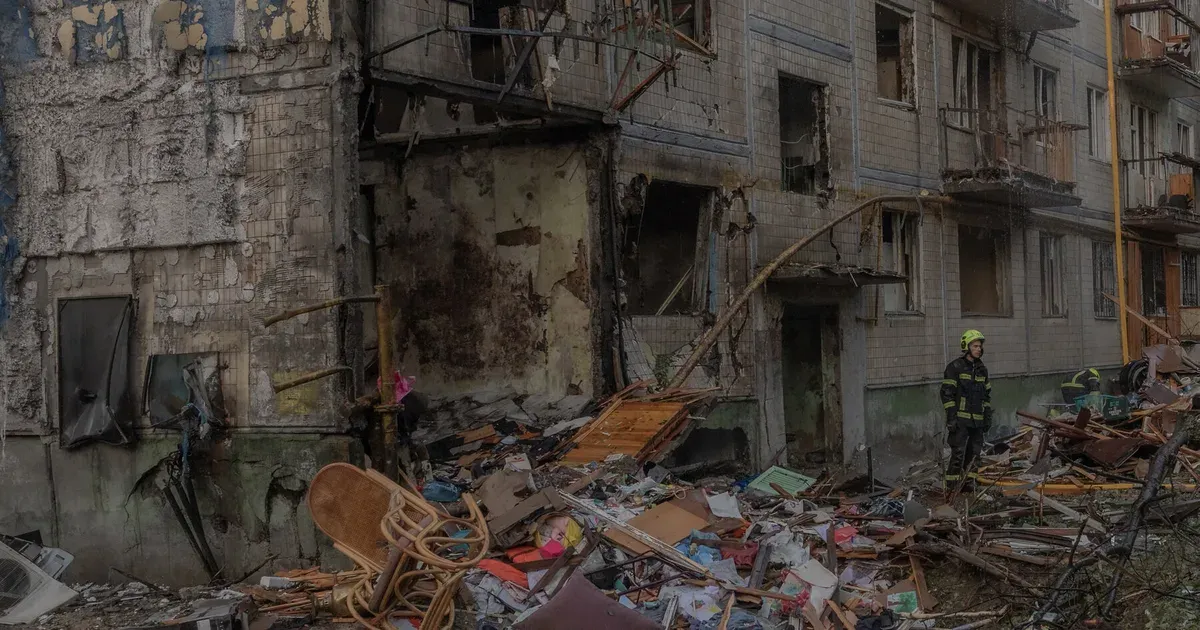
Russian ballistic missile strikes killed at least nine people in Kyiv on Saturday and injured dozens more, according to Ukrainian officials cited by the BBC. The attack hit residential areas across the capital, damaged apartment buildings and triggered fires and power cuts. It also renewed a question that has followed Russia's recent escalation: whether Ukraine can protect its cities when the weapons most capable of stopping ballistic missiles are in short supply.
Kyiv Mayor Vitali Klitschko said the city came under a ballistic missile attack after more than 10 explosions were reported. Emergency services said seven people died in the Darnytskyi district, while two others were killed in Solomyanskyi. Fourteen people were injured in Darnytskyi, including two children, and eight were hurt in Solomyanskyi, including two more children. The figures were reported on August 1, 2026, as rescuers continued working through damaged buildings.
A residential building in Shevchenkivskyi was partially destroyed and residents were trapped inside, according to the account. The attack also broke windows near the Lithuanian embassy and scattered debris across the compound. Fires appeared in several parts of Kyiv, and local authorities reported electricity cuts. The pattern made the strike more than a hit on a single military target: it placed apartment blocks, diplomatic property and basic services inside the immediate damage zone.
Ukrainian President Volodymyr Zelensky said the country needed urgent help with missile defense. His comments followed a meeting with President Donald Trump in Washington, where he asked the United States to allow Ukraine to produce Patriot interceptor missiles. The request is tied to a specific battlefield problem rather than a general appeal for more weapons. Ukraine says the Patriot remains the only system in its arsenal capable of reliably engaging the ballistic missiles used in the latest attacks.
Residential Districts Absorb the Strike
The reported deaths were spread across Kyiv's districts rather than confined to one site. In Darnytskyi, emergency workers described a deadly strike and multiple injuries. In Solomyanskyi, a five-storey residential building was partly destroyed. The presence of children among the injured underscored how quickly a military exchange becomes a civilian emergency when missiles reach dense urban neighborhoods.
The damage near the Lithuanian embassy added a diplomatic dimension to the attack. Broken windows do not by themselves establish that the embassy was the intended target, and the BBC report did not make that claim. They do show how the blast radius reached international facilities in the capital. For Kyiv, every such incident increases the cost of keeping embassies, businesses and residents operating under normal conditions.
The strike came two days after a suspected Russian cruise missile landed in Poland during a broader attack on Ukraine. That earlier assault killed at least eight people, including six members of one family, according to the BBC. The sequence helps explain why Ukrainian officials are focusing on the interceptor shortage: repeated attacks compress the time available to replenish systems while increasing the chance that debris, missiles or blast effects cross national borders.
Patriot Interceptors Become the Main Pressure Point
Trump said the United States had not agreed to let Ukraine build Patriots but that discussions were continuing. He cautioned that Washington had to be careful about allowing another country to manufacture technology connected to an advanced American weapon. His position leaves Kyiv facing a gap between the missiles it needs immediately and the industrial permission it says could improve its long-term resilience.
“Air defence — specifically Patriot interceptors against ballistic missiles — remains a top priority.”
Zelensky wrote that sentence on social media after speaking with Vice-President JD Vance. The wording placed the request inside a broader defense strategy, but the immediate issue is narrow: Ukraine needs enough Patriot interceptors to cover cities that are being attacked with ballistic weapons. A production agreement would not solve the current shortage overnight, yet without a domestic or expanded supply route the same vulnerability will return with each new wave.
Russia's attacks have intensified as Ukraine has also expanded its own strikes. The BBC reported that Ukrainian drones separately sank the Russian-owned container ship Yanina in the Black Sea. Moscow's state-owned nuclear operator Rosatom said all 17 crew members were rescued and described the attack as piracy. The maritime incident is a separate part of the confrontation, but it shows how the conflict now combines urban missile pressure with attacks on logistics and commercial assets far from the front.
Air Defense Now Shapes the Strategic Choice
The Kyiv strike turns the Patriot debate into a question of time, capacity and control. Washington can continue supplying finished interceptors, approve Ukrainian production, or keep the manufacturing decision unresolved while attacks continue. Each route carries a different cost: transfers can be limited by American stockpiles, local production requires technology safeguards and time, and delay leaves Ukrainian cities dependent on a system whose numbers are already tightening.
For civilians in Kyiv, that industrial argument is measured in damaged homes, interrupted power and the minutes available to reach shelter. For Ukraine's government, the attack is evidence that air defense is no longer one item on a weapons list; it is the condition that allows cities and institutions to keep functioning. The next phase of the conflict will therefore be shaped not only by where missiles are fired, but by who can produce enough interceptors to stop them.