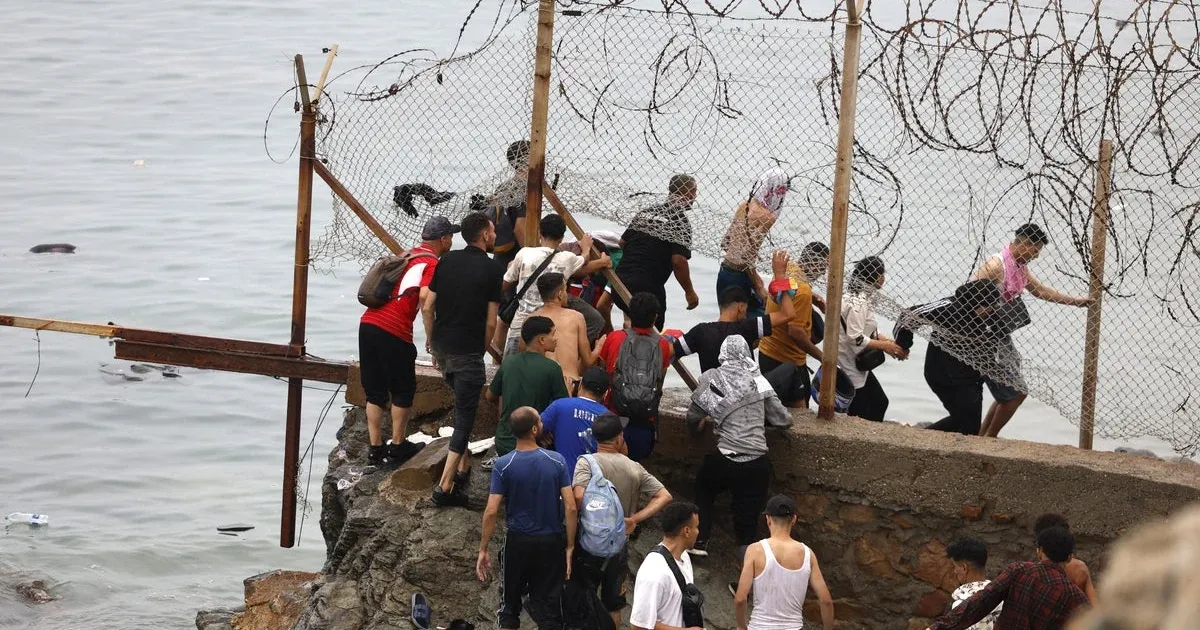
Ceuta is facing its largest border emergency in years after an influx of more than 40,000 people from Morocco. At least 24 people died, according to The Guardian, with some drowning and others caught in a crush near the Tarajal beach breakwater.
The arrival of a population approaching half the city’s size has pushed a local migration episode into a national and European dispute. Ceuta has about 85,000 residents. People reached it by swimming across the border or climbing the high fence that separates the Spanish territory from Morocco.
Prime Minister Pedro Sánchez travelled to Ceuta on Friday with Interior Minister Fernando Grande-Marlaska as the city struggled to provide shelter. Thousands, including unaccompanied children, were reported to be sleeping in parks and on pavements. The immediate challenge is not only controlling the frontier but identifying and assisting people already inside the enclave.
Spain Adds Forces While Officials Debate the Trigger
Spain’s interior ministry announced the deployment of 60 armed-forces personnel and 30 Guardia Civil officers. The military was assigned to reinforce the Guardia Civil and support security and humanitarian work, rather than take over ordinary policing.
Rachid Sbihi, who represents Civil Guard workers in Ceuta, said reinforcements were helping injured people and other humanitarian efforts while crossings continued. He called conditions a “serious humanitarian crisis.”
“People are still entering. The reinforcements that have arrived are only helping the injured and other humanitarian efforts.”
Moroccan government sources attributed the surge to criminal organisations and said Rabat’s cooperation with Madrid remained exemplary. Spain’s territorial policy minister, Ángel Víctor Torres, pointed to a recent Supreme Court ruling as a possible contributing factor. The ruling said migrants intercepted at sea while trying to reach Ceuta or Melilla could not be summarily returned under special rules.
The government rejected a demand from Ceuta’s mayor-president, Juan Jesús Vivas, for a national emergency declaration. Madrid said that legal mechanism was not available for a migration crisis and was reserved for threats such as severe weather, volcanic activity or a nuclear incident.
A 2021 Comparison Shows the Scale of the Surge
The latest crossing is far larger than the previous major episode in May 2021, when about 10,000 people entered Ceuta over two days as border controls loosened during a dispute between Madrid and Rabat. That crisis followed Madrid’s decision to provide medical treatment to the leader of the Western Sahara independence movement, the Polisario Front.
Relations later changed. In 2022, Spain backed Morocco’s plan for Western Sahara, ending Madrid’s long policy of neutrality and creating a rift with Algeria, which supports the Polisario Front. The recent surge now places that diplomatic balancing act under pressure again, even as Morocco says its cooperation with Spain has not broken down.
Ceuta Has Become a Schengen Dispute
Ceuta and Melilla are the European Union’s only land borders with Africa, which gives a local crossing consequences beyond the territory itself. Italy’s government urged that Spain be suspended from the Schengen free-movement area, while France ordered stronger controls at its Spanish border. Sweden and Finland also urged Madrid to restore control of the external border.
Spain’s foreign minister, José Manuel Albares, called Italy’s ambassador to the ministry after the criticism. The dispute is now running on two tracks: Spanish authorities must manage deaths, shelter and identity checks in Ceuta, while European governments are arguing over whether Spain’s migration choices have shifted pressure onto the rest of the Schengen area.
The Humanitarian Response Will Shape the Political Fallout
The scale of the crossing makes the next phase dependent on capacity as much as on border policy. The Guardian’s account describes people still arriving, children without shelter and officials trying to separate security duties from emergency assistance. That combination leaves little room for a response based only on deterrence.
Madrid’s political exposure will grow if the government cannot establish who has entered, where people can safely stay and how deaths at the border will be investigated. The European reaction is already widening the issue, but the first measurable test remains inside Ceuta: whether Spain can restore order without losing sight of the people caught in the crossing.