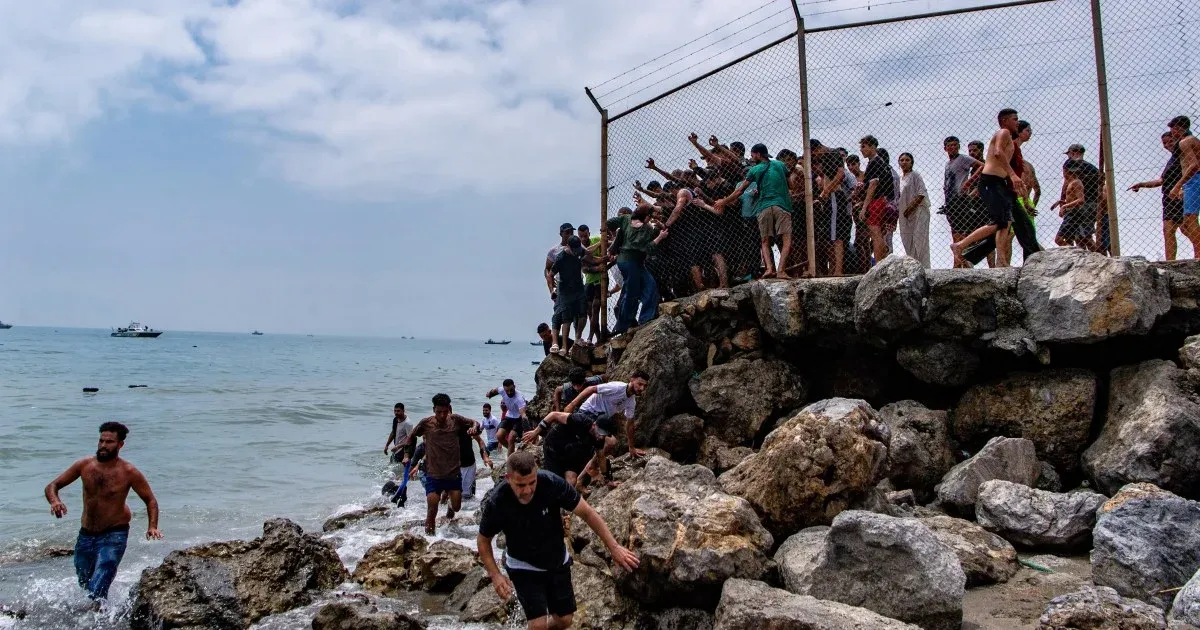
Ceuta is trying to manage a sharp rise in arrivals from Morocco while its shoreline patrols, reception facilities and return procedures operate under different constraints. The regional government estimated that 1,500 to 2,000 people entered the Spanish enclave over the preceding 10 days, but no final count for Thursday's surge was available.
On July 30, 2026, regional President Juan Jesús Vivas described the situation as a humanitarian and social emergency and asked Madrid for more police and military support. Spain's Interior Ministry rejected his request for a national-emergency declaration, saying the law governing that measure does not treat migration flows as a national security risk. It nevertheless promised additional resources.
The competing estimates show why the scale remains unsettled. State broadcaster TVE reported that 2,000 to 3,000 young people crossed on Thursday alone, a higher figure than the regional government's 10-day estimate. The Guardia Civil did not provide its own number. Those figures should be read as separate snapshots from different institutions, not combined into a single total.
Sea Arrivals Push an Already Full Reception System
Video and agency reports showed many people reaching Ceuta by swimming or using inflatable devices around the Tarajal breakwater. EFE reported that others crossed on land after scaling border fences. The arrivals therefore did not pass through one controlled entry point that could support immediate registration and counting. El País reported, citing activists and border sources, that messaging groups helped people coordinate movement toward less guarded sections. That report does not establish how many arrivals followed online directions or that the crossings had one organizer.
G1 reported that Spain's coast guard assisted people in the water and that some arrivals became ill after the journey. These cases add a rescue and medical-assessment burden before registration begins. They also make a real-time head count harder: people can be recovered at sea, reach different parts of the shoreline or arrive over the land barrier within the same period.
The pressure continued after people reached shore. Ceuta's formal reception system had 512 places already occupied, according to figures reported by G1. More than 400 people were waiting for admission on Wednesday, and Vivas said hundreds were sleeping on the streets. A larger patrol presence could affect crossings at the frontier, but it would not create beds or processing space inside the enclave.
Ceuta and Melilla are Spain's autonomous cities on the North African coast and form the European Union's only land borders with Africa. Both have experienced previous spikes in crossings. In May 2021, approximately 10,000 Moroccan and sub-Saharan young people entered Ceuta within several days, providing a recent measure of how quickly local systems can be overwhelmed.
Madrid Adds Resources Without Invoking Emergency Powers
The dispute between Ceuta and Spain's central government concerns legal authority as well as staffing. Vivas asked for national-emergency powers and military deployment to protect the border and public safety. The Interior Ministry answered that the requested emergency framework was unavailable for a migration event, while saying national and regional administrations were coordinating their response.
Madrid also said Morocco was cooperating and that Moroccan police had stopped numerous people attempting to cross. Interior Minister Fernando Grande-Marlaska was expected to travel to Ceuta on Friday, July 31, to assess conditions. At that point, the concrete central-government commitments described publicly were additional resources and intergovernmental coordination, not an emergency declaration.
The Guardia Civil characterized the pace of arrivals as a sudden change rather than a steady increase:
It has been a slow trickle since the Supreme Court's ruling, but today has been an explosion.
That observation links the operational surge to a separate legal development, but it does not establish why each person attempted the crossing. The Interior Ministry blamed smuggling networks for exploiting the ruling. That is the ministry's assessment; the available reports did not provide evidence that every arrival followed the same route, received the same message or used a smuggler.
The Court Ruling Separates Interception From Return
A Supreme Court decision issued earlier in July narrowed the procedure available at the two enclaves. It prevents authorities from using their special border-rejection rules for immediate transfers to Morocco when officers encounter people at sea en route to Ceuta or Melilla. The decision does not by itself settle an individual's immigration status, guarantee admission or eliminate other lawful procedures after identification and review.
Spain and Morocco said they would review measures for the immediate return of people entering without authorization and strengthen their coordination, according to G1. That political commitment still has to operate within the court's limit and whatever individual procedures remain available. The sources did not identify a completed return list, a schedule or a replacement mechanism that could be applied automatically to the latest arrivals.
This distinction matters because the current response has three stages that cannot be treated as one task. Officers may intercept people at sea or at the frontier; Ceuta must then register and shelter those who arrive; and any return must follow a legally available process. The reported bottleneck is therefore simultaneously territorial, administrative and legal.
Moroccan enforcement may reduce new attempts, and personnel sent by Madrid may strengthen shoreline control. Neither measure alone resolves the occupied reception centers or determines which return procedures apply. The clearest test of the response will be whether officials publish a reconciled arrival count, add usable reception capacity and explain how individual cases will move from registration to a lawful decision.