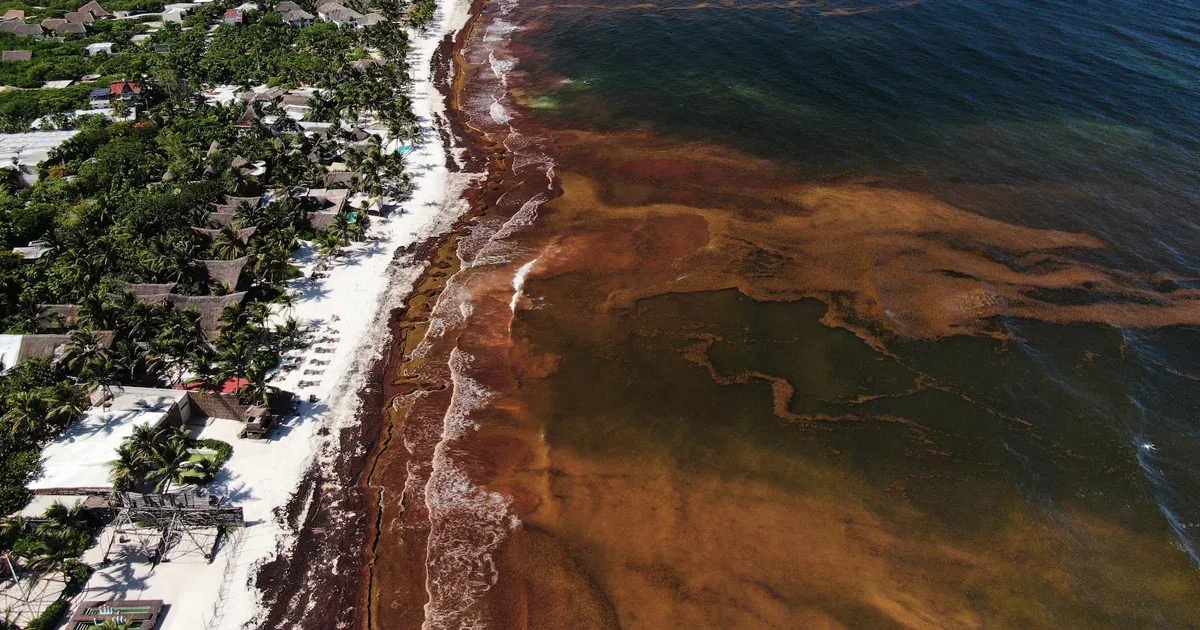
A vast sargassum bloom is reaching Caribbean and Gulf of Mexico coastlines faster than some communities can collect and process it. A July assessment by the University of South Florida's Optical Oceanography Lab put the combined load in three connected regions at 27 million metric tons: the Atlantic basin, the Caribbean Sea and the Gulf. The lab released that estimate on July 31, 2026, as beach towns confronted damage to tourism, marine habitats and public health.
The scale is not only a matter of seaweed drifting in from distant waters. Researchers observed large quantities growing within the Caribbean and Gulf this year, an unusual pattern that left local coastlines exposed to both incoming material and reproduction closer to shore. Scientists traced that early growth to the record 40 million metric tons measured in 2025, when enough of the bloom remained to help seed another cycle.
A 2025 Carryover Is Feeding Growth Near Shore
Sargassum is a floating brown algae that can support fish, turtles and seabirds when it remains offshore. The same material becomes destructive in shallow water and on beaches. Dense mats cut oxygen levels, shade coral and seagrass, cover mangrove roots and create barriers for newly hatched turtles trying to reach open water.
The Great Atlantic Sargassum Belt has expanded since 2011, but researchers have not assigned the increase to a single cause. Warmer water, farm runoff and shifts in rain, wind and ocean circulation are among the factors under study. June brought a Gulf reading of 5 million metric tons from the University of South Florida. That was close to double the year-earlier record, and the Caribbean set its own high for the month.
The June measurement across the Atlantic, Caribbean and Gulf reached 34 million metric tons, about 10 percent below the same month in the record-setting previous year. Scientists still expect 2026 to finish with the second-largest amount recorded across those waters. The comparison shows why the earlier local growth matters: a slightly smaller basin-wide peak can continue to produce exceptional pressure in individual coastal areas.
Those figures connect a basin-wide change to immediate coastal losses. Businesses in Mexico's Caribbean state of Quintana Roo put their first-half sales decline at 30 percent. In Playa del Carmen, a waiter told the Associated Press that empty tables forced an early restaurant closing as decomposing algae darkened water normally marketed for its turquoise color.
Cleanup Capacity Trails the Daily Landfall
Mexico has announced a $115 million response plan, yet its own estimates show the operating gap. As much as 9,000 tons can reach the country's Caribbean shore on the worst days, while existing crews and equipment can remove about 1,200 tons per day. Even a full day at stated capacity would handle only a fraction of a severe landfall.
Other islands are managing different parts of the same burden. Puerto Rico declared an emergency after record accumulations from 2025 reached its shores. In the U.S. Virgin Islands, environmental consultant Amy Dempsey said people have crossed mats extending as far as 25 feet before reaching the water. Such deposits change access to beaches before cleanup costs or lost bookings are counted.
The recent sequence has also reset the regional baseline. Material from the 2025 record exceeded the previous peak of about 22 million metric tons set in 2022, then persisted long enough to support this year's local reproduction. Emergency declarations and unusually thick nearshore mats are therefore connected to consecutive large seasons, not an isolated shipment that can be cleared once and forgotten.
Decay creates a second problem. Piles on land release ammonia and hydrogen sulfide, producing the familiar rotten-egg odor and exposing nearby residents to gases that the U.S. Environmental Protection Agency says can cause headaches, nausea and lung irritation. Martinique opened temporary shelter for affected residents after protests over the fumes.
Martinique's crews had collected more than 11,500 tons by late July, including 638 tons over four days in the same month. Offshore barriers intercept part of the flow, while workers gather the rest by hand and send it for composting or bioenergy use. Heavy machinery can accelerate removal, but scientists warn that it can also damage turtle nests hidden beneath the sand.
Local Systems Cannot Match an Atlantic-Scale Bloom
Monitoring has become more sophisticated than the physical response. University of South Florida and National Oceanic and Atmospheric Administration researchers used artificial intelligence to track macroalgae blooms from 2003 through 2022. Their study found annual growth above 13 percent in the tropical Atlantic and western Pacific, with affected waters covering 43.8 million square kilometers.
That widening record leaves coastal governments with a capacity problem rather than an information shortage. Satellite measurements can show where the algae is accumulating, but communities still need barriers, collection crews, safe storage and processing sites before it rots beside homes and businesses. Mexico's reported worst-day arrival is 7.5 times its stated daily collection capacity, a comparison that makes the operational deficit visible. Collection policy also has to distinguish useful offshore habitat from harmful nearshore decay. Intervening too late increases gas exposure and oxygen loss, while heavy equipment on nesting beaches can create a separate ecological cost. The most useful benchmark will be how much material is intercepted and processed before it reaches shore, measured against peak daily arrivals rather than annual spending alone.