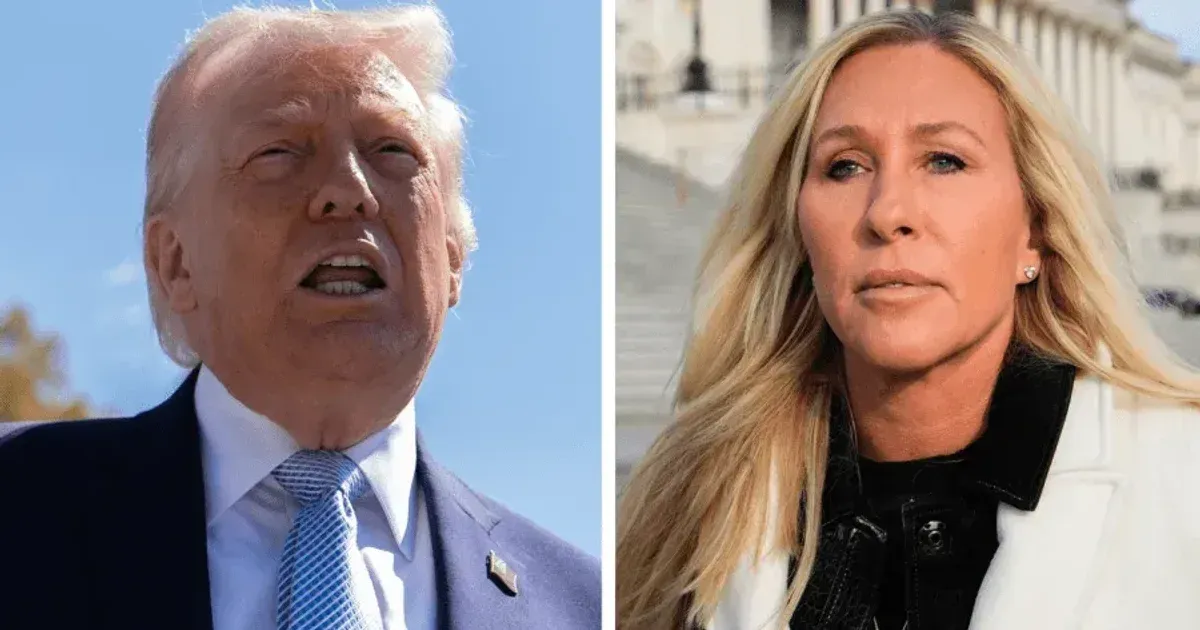
Marjorie Taylor Greene's call to invoke the 25th Amendment against Donald Trump marks a dramatic break inside a political camp that usually treats loyalty as a central test. Her argument ties the president's Iran rhetoric to questions about judgment, authority and constitutional removal. The statement landed on April 7, 2026, as Trump defended escalation in unusually inflammatory terms. Greene's response pushed an internal foreign-policy dispute into the language of presidential incapacity, making it harder for Republicans to treat the disagreement as ordinary criticism.
Blumenthal Questions Military Efficacy of Air Strikes
Military strategy in the Persian Gulf involves more than simple aerial bombardment. Senator Richard Blumenthal noted that "bombing alone" could not accomplish the geopolitical objectives sought by the president. He suggested that the administration's boasts of total control do not align with intelligence reports regarding Iranian surface-to-air missile systems. These systems include advanced Russian-made S-300 batteries and domestic variants capable of tracking stealth aircraft.
Pentagon officials have privately expressed concerns similar to those voiced by the senator. Confidence in a quick and bloodless victory often evaporates once actual hostilities begin. Iranian forces have spent decades preparing for an asymmetric conflict designed to inflict maximum casualties on invading forces. Blumenthal's assessment highlights the gap between political rhetoric and battlefield reality.
"Here's what I think the stark hard truth is: that the Iranians still have the capacity to attack our aircraft, despite the claim and the boasting that we have total superiority and control," Senator Richard Blumenthal said.
Jeffries Urges Republicans to Restrain Executive Threats
Lawmakers from both parties are now weighing the legal limits of executive power. Hakeem Jeffries challenged his Republican counterparts to prioritize national security over party loyalty. He insisted that the president's social media posts are more than tough talk; they are dangerous precursors to unauthorized kinetic action. Jeffries noted that the War Powers Resolution of 1973 requires the president to consult with Congress before introducing U.S. forces into hostilities.
National security experts worry that the president's unpredictability undermines the credibility of the United States. Allies in Europe and the Middle East have reportedly contacted the State Department seeking clarification on the Truth Social post. Instead of providing clarity, the White House has doubled down on its aggressive stance. Jeffries stated that the president's behavior has reached a point where legislative intervention is the only viable path forward.
Greene Cites Civilizational Rhetoric in Removal Demand
Calls for the 25th Amendment represent a major escalation in the domestic political crisis. Marjorie Taylor Greene has historically defended the president against nearly all accusations of misconduct. Her decision to lead the charge for his removal suggests that the threat to civilian infrastructure was a bridge too far. She stated that the intentional destruction of a civilization is an act of evil that no American should support.
Every previous attempt to invoke the 25th Amendment has failed due to the high bar set by the Constitution. The process requires a level of cooperation between the vice president and the Cabinet that rarely exists in modern politics. Greene's public demand may be intended more as a symbolic protest than a realistic legal maneuver. Regardless of its eventual success, the move has shattered the image of a unified conservative front. Destruction of military targets does not guarantee the surrender of a determined adversary. History shows that sustained air campaigns often energize domestic support for the targeted regime. Blumenthal argued that the president's current approach lacks a clear endgame or a plan for regional stability. Conflict with Iran would likely draw in multiple regional actors and disrupt global energy markets for years.
Republican leaders have largely remained silent despite Jeffries' demands. Some backbenchers have quietly expressed support for Greene's position, though they fear the political repercussions of a public split. The lack of a unified response from the GOP has emboldened the Democratic leadership to push for more aggressive oversight. Jeffries indicated that he would support a resolution of censure if the president does not retract his comments.
No other high-ranking Republican has yet followed Greene's lead in calling for immediate removal. Several have instead suggested that the president's words were hyperbolic and not intended as literal policy. This defense has done little to satisfy critics who point to the president's past willingness to bypass traditional diplomatic channels. Greene remains firm in her belief that the presidency has become a source of erratic danger.
While the president maintains that he has the authority to defend the nation, the definition of defense is being stretched to its breaking point. Iran maintains its own set of retaliatory options, including cyberattacks on U.S. infrastructure. Because the conflict involves nuclear-adjacent technologies, the risks of miscalculation are extremely high. The debate over the president's rhetoric is no longer about politics but about the survival of international norms.
Removal Talk Marks a Coalition Break
The 25th Amendment is not a protest tool; it is a constitutional process built around incapacity and cabinet action. That makes Greene's demand procedurally unlikely even if it draws attention. The political meaning is clearer. A figure closely associated with Trump's movement is now using removal language against him, and that signals how sharply Iran policy is straining parts of the coalition.