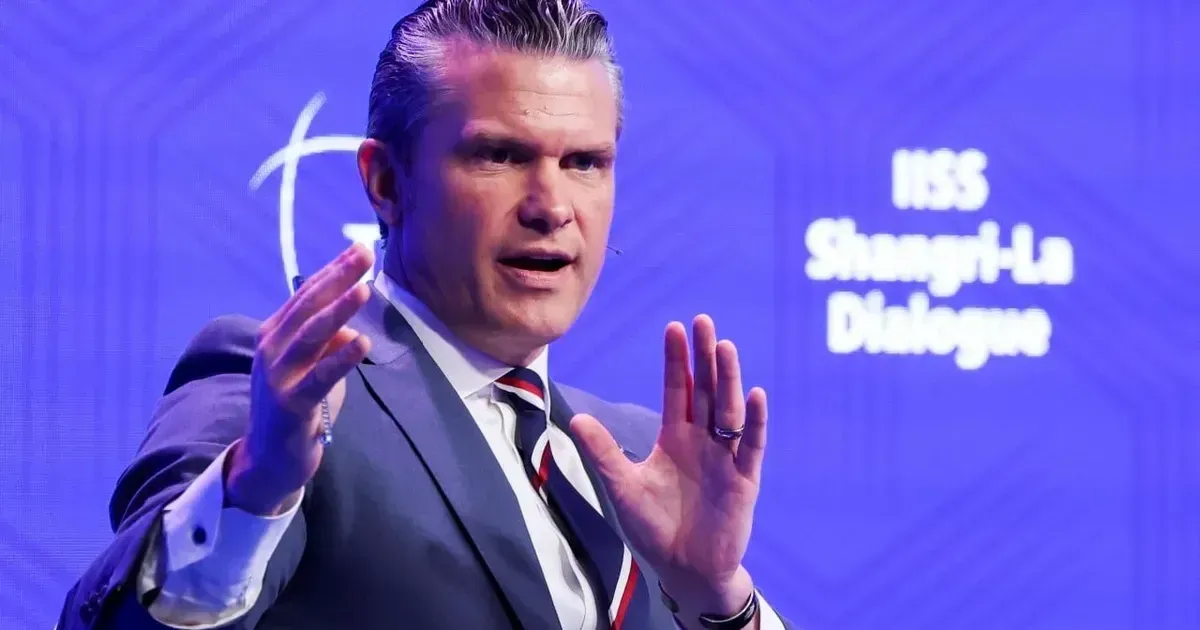
Defense Secretary Pete Hegseth arrived in Singapore to deliver a major policy address at the annual Shangri-La Dialogue. Remarks delivered during the plenary session were the first major articulation of US regional strategy following a recent change in administration. Officials scheduled the talk for May 30, 2026, to coincide with the conclusion of two weeks of high-level diplomatic activity in Southeast Asia.
Hegseth used the forum to establish a new baseline for security partnerships in the Indo-Pacific. A primary component of his message focused on the financial obligations of regional allies. He explicitly stated that the US now expects its Asian partners to increase their defense spending to 3.5% of their gross domestic product. This figure is above the 2% target traditionally requested of NATO members in Europe.
Regional leaders and defense ministers from dozens of nations listened as Hegseth framed the request as a necessary response to shifting security dynamics. He characterized the current environment as one defined by a historic military build-up by the People's Republic of China. The 3.5% mandate appears designed to distribute the burden of regional deterrence more broadly among treaty allies and strategic partners.
Beijing’s recent naval expansions and missile tests have heightened tensions across the Taiwan Strait and the South China Sea. Hegseth described these activities as a challenge to the established international order. He noted that the US military maintains a substantial presence in the region but suggested that American taxpayer support for foreign security depends on reciprocal investment from local governments.
"No state, including China, must dominate Asia," Hegseth stated during the plenary session on Saturday morning.
Partners across the region expressed immediate reactions to the budgetary demand. Several delegations noted that reaching such a high threshold would require major shifts in domestic policy and social spending. Japan and Australia have already moved toward the 2% mark, but a jump to 3.5% would place them among the highest-spending nations in the developed world. This requirement places political pressure on administrations already dealing with aging populations and economic headwinds.
Hegseth Sets New Defense Spending Floor for Asian Allies
Spending requirements of 3.5% would fundamentally alter the fiscal paths of nations like South Korea and the Philippines. Hegseth argued that the cost of inaction outweighs the immediate financial strain of military modernization. He pointed to specific areas where increased funding is required, including integrated air defense systems, undersea warfare capabilities, and long-range precision fires. The Secretary emphasized that these investments must be compatible with US systems to ensure seamless joint operations.
Security in the Indo-Pacific depends on a credible deterrent that China cannot easily overcome. Hegseth noted that the US is not seeking direct confrontation but will not retreat from its commitments. The demand for higher spending is paired with a promise of deeper technology sharing and more frequent joint exercises. These initiatives aim to create a network of capable partners rather than a hub-and-spoke model where the US provides all the heavy lifting.
National security advisors from several Southeast Asian nations met privately after the speech to discuss the implications. Some officials voiced concerns that such a rapid increase in military spending could intensify regional competition. Hegseth countered that stronger deterrence would reduce the risk of coercion.
Policy Shift Follows High-Stakes Summit with President Xi
Summit outcomes between President Donald Trump and President Xi Jinping two weeks ago provided the immediate context for this address. Hegseth’s remarks functioned as a barometer for those talks, suggesting that while communication remains open, the US has not softened its stance on regional security. The tone was described by attendees as tough but less confrontational than some had anticipated, focusing on clear red lines and expectations.
China's military activities continue to serve as the primary justification for the shift in US posture. Hegseth referenced specific data regarding the growth of the People's Liberation Army Navy, which now operates more hulls than the US Navy. He asserted that the rapid pace of Chinese shipyard production requires a collective response from the Pacific community. The perspective aligns with the broader US strategy of de-risking and building resilient supply chains for critical defense technologies.
Diplomats in Singapore observed that the 3.5% demand might be an opening move for future negotiations. By setting the bar high, the US establishes a strong position for bilateral talks regarding base access and troop deployments. Hegseth did not offer a timeline for when allies must reach the new spending target, though he suggested that progress should begin immediately.
Strategic Competition and the Indo-Pacific Security Framework
The Shangri-La Dialogue brings rivals and allies into the same forum. Hegseth's insistence on a 3.5% floor reflects a belief that regional stability can no longer be maintained by US power alone. He argued that a multi-polar security architecture is the only way to prevent any single nation from establishing hegemony. The vision requires partners to move beyond symbolic contributions and toward resilient, independent military capabilities.
Military spending trends in the region have been on an upward trajectory for a decade. Hegseth noted that this organic growth should now be formalized into a strategic commitment. He praised countries that have already initiated procurement programs for advanced fighter jets and submarines. These efforts, he claimed, are the building blocks of a free and open Indo-Pacific.
The policy direction indicates a more transactional approach to security alliances. Washington appears increasingly unwilling to provide a security umbrella without a corresponding increase in local defense budgets. Hegseth concluded his remarks by inviting further dialogue on how the US can assist partners in reaching these ambitious goals through industrial cooperation and training programs.
Allies Must Weigh Deterrence Against Domestic Costs
The demand for a 3.5% defense spending floor is a major departure from decades of US-Asia security policy. For countries like Japan, which recently broke its 1% ceiling, the new target is both a fiscal challenge and a fundamental test of their constitutional and political resolve. If the US holds firm on this requirement, the Indo-Pacific could see a large infusion of capital into military technology, shifting the balance of power toward a more heavily armed regional bloc.
Regional stability now hinges on whether allies perceive this demand as a fair burden-sharing request or an excessive fiscal test. Beijing is likely to use this friction to present itself as a more stable and less demanding partner, potentially driving a wedge between Washington and its more budget-conscious allies. The success of the Hegseth doctrine will depend on the ability of the US to provide security benefits that justify the domestic political costs of these defense hikes.
Strategic calculations across Asia are already changing. Governments must now decide whether the cost of the American alliance has risen too sharply or whether China's military expansion makes the 3.5% target necessary.