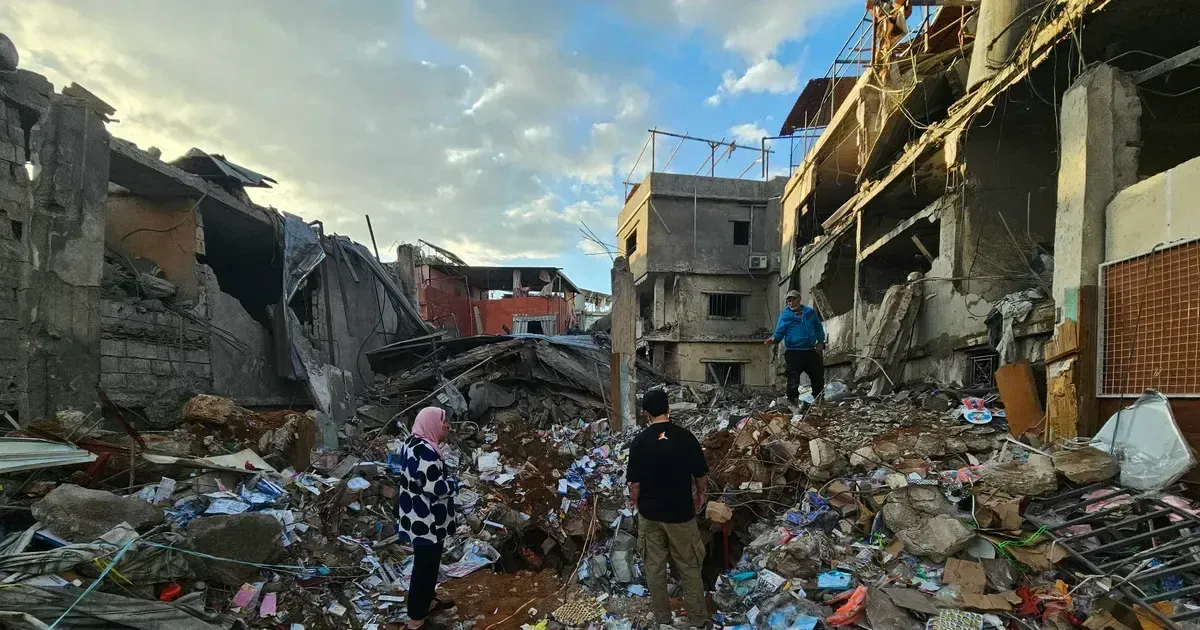
Hezbollah commander Hassan, speaking from a clandestine medical facility, detailed how his militia reorganized its front-line operations to withstand sustained Israeli bombardment. Shrapnel wounds visible on his forearm testify to the intensity of recent engagements near the border. Military analysts previously speculated that the elimination of senior leadership would paralyze the group, yet Hassan claims a different reality exists on the ground. Tactical autonomy has replaced the traditional top-down hierarchy that once defined the organization. Fighters now operate in small, self-sufficient cells capable of making high-stakes decisions without direct orders from Beirut.
Israel continues to launch precision strikes against suspected weapons caches and transit routes. These aerial campaigns seek to sever the supply lines connecting the Bekaa Valley to the southern front. Despite these efforts, Hezbollah maintains a consistent rate of rocket fire into northern territories. Mobile launch platforms, often hidden within civilian infrastructure or deep subterranean tunnels, allow units to fire and relocate within minutes. Success for these units depends on their ability to stay invisible to drone surveillance. Hassan noted that his men often spend weeks underground without seeing sunlight.
Hezbollah Decentralizes Command Near the Border
Communication networks underwent a radical transformation to evade Israeli signals intelligence. High-tech encryption and fiber-optic cables buried deep in the Lebanese soil provide the backbone for this resilient system. Command centers no longer exist as singular, vulnerable hubs. Instead, the militia utilizes a web of localized bunkers where junior officers hold the authority to initiate ambushes. Israel faces a challenge where killing a regional leader does not stop the activities of the subordinates. Every cell functions like an independent militia with its own stockpile of anti-tank missiles and food supplies. Hassan confirmed that his unit operates with a six-month reserve of essentials.
Guerrilla warfare strategies have evolved to exploit the rugged terrain of southern Lebanon. Fighters use the limestone hills and thick vegetation to mask their movements from thermal imaging. Hezbollah's engineering corps spent years carving a maze of tunnels that bypass main roads. These passages allow for the rapid reinforcement of besieged villages without exposing troops to air strikes. Combatants often wait for Israeli armored columns to enter narrow valleys before engaging with Kornet missiles. This specific tactic relies on patience and local knowledge. Hassan described one instance where his team waited forty-eight hours for a single target to appear.
Electronic warfare plays an increasingly important role in the daily skirmishes. IDF technicians attempt to jam Hezbollah's communication frequencies and disable the GPS guidance on their long-range drones. In response, the militia has reverted to low-tech solutions, including runners and hard-wired field telephones. These methods are immune to the sophisticated jamming equipment deployed by Israel. Intelligence gathering also relies on a vast network of local informants who monitor border movements. Information flows through decentralized channels to ensure that no single intercept can compromise the entire operation. One informant recently identified a hidden observation post near the Blue Line.
Rocket Fire Persists Despite Israeli Air Superiority
Logistical hubs in the Litani River region serve as the primary staging grounds for daily barrages. Small teams transport rockets on the backs of civilian vehicles or specialized motorcycles to avoid detection. Launchers are frequently pre-positioned in orchards or inside unassuming sheds with retractable roofs. Once a firing sequence completes, the crew abandons the site before the IDF can calculate the trajectory and return fire. Sophisticated counter-battery radar makes this a race against seconds. Hassan estimated that his team has less than three minutes to clear the area after a launch. Recent data indicates that over $11 billion has been spent by Israel on interception and offensive measures in this theater alone.
Psychological warfare remains a core component of the militia's broader strategy. By maintaining a steady tempo of fire, Hezbollah aims to demonstrate that Israeli air power cannot guarantee safety for residents in the north. The constant threat of sirens forces thousands of civilians to stay in shelters, straining the social fabric of the border towns. Hassan emphasized that the goal is not total military victory, but the exhaustion of the enemy's resolve. He believes that the sheer persistence of the rocket fire is a potent political tool. Media offices within the group quickly circulate footage of successful strikes to strengthen morale among the Shia population. Video clips show rockets clearing the ridge lines of the Galilee.
Anti-tank guided missiles are the primary weapon for stalling Israeli ground maneuvers. The Hezbollah arsenal includes various generations of Russian and Iranian-designed projectiles. Skilled operators can hit targets several kilometers away with high precision. These teams work in pairs, with one spotter and one shooter, often staying stationary for days to find the perfect angle. Israeli tanks have responded by installing active protection systems like Trophy, which can intercept incoming missiles. This technological arms race forces the militia to fire multiple missiles at a single target to overwhelm the sensors. Hassan lost three men in a single afternoon while attempting to disable a main battle tank.
Front-line commanders now hold more influence than they did during the 2006 conflict. Local leaders are encouraged to innovate and adapt to the specific conditions of their geographic sector. While the central leadership provides the strategic vision, the execution is entirely local. The shift has created a more nimble force that can react to sudden shifts in the battlefield. Hassan stated that he has not received a direct order from the central command in over two weeks. He operates based on a pre-established set of objectives. His unit currently monitors a critical crossroad near the village of Aita al-Shaab.
Decentralized War on the Border
Obsession with decapitation strikes often blinds military analysts to the horizontal nature of ideological insurgencies. Israel's campaign against the Hezbollah leadership assumes that the organization is a traditional pyramid where removing the apex causes the base to crumble. The logic fails against decentralized mission command. By empowering local cells to operate autonomously, Hezbollah has insulated its operational capacity from the loss of its top-tier commanders. The wounded Hassan's testimony suggests a force that is not only surviving but evolving under the pressure of total air superiority.
Technology, while a major advantage for the IDF, creates a false sense of security. Sensors and drones can map the surface, but they struggle to penetrate the cognitive and physical depths of a determined local defense. Hezbollah has effectively turned the landscape itself into a weapon, using the very earth to neutralize the high-tech eyes of its adversary. The conflict is no longer about who has the better jet or the faster processor; it is about the endurance of the local fighter against the high-cost exhaustion of the state. Is a modern military capable of winning a war where the enemy refuses to have a single neck to wring? The persistent rocket fire suggests the answer is a decisive no.