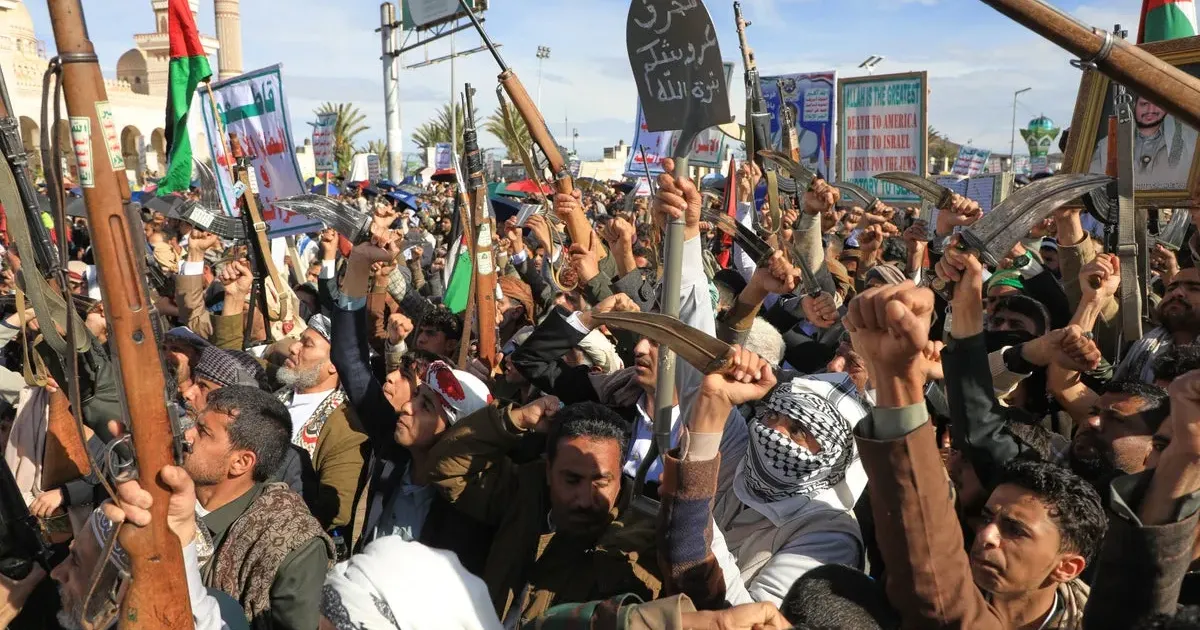
A Houthi missile launch from Yemen toward Israel added a new southern pressure point to an already expanding regional conflict. On March 28, 2026, Israel said it intercepted a missile fired from Yemen, with no casualties or damage reported. The Houthis claimed responsibility and framed the attack as part of a wider confrontation involving Israel, Iran and aligned armed groups.
The military result was limited because the missile was stopped. The strategic result was larger because the launch showed how quickly separate theaters can connect. A militia rooted in Yemen forced Israeli air defenses to respond more than a thousand miles away, while shipping companies and governments watched for signs that Red Sea attacks could return with greater intensity.
The timing made the attack more important. It came as the U.S.-Israeli war with Iran had already shaken regional security and economic confidence. The Houthis had previously used missiles, drones and maritime attacks to project influence beyond Yemen. A launch toward Israel signaled that they were prepared to re-enter the wider confrontation rather than remain a background threat.
Yemen Became Part Of Israel's Air-Defense Problem
Long-range fire from Yemen changes how distance is read in the region. Israel must account for threats from the south as well as Iran, Lebanon, Gaza and other fronts. Gulf states have to consider airspace, spillover and interception risk. The United States has to decide how much naval and air-defense capacity is required to keep commercial corridors open.
The Houthis' arsenal reflects years of technical development and outside assistance. Iran denies directing every Houthi operation, but the group's missile and drone capabilities are widely understood as part of a broader network of aligned forces that share designs, components and battlefield lessons. Each launch is therefore a signal about Yemen and about the regional proxy system around Iran.
Interception reduces immediate damage but does not erase the burden. Air defenses cost money, alert civilians and create the risk of debris, miscalculation or retaliatory escalation. A failed strike can still force a state to spend resources and adjust planning.
Red Sea Risk Turns Security Into Economics
The Red Sea and Bab el-Mandeb corridor matter because they connect Europe, Asia and energy markets through one of the world's most sensitive trade routes. The Houthis' earlier attacks on merchant shipping showed that a Yemen-based group can impose costs far beyond Yemen's borders. Even the threat of renewed maritime disruption can move insurance, routing and freight decisions.
A missile fired toward Israel may not target a container ship, but it belongs to the same risk environment. Shipping firms do not price only the specific weapon in the air. They price the likelihood that the corridor is becoming unstable again. Higher insurance, longer routes and naval deployments can all work their way into supply chains even when no vessel is hit.
That is why the Houthis gain leverage from symbolic attacks. They can pressure military planners and commercial actors at the same time. They do not need to win a conventional war to make governments and companies behave more defensively.
Retaliation Carries Its Own Limits
The United States, Israel and partners face a familiar dilemma. Striking launch sites may degrade Houthi capability, but Yemen's terrain, mobile systems and years of war make complete suppression difficult. A heavier campaign could widen the conflict and strengthen the Houthi claim that they are fighting a regional war on behalf of a broader axis.
A lighter response carries its own risk. If interceptions are treated as enough, the Houthis may conclude that they can keep testing defenses at an acceptable cost. That is the strategic trap: a heavy response can escalate, while a restrained response can invite repetition.
Diplomacy is not clean either. The Houthis use external confrontation to reinforce domestic and regional legitimacy. Pressure from Iran, Gulf states, the United States or international organizations may influence tactics, but the movement has repeatedly shown it can absorb hardship when visibility is the reward.
The Intercepted Missile Still Changed The Map
The absence of casualties should not make the launch look harmless. The missile tested air defenses, markets and political nerves. It linked Yemen, Israel, Iran, Red Sea shipping and U.S. military posture in one event.
For Iran, aligned groups create pressure points without requiring direct conventional escalation in every theater. For the Houthis, long-range launches elevate their status from local combatant to regional actor. For Israel and the United States, each interception becomes part of a larger deterrence calculation.
That is the hard point of the attack. The damage was prevented, but the uncertainty was not. If the pattern continues, the cost will be measured not only in explosions but in permanent readiness across one of the world's most important trade corridors.