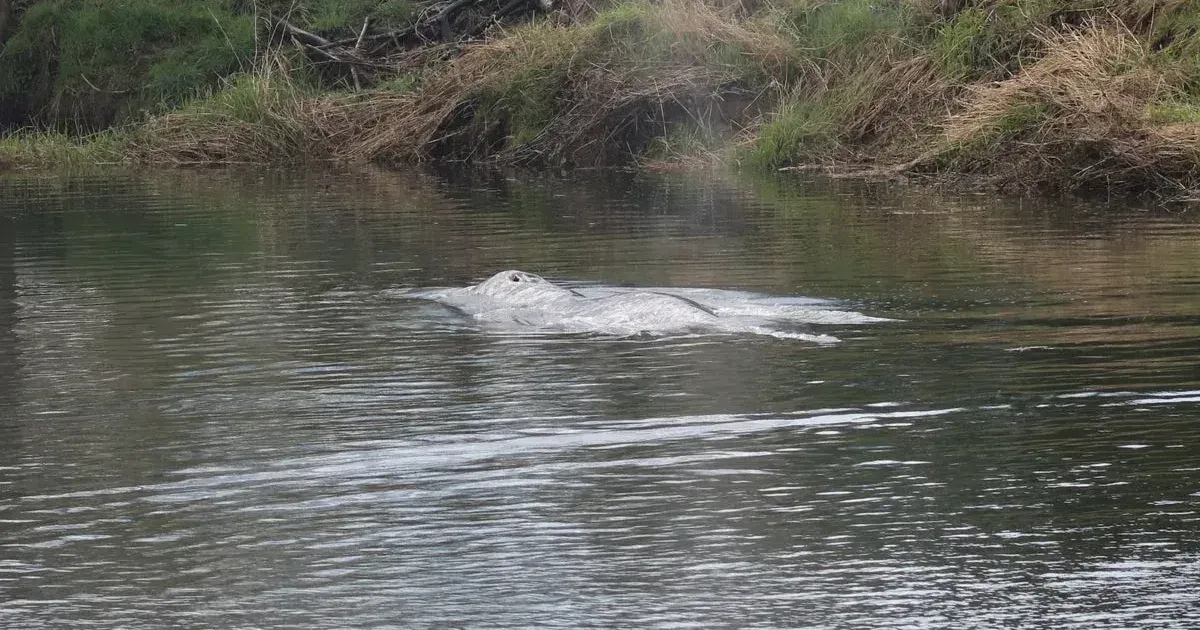
The death of a young gray whale in a Washington river is being treated as a biological warning sign. Starvation appears to have pushed the animal away from normal migration logic and into an environment it could not survive.
The case is local, but the signal is broader.
Washington wildlife officials confirmed on April 6, 2026, the death of a young gray whale that traveled deep into a freshwater river system. Willapa Willy, a juvenile member of the species, entered the inland waterway several days ago and drew immediate attention from local residents. Marine biologists observed the animal moving sluggishly through the shallow reaches of the river, appearing disoriented and physically diminished. Initial assessments from the Marine Mammal Research Group indicate that the animal likely died from complications related to severe malnutrition.
Willapa River Marine Mammal Research Findings
Biologists began a field necropsy immediately to determine the exact physiological stressors that led to the animal's demise. Examination of the stomach contents revealed almost no digestible organic matter. Gray whales usually feed by sifting through seafloor sediment for amphipods and small crustaceans. Freshwater riverbeds do not provide the specific caloric density or species variety required to sustain a marine mammal of this size. Willapa Willy lacked the energy to return to the saline environment of the open sea.
Lack of food often forces young whales to take extreme risks in their search for sustenance. Marine biologists noted that the juvenile whale was likely separated from its mother during the northward migration to Alaskan feeding grounds. Juvenile whales depend on milk and early training to identify reliable food sources along the coastline. Without this guidance, the animal may have entered the river under the false impression that the calmer waters held reachable prey. The Marine Mammal Research Group confirmed that starvation creates a state of cognitive decline in cetaceans.
"A marine mammal research group suspects hunger may have driven the whale to new hunting grounds," reported The Independent on the status of the necropsy.
Gray Whale Migration Routes and Food Scarcity
Migration patterns for gray whales span nearly 12,000 miles from the lagoons of Baja California to the Chukchi and Bering Seas. Every year, these mammals traverse the Washington coastline in one of the longest mammal migrations on the planet. Problems arise when the traditional feeding grounds in the north experience shifts in temperature or sediment composition. Recent data from the National Oceanic and Atmospheric Administration shows a decline in the availability of benthic amphipods in core Arctic habitats. Whales arriving at these locations find less food, forcing them to prolong their fasting periods.
Survival rates for calves and juveniles have fluctuated wildly over the last decade. Smaller whales possess less physical resilience than adults, making them the first to succumb when environmental conditions shift. If a whale cannot find enough food in its primary habitat, it will deviate from established paths to explore estuaries and river inlets. Experts call these areas death traps for large cetaceans because of the shallow depths and lack of buoyancy provided by freshwater. The riverbed in the Willapa region is notorious for shifting sandbars.
Washington State Wildlife Management Response
Local authorities established a perimeter around the carcass to prevent public interference with the research team. Federal law under the Marine Mammal Protection Act prohibits the touching or removal of any part of a dead whale. State troopers monitored the riverbanks to ensure that curious onlookers did not disrupt the collection of biological samples. Data gathered from the necropsy will be added to a national database tracking unusual mortality events among Pacific cetaceans. Officials plan to let the carcass decompose naturally in a remote area to return nutrients to the local ecosystem.
Earlier attempts to steer the whale back toward the ocean using acoustic deterrents were unsuccessful. Specialized teams deployed underwater speakers that emit sounds unpleasant to whales, hoping to nudge the animal downstream. Willapa Willy ignored these signals, potentially due to the hearing impairment that accompanies advanced starvation. Starving whales often become lethargic and unresponsive to external stimuli. The whale remained in the upper reaches of the river for three days before it finally expired.
Researchers first tracked the whale as it bypassed the traditional coastal migration routes to enter the mouth of the Willapa River. Witnesses reported seeing the animal surfacing frequently, its blowhole producing weak mists that signaled respiratory distress. Search teams eventually located the carcass lodged against a muddy bank several miles upstream from the Pacific Ocean. Physical signs on the body showed no immediate evidence of boat strikes or entanglement in fishing gear. The ribs and spine were clearly visible through the skin, indicating a total depletion of blubber reserves.
Fatty tissue levels in the specimen were negligible. Healthy gray whales maintain a thick layer of blubber that serves as both an energy reserve and an insulation layer against cold water. Willapa Willy had exhausted these reserves, leaving its internal organs vulnerable to the thermal shock of the colder river currents. Freshwater intake also causes serious osmotic stress on the skin and kidneys of saltwater species. Sustained exposure to non-saline water leads to the breakdown of epidermal layers.
Saltwater buoyancy helps support the huge internal organs of the gray whale. In the less dense freshwater of the river, the weight of the whale's own body can compress its lungs and heart. This physical pressure makes every breath an exhausting effort for a starving animal. Willapa Willy likely suffered from increasing respiratory failure as it moved further away from the coast. The whale was approximately 22 feet long at the time of its death.
Ocean Health Warning
Observers often mistake individual animal tragedies for isolated incidents. In reality, the death of Willapa Willy in a Washington river is the logical conclusion of a broken oceanic conveyor belt. We are not looking at a wayward animal that took a wrong turn; we are looking at a desperate scavenger pushed to the brink by the systematic depletion of the North Pacific. The romanticized version of whale migration as a majestic, clockwork journey is dead. It has been replaced by a brutal, high-stakes search for calories in a sea that is increasingly barren.
The Marine Mammal Research Group can point to hunger all they want, but the broader question is why the hunger exists. If the National Oceanic and Atmospheric Administration cannot protect the benthic habitats of the Arctic, then every migration will become a gauntlet of starvation. We should stop feigning surprise when these mammals appear in our rivers. They are refugees from an environment that can no longer support them. The policy of letting a carcass rot in a riverbank while filing away a necropsy report is the height of bureaucratic indifference.