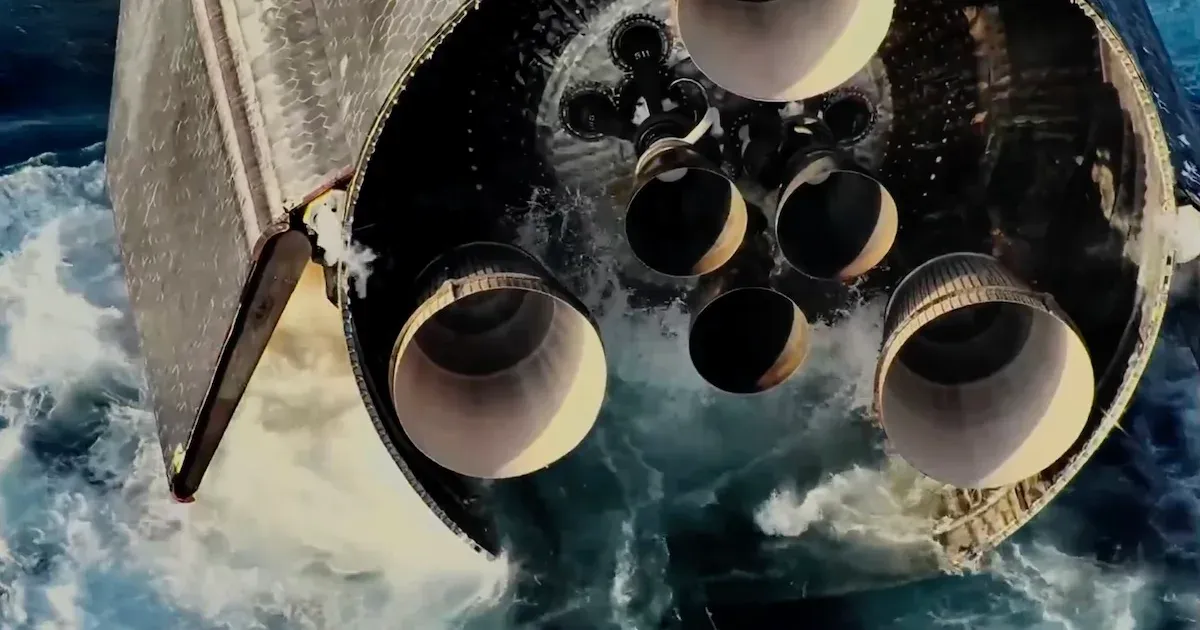
SpaceX is considering an attempt to catch Starship with its launch tower after the vehicle completed its 13th full-scale test with an intact splashdown. The flight ended on July 24, 2026, in the Indian Ocean west of Australia, where the ship tipped over gently and remained floating instead of breaking apart or burning.
The intact vehicle gives engineers a post-flight object to inspect rather than only telemetry and debris. Drones flew over Starship after landing, providing a view of the heat shield and the more than 18,000 ceramic tiles that protected its stainless-steel structure during reentry.
The ship had traveled from South Texas on an hour-long trajectory and encountered temperatures of up to about 2,600 degrees Fahrenheit, or 1,430 Celsius, while returning through the atmosphere. SpaceX also subjected the vehicle to higher dynamic pressure during ascent, increasing the stress on the airframe before it reached the reentry phase.
Previous Starship tests had reached accurate water targets, but the vehicles were destroyed or consumed by fire after arrival. Friday's result changed the available evidence. Engineers can compare flight data with visible tile condition, and SpaceX may be able to tow the ship toward Australia for a more detailed examination, although the vehicle is not designed to fly again after saltwater exposure.
The splashdown sequence joined several tests that normally have to be judged separately. Guidance had to deliver the ship to a remote target, the engines had to manage the final descent, and the structure had to survive long enough for the vehicle to settle on the water. Keeping the hull afloat then gave drone crews time to inspect areas that would otherwise disappear beneath fire or the ocean. That continuity lets engineers connect a visible mark on the vehicle with the exact pressure and temperature recorded at that point in flight.
Recovering the ship for inspection would add a different kind of evidence. Salt water rules out returning this vehicle to service, but technicians could examine tile attachments, seams and internal hardware away from the limits of aerial imagery. Even if a tow is not completed, the drone survey already provides a reference for deciding which parts of the thermal system require design changes and which survived the planned stress.
Heat-Shield Condition Controls the Reuse Goal
Starship's long-term design depends on rapid reuse rather than rebuilding the thermal-protection system after every mission. Ceramic tiles must tolerate launch vibration, extreme heat and the transition back through the atmosphere without requiring wholesale replacement. A splashdown that leaves the hull afloat gives engineers a better way to identify where tiles loosened, cracked or remained secure under combined loads.
That evidence matters beyond one flight. SpaceX ultimately wants Starship to support frequent launches, potentially multiple missions in a day. Such a cadence cannot work if technicians must inspect and replace thousands of tiles after each return. The latest vehicle therefore serves as a physical test record for the maintenance burden as much as proof that the guidance system reached its target.
A Tower Catch Adds Recovery Risk to the Next Flight
Elon Musk said SpaceX would attempt a tower catch on the next launch if the mission-data review reveals no blocking problem. The plan would send Starship on a longer trajectory, possibly into low-Earth orbit, then bring it back toward the launch site to slow beside mechanical arms on the tower. SpaceX has already caught the larger Super Heavy booster this way, but the ship returns from a faster and more demanding flight regime.
The decision now rests on whether the intact splashdown confirms enough control margin for a return over the launch site. A water target isolates failure far from the tower, while a catch requires accurate guidance, reliable engines, a durable heat shield and confidence that the ship can approach critical ground hardware safely. The 13th flight did not prove that entire sequence. It supplied the condition SpaceX needed before considering it: a vehicle that survived reentry well enough to reveal what the next recovery test would actually risk. Mission review must now connect the visible condition of the recovered ship with engine, guidance and structural data before SpaceX commits tower hardware to the attempt.