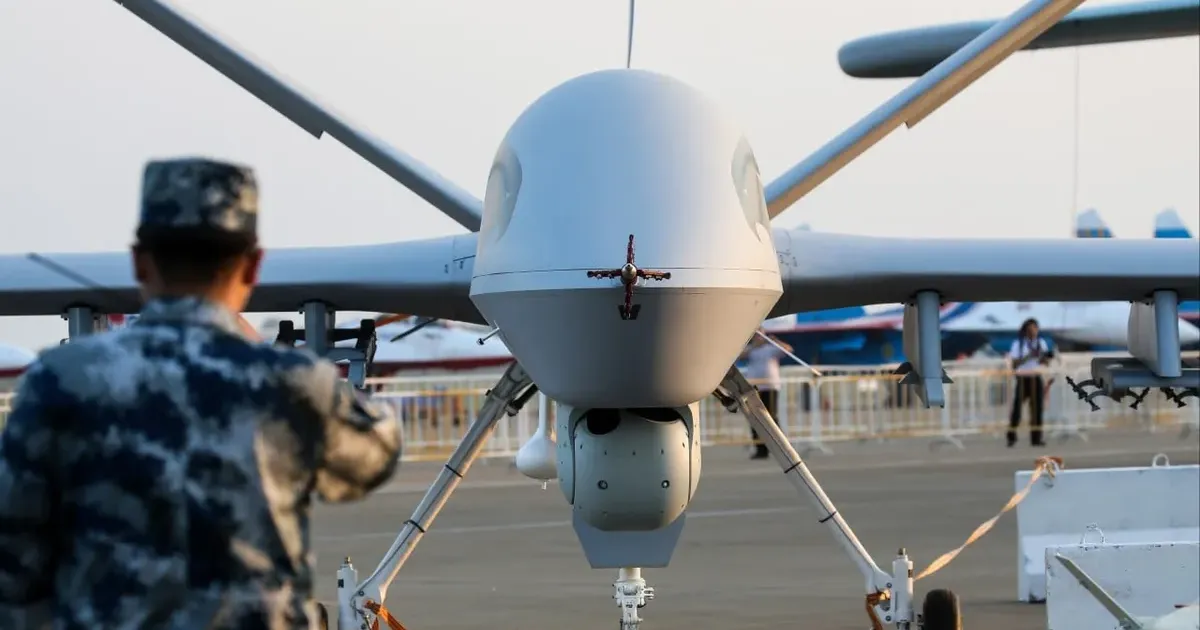
Shiraz military officials confirmed on April 4, 2026, that Iran air defense units destroyed a Chinese-made Wing Loong II drone during active combat operations involving the United States and Israel. Esmail Baqaei, the Iranian foreign ministry spokesman, released photographic evidence showing the scorched wreckage of the unmanned aerial vehicle scattered across the southern outskirts of the city. National intelligence services in Tehran currently possess the flight recorder and internal circuitry recovered from the site. This specific hardware suggests the aircraft was configured for high-altitude reconnaissance before it was neutralized.

Tehran is now demanding formal diplomatic explanations from Saudi Arabia and the United Arab Emirates regarding the presence of the drone. Both Gulf nations maintain meaningful inventories of the Chengdu-designed aircraft, which is a primary platform for their respective air forces. Baqaei used his official social media channels to distribute images of the fuselage, which still displayed serial numbers linked to recent international arms shipments. Iranian diplomats have presented these findings to regional intermediaries to enable a formal inquiry into the breach of sovereignty.

Wing Loong II Debris Fuels Regional Friction

Military analysts in the region suggest the presence of the Wing Loong II indicates a widening of the current kinetic theater. These drones, often compared to the American MQ-9 Reaper, carry an array of air-to-surface missiles and laser-guided bombs. Iran claims the aircraft originated from a base within a neighboring Gulf state, though specific radar tracks have not yet been made public. Saudi Arabia has used the Wing Loong series for over a decade in various regional conflicts, including operations in Yemen. United Arab Emirates officials have similarly integrated the platform into their border security and overseas strike capabilities.

Beijing finds itself in an increasingly uncomfortable position as the primary supplier of this technology. Chinese officials traditionally attempt to maintain a balance between their energy partnerships with Iran and their defense contracts with the Gulf Cooperation Council. The shoot-down in Shiraz forces China to address the reality that its hardware is being used in direct confrontations against its strategic partners. Evidence from the crash site suggests the drone was equipped with advanced synthetic aperture radar. Such technology allows for high-resolution imaging of Iranian military installations even in low-visibility conditions.

Intelligence reports from the Shiraz sector indicate the drone was loitering at 30,000 feet before the engagement. Iranian surface-to-air missile batteries tracked the target for fourteen minutes prior to the order to fire. Debris fields indicate the impact occurred directly over sensitive industrial zones. Iranian state media reports that no casualties occurred on the ground.

European Union Finance Ministers Target Energy Profits

Finance ministers from Germany, Italy, Spain, Portugal, and Austria petitioned the European Commission on April 4, 2026, to implement a windfall tax on energy corporations. Their joint letter argues that the escalating war involving Iran has artificially inflated fuel prices, creating an unearned profit surge for oil and gas majors. These five nations believe a coordinated tax response would demonstrate European solidarity during the worsening energy crisis. Economic data shows that European households are facing a 40% increase in heating costs compared to previous projections.

"It would also send a clear message that those who profit from the crisis must contribute to the collective effort," the finance ministers stated in their joint letter to the European Commission.

Rome and Berlin are particularly vulnerable to these price shocks because of their industrial energy requirements. Italian officials have already seen manufacturing output slow as electricity costs hit record highs. The letter, seen by Reuters, suggests that revenue from the proposed tax should be redirected toward consumer subsidies and green energy infrastructure. Germany has historically been cautious about windfall taxes, but the severity of the current conflict has shifted the political consensus in Berlin.

Energy firms, however, argue that such taxes would discourage the very investment needed to diversify Europe's fuel sources. Shell and BP have already issued statements warning that fiscal instability could lead to project cancellations. Trade unions across Spain and Portugal have threatened strikes if the government does not provide immediate relief for transport workers. The European Commission is expected to review the proposal during an emergency session in Brussels next week.

Middle East Conflict Drives European Windfall Tax Demands

Rising fuel prices, driven by the war, have pushed several European economies toward the brink of recession. Finance ministers in the five-nation coalition believe the tax is a necessary tool to prevent social unrest. Italy and Austria have seen a spike in populist rhetoric as citizens struggle with the cost of living. The joint letter emphasizes that the measure is a temporary reaction to an extraordinary geopolitical event. Current projections suggest that energy firms could realize over $80 billion in excess profits by the end of the fiscal year.

Stock markets in London and Paris reacted sharply to the news of the proposed tax. Shares in major energy producers fell between 3% and 5% during morning trading sessions. Investors fear that a successful implementation in these five countries would lead to a broader European Union policy. Portugal and Spain have already experimented with national-level profit caps on utility companies. Expanding this to the entire European Union would require unanimous support from member states, which persists as a serious legislative hurdle.

Shiraz Drone Shoot-Down Rattles Oil Markets

Crude oil futures surged as news of the Shiraz shoot-down reached international trading desks. Brent Crude surpassed $115 per barrel on April 4, 2026, as traders weighed the risk of a wider regional escalation. Market participants are specifically concerned about the safety of shipping through the Strait of Hormuz. Any direct conflict between Iran and the Saudi Arabia or United Arab Emirates bloc could effectively shut down 20% of the world's oil supply. Shipping insurance premiums for tankers operating in the Persian Gulf have already tripled since the incident began.

Global logistics companies are rerouting vessels around the Cape of Good Hope to avoid the escalating risk. This detour adds approximately twelve days to the transit time between Asia and Europe. Freight rates for liquefied natural gas carriers have reached the highest levels since the 2022 energy crisis. Supply-chain disruptions are expected to impact the availability of consumer goods in the United Kingdom and the United States by early summer.

Tehran maintains its right to defend its airspace with any necessary force. Military officials in the southern command have been placed on high alert. United Arab Emirates air defense units have similarly increased their readiness levels along the coastline. Communication between the rival regional powers is currently restricted to back-channel negotiations enabled by Omani diplomats.

The Elite Tribune Strategic Analysis

European leaders are attempting to solve a geopolitical catastrophe with a domestic tax grab. By targeting energy firms with windfall levies, the finance ministers in Berlin and Rome are merely distracting their constituents from a decades-long failure to secure strategic autonomy. This fiscal maneuver provides a convenient scapegoat for the inflationary pressure that is actually a product of Europe's total reliance on fragile global supply chains. Taxing the profits of BP or Eni will not stop a Wing Loong II from flying over Shiraz, nor will it protect the Strait of Hormuz from an Iranian blockade. It is a political sedative, not a strategy.

The shoot-down of Chinese hardware over Iranian soil creates a deep crisis for Beijing's Middle East policy. For years, China has played both sides, selling sophisticated strike drones to the United Arab Emirates while buying millions of barrels of oil from Iran. That period of easy ambiguity has ended. Iran is now forcing China to choose between its most loyal energy supplier and its most lucrative arms customers. If Beijing does not discipline its Gulf clients for their incursions into Iranian airspace, it risks losing its preferred status in Tehran. The incident represents the collapse of the non-interference doctrine that China has used to expand its influence across the region.

War in the Persian Gulf is no longer a theoretical risk; it is an active economic reality. The move by Germany and its allies to tax profits is the first sign of a desperate continent bracing for a long-term disconnection from Middle Eastern energy. If the Wing Loong II wreckage leads to a direct military exchange between Iran and Saudi Arabia, the ensuing oil shock will make the current price hikes look like a minor market correction. Global stability now rests on whether Iran accepts a diplomatic apology or chooses to turn the Shiraz incident into a casus belli. The era of cheap energy and quiet skies is over.